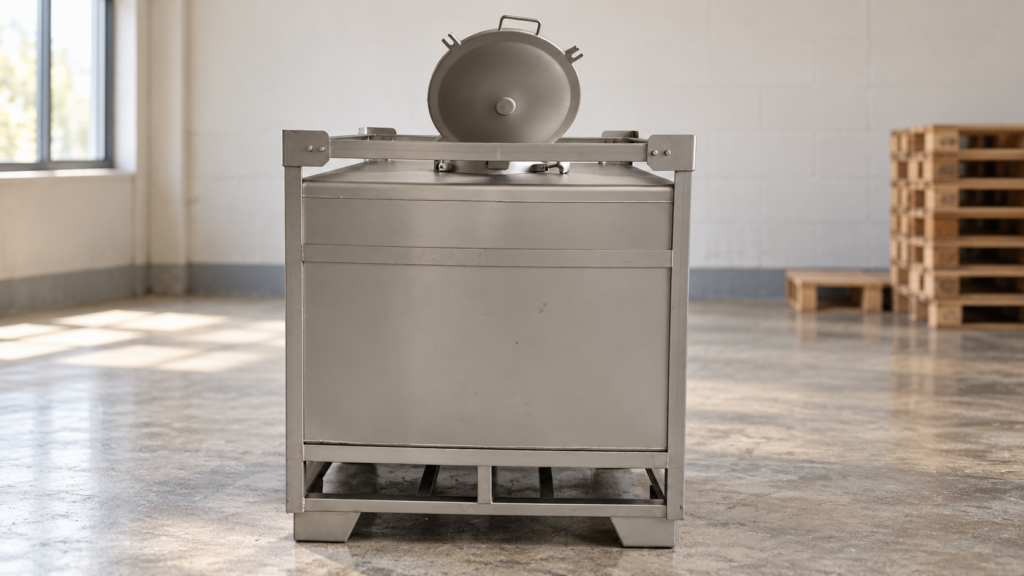
A metal IBC receiving checklist helps a warehouse record the delivered equipment before it enters service. Focus on identification, visible condition, fittings and documentation. These receiving observations support a traceable handover; they do not establish chemical compatibility, transport approval or permission to stack the tank.
Prepare a record for each delivered unit
Have the purchase order, approved specification and packing list available. Decide how each IBC will be identified in your own records, especially when several similar units arrive together. Photograph the manufacturer’s identifying information where present and associate it with the correct order line.
If a delivery includes different materials, outlet arrangements or capacities, avoid treating the whole shipment as one identical batch. Keep a separate record for each configuration so that a later question can be traced to the right unit.
Record visible condition on arrival
Take an overall photograph before moving or unpacking the equipment beyond what is necessary for the agreed receiving process. Record the packaging and any visible marks, distortion or displaced components. Use the supplier’s handling instructions and the site’s authorised receiving arrangements.
Once safely accessible, look at the visible tank surfaces, protective frame, base, top closure and outlet area. The aim is to document observations, not to certify structural integrity. If something is damaged or unclear, keep the unit from entering service until the responsible person and supplier have reviewed it.
Check fittings against the agreed specification
Compare the delivered outlet, closure and supplied adapters with the order documents. Record any identifying marks and count separately packed accessories. Ask for clarification when a connection differs from the drawing or when a supplied component is not identified.
- Does the outlet arrangement match the approved drawing?
- Are the agreed caps, closures and adapters present?
- Are separately packed items assigned to the correct unit?
- Are material and seal details documented where required?
- Have any substitutions been confirmed in writing?
Do not trial-fit an uncertain adapter or assume that matching appearance confirms connection compatibility. Resolve the specification with the supplier and the person responsible for the receiving process.
Keep the documentation with the asset record
Collect the operating, handling, inspection and cleaning information supplied for the exact model. Where your intended use requires supporting approvals or other documents, check them against the delivered identification and ask a qualified reviewer to confirm applicability.
A sales brochure describes a product range; it may not identify the particular configuration on the warehouse floor. Preserve the approved order specification and any later amendments alongside the manufacturer’s documents.
Plan the warehouse handover
Before assigning a storage position, give the responsible warehouse team the unit’s dimensions, weight information and handling requirements. Follow the documented restrictions for the delivered equipment. A photograph of stacked containers elsewhere is not evidence that your IBC may be stacked in the same way.
Agree who releases the unit for its intended service and which questions must be closed first. If the intended liquid or operating conditions differ from the original order, obtain a new suitability review rather than relying on the receiving check.
A compact handover checklist
- Unit identification and purchase-order reference recorded.
- Packaging and visible condition photographed.
- Delivered fittings and accessories matched to the specification.
- Manufacturer’s documents filed against the unit.
- Handling and storage arrangements reviewed by the responsible team.
- Open questions assigned to an owner before release.
Keep the record easy to retrieve. A folder named with the unit identifier, containing the approved specification, photographs and correspondence, is more useful than evidence scattered across individual message threads.
Frequently asked questions
Does a receiving check replace a leak test or inspection procedure?
No. Any required testing or inspection must follow the manufacturer’s instructions and the requirements applicable to the intended use. This checklist is an administrative and visual receiving record.
Can the IBC be filled as soon as the delivery is accepted?
Delivery acceptance and release for use are different steps. Confirm suitability, documentation and the required preparation with the responsible team before filling.
Review MEBIUSE metal IBC tanks and the pre-order buying guide. For questions about a proposed configuration, send your requirements to MEBIUSE.