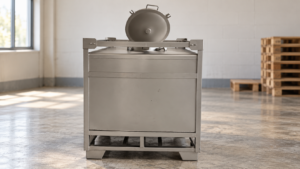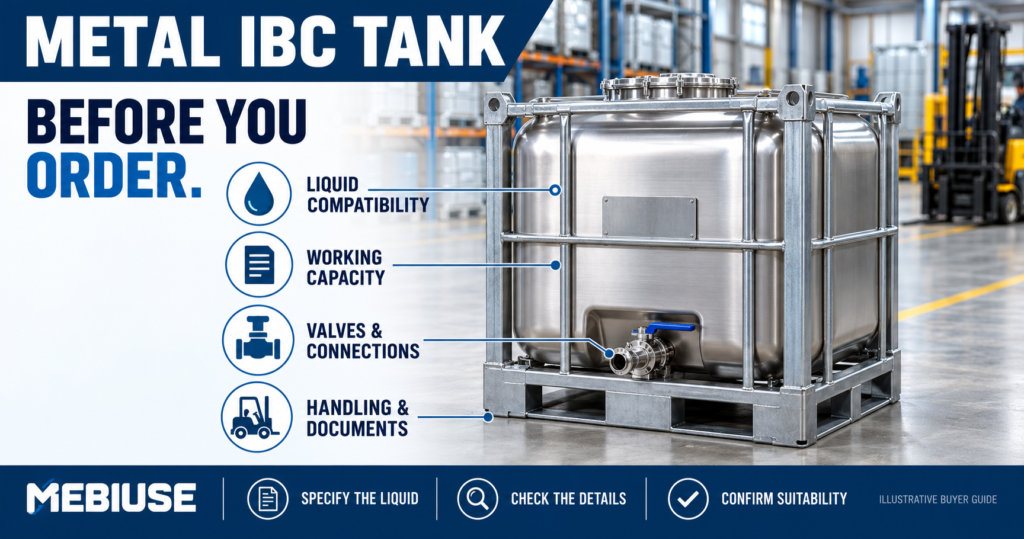
Choosing a metal IBC tank involves more than selecting a capacity. Before requesting a quotation, define the liquid, operating conditions, handling method and connections you need. A written specification gives both buyer and supplier a clearer basis for confirming suitability.
Start with the liquid and its operating conditions
Identify the exact liquid, its concentration where relevant, and the expected temperature range. Provide the supplier with the current safety data sheet and any process requirements. Ask for written confirmation of compatibility for the complete proposed assembly, including the tank, seals, valve and fittings.
The term “metal IBC” does not establish suitability for every chemical, food product or fuel. Do not infer a material grade, hygienic finish or transport approval from the product name or photograph.
Define capacity and the working envelope
State the batch size you need to handle and ask the supplier to distinguish nominal capacity from the recommended working fill for your application. Provide available floor space, access dimensions and any restrictions on height or handling equipment.
- What external dimensions are proposed?
- What are the empty weight and applicable loaded-weight limits?
- How will the tank pass through doors and reach its operating position?
- Are stacking or lifting arrangements required, and what written limits apply?
Ask for a dimensional drawing before approving the configuration. This is particularly useful when the IBC must fit an existing production area or connect to fixed equipment.
Specify outlets, closures and transfer connections
Give the supplier the connection standards and sizes used by your receiving equipment. Explain whether you need gravity discharge or a separate transfer arrangement. Ask the supplier to identify the valve type, seal material, closure details and supplied adapters in the quotation.
A connection that looks similar in a photograph may not match your hose or process line. Written connection details reduce the risk of discovering a mismatch after delivery.
Clarify handling and documentation
Describe whether the IBC will stay on site, move between buildings or be transported by an external carrier. Ask what documentation is available for the exact model and intended use. Where an approval is needed, verify its scope and applicability before ordering; do not assume it covers every liquid or transport route.
Request the manufacturer’s handling, inspection and cleaning instructions. If the tank will be reused for different liquids, have a qualified person assess the cleaning and compatibility requirements before that change.
What to include in your quotation request
- Liquid name, relevant safety data sheet and operating conditions.
- Required working volume, quantity and delivery destination.
- Space, access and handling constraints.
- Required outlet, valve and connection details.
- Applicable documentation and inspection requirements.
- Any branding or configuration requests.
Frequently asked questions
Does a metal IBC automatically have transport approval?
No approval should be assumed from the description alone. Ask for the documentation for the exact supplied model and check that it matches the intended use.
Can I use the same IBC for a different liquid later?
That requires a fresh compatibility and cleaning assessment. Keep the original specification and consult the supplier before changing service.
View MEBIUSE metal IBC tanks and send your liquid-handling requirements. For project-specific configurations, see our OEM/ODM services.