What Is Rotomolding and Why Does It Dominate Portable Fuel Tank Manufacturing?
Rotomolding (rotational molding) is a plastic casting technique used to produce hollow, seamless, double-walled fuel tanks source: Plastic Tank Companies. Unlike injection molding or blow molding, rotomolding uses a hollow mold where thermoplastic powdered resin is heated while being slowly rotated on two perpendicular axes, then cooled to solidify.
Portable diesel fuel tanks benefit uniquely from rotomolding for three reasons:
- Seamless construction — No weld points means no potential leak paths. The entire tank is one continuous piece.
- Uniform wall thickness — Even coating during rotation ensures consistent structural integrity throughout the tank.
- Design flexibility — Complex shapes and custom geometries are achievable without additional tooling complexity.
For B2B buyers evaluating fuel tank manufacturers, understanding rotomolding helps distinguish genuine rotomolded tanks from cheaper blow-molded alternatives that may have structural weaknesses.
The 5 Stages of Rotomolded Fuel Tank Manufacturing
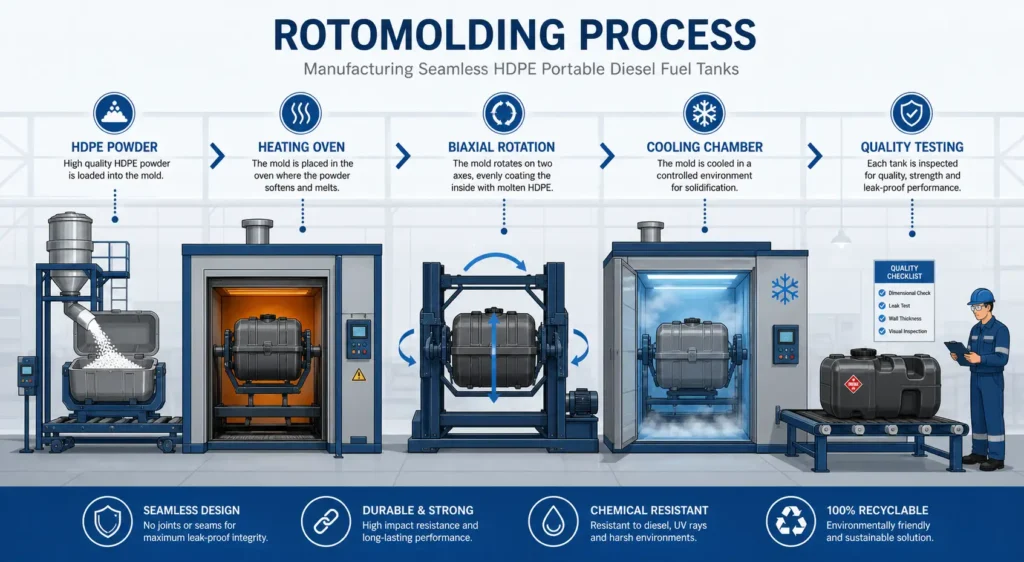
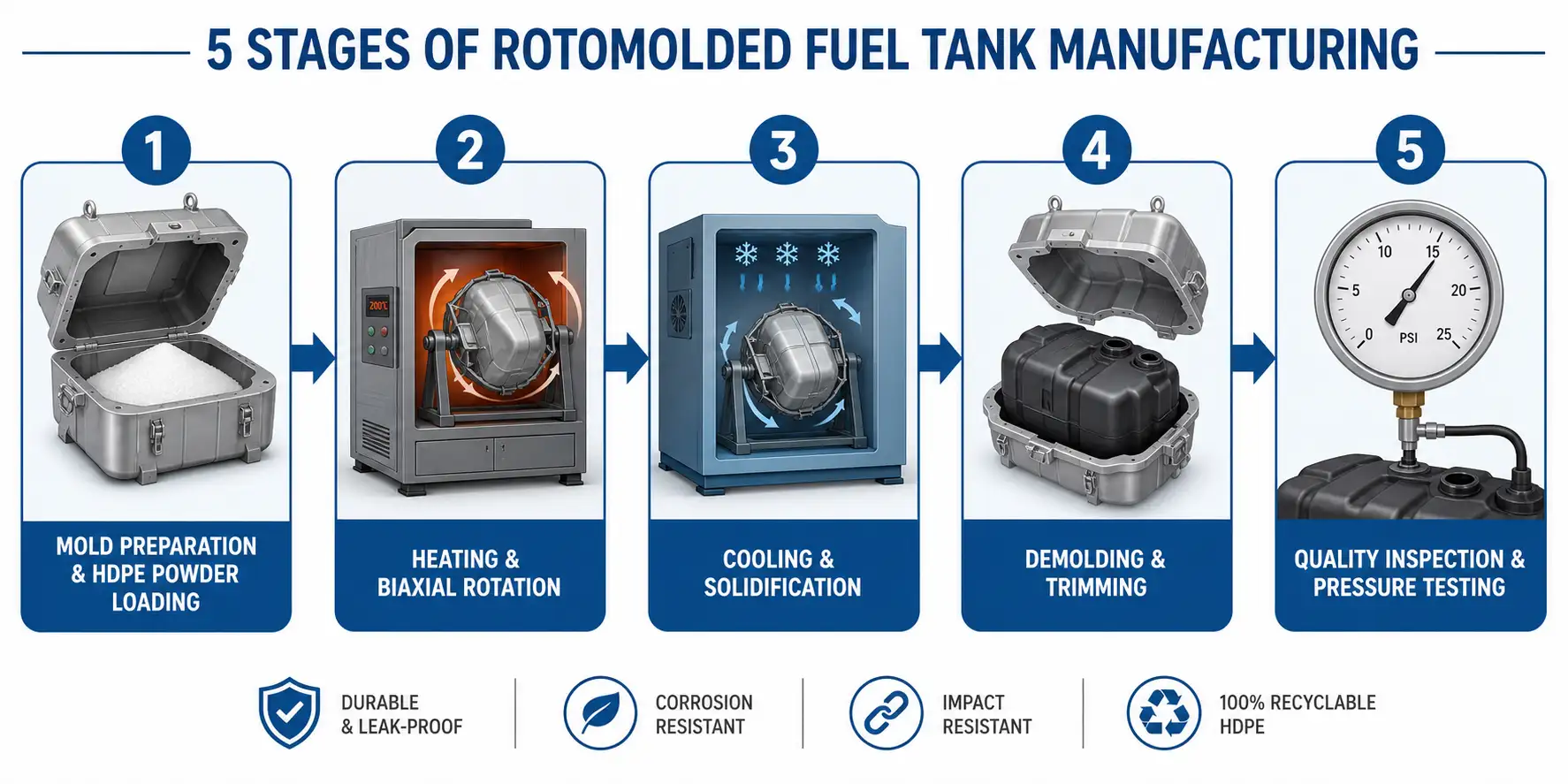
The rotomolded fuel tank manufacturing process consists of five sequential stages source: Xinghui Rotomold:
Stage 1: Mold Preparation and HDPE Powder Loading
A precision CNC-machined aluminum mold is prepared and cleaned. HDPE powder (or LLDPE/XLPE depending on the application) is measured and loaded into the mold cavity. Aluminum molds are preferred for rotomolding because they are lightweight, cost-effective, and conduct heat evenly during processing.
Stage 2: Heating and Biaxial Rotation
The mold is sealed and placed in a heating oven. As the mold rotates on two perpendicular axes (typically 4–12 RPM), the HDPE powder melts and fuses against the heated mold walls, forming an even coating. The biaxial rotation ensures complete coverage without pooling or thin spots. This stage typically runs at 260–370°C depending on the polymer grade.
Stage 3: Cooling and Solidification
After heating, the mold is transferred to a cooling chamber. Controlled cooling while maintaining rotation ensures the molten polymer solidifies with uniform wall thickness. Rushing this stage can cause warping or internal stress. Some manufacturers use water mist cooling; others rely on ambient air cooling for gradual, controlled solidification.
Stage 4: Demolding and Trimming
Once cooled, the mold opens and the finished tank is extracted. Excess material around the opening (flash) is trimmed away using CNC or manual finishing tools. The tank is now a complete, seamless vessel ready for fittings installation.
Stage 5: Quality Inspection and Pressure Testing
Every rotomolded fuel tank undergoes three mandatory quality checks before shipment source: Xinghui Rotomold:
- Pressure testing — Verifies structural integrity under specified internal pressure
- Leak testing — Ensures no seepage through walls or fittings
- Durability testing — Confirms resistance to impact, UV exposure, and chemical contact
Reputable manufacturers such as MEBIUSE double-test all parts before shipping, complying with CE, ISO 9001, and relevant transport regulations.
HDPE Material: Why It Is the Preferred Choice for Rotomolded Diesel Tanks
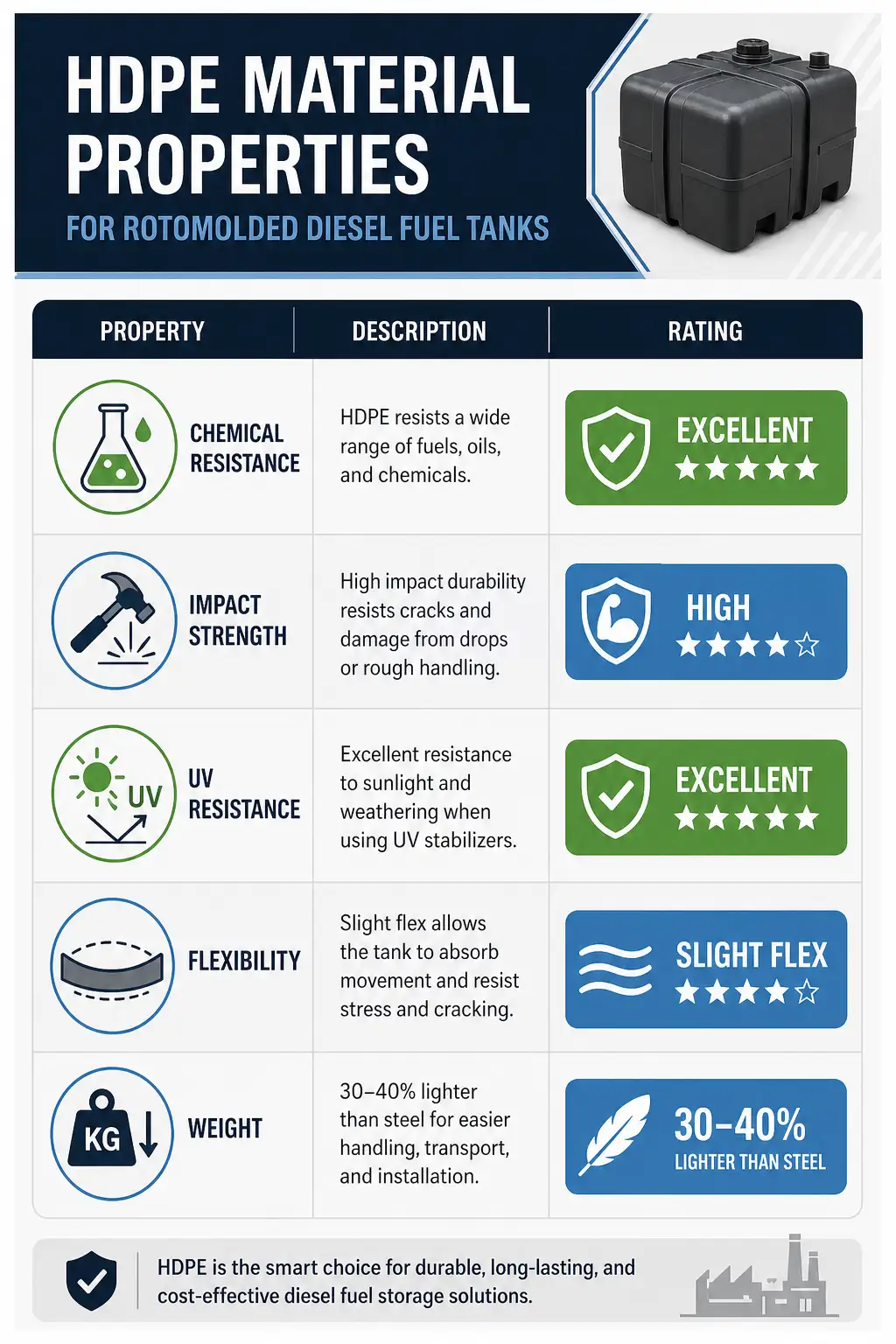
HDPE (High-Density Polyethylene) is the industry standard material for rotomolded portable diesel fuel tanks source: Plastic Tank Companies. Its material properties align precisely with the demands of fuel storage and mobile refueling:
| Property | HDPE Performance | Benefit for Fuel Tanks |
|---|---|---|
| Chemical resistance | Excellent resistance to hydrocarbons, diesel, and fuel additives | No degradation from fuel contact |
| Impact strength | High — absorbs blows without cracking | Durable for field and job site use |
| UV resistance | Excellent with UV-stabilized formulations | Long service life in outdoor applications |
| Flexibility | Slight flex under load | Absorbs thermal expansion and vibrations |
| Weight | ~30–40% lighter than steel | Easier handling and lower transport costs |
HDPE’s seamless, multi-layer construction capability also enables advanced designs such as double-wall tanks for enhanced environmental protection and fuel vapor control.
Alternative Materials: LLDPE and XLPE
While HDPE dominates, Linear Low-Density Polyethylene (LLDPE) and Cross-linked Polyethylene (XLPE) are used for specialized applications. LLDPE offers better stretch and formability, while XLPE provides superior chemical resistance for aggressive fuel blends or chemical storage.
Why China’s Rotomolding Factories Lead in Portable Fuel Tank Production
China has become the global hub for rotomolded fuel tank manufacturing due to several structural advantages:
Cost advantages. Aluminum tooling costs for rotomolding in China are significantly lower than in Western countries. Tooling can be 40–60% cheaper, making small-batch OEM production economically viable for distributors and brand owners.
Equipment infrastructure. Chinese rotomolding factories have invested heavily in multi-axis rotational equipment capable of producing tanks from 20L portable units to 10,000L industrial containers. Facilities with 6+ rotomolding machines can handle both custom OEM orders and standard product lines simultaneously.
Flexible OEM/ODM capabilities. China’s manufacturing ecosystem supports full OEM/ODM customization: custom shapes, capacity scaling, fitting specifications, Pantone color matching, and logo printing. Custom rotomolded fuel tank mold development typically takes 25–35 days with ISO 9001 quality control source: Xinghui Rotomold.
Certification coverage. Leading Chinese rotomolding factories hold CE, ISO 9001, and relevant transport certifications (ADR, AS1940) that satisfy import requirements in the US, EU, Australia, and Southeast Asia.
Request an OEM Portable Fuel Tank Quote
How MEBIUSE Uses Rotomolding to Produce Industrial-Grade Fuel Tanks
MEBIUSE (Binzhou Shizhou Intelligence Technology Co., Ltd.) operates rotomolding production lines at manufacturing bases in Zhejiang and Shandong provinces, China source: MEBIUSE official. Founded in the early 2010s, MEBIUSE focuses specifically on portable fuel tanks and mobile energy supports, exporting to 30+ countries and serving 500+ global clients.
Rotomolding capability highlights:
- UV-stabilized HDPE is the standard material for all MEBIUSE portable diesel tanks, providing 10–20 years of outdoor service life
- Seamless rotomolding process eliminates weld weak points, delivering leak-proof performance certified to international standards
- CE and ISO 9001 certified — all parts are double-tested before shipping
- Custom OEM/ODM — MEBIUSE develops custom molds and produces branded fuel tanks for distributors and private label programs
MEBIUSE’s rotomolding expertise positions it as both a standard product supplier and an OEM manufacturing partner for businesses seeking custom portable fuel tank solutions.
Frequently Asked Questions
What is the rotomolding process for fuel tanks?
Rotomolding (rotational molding) is a plastic casting technique that produces hollow, seamless, double-walled fuel tanks. The process involves loading HDPE powder into an aluminum mold, then heating and rotating the mold on two perpendicular axes until the powder melts and coats the interior walls evenly. The mold is then cooled while rotation continues, producing tanks with uniform wall thickness and no weld seams — a critical advantage for leak-proof diesel storage source: Plastic Tank Companies.
How long does a rotomolded HDPE fuel tank last?
With proper care and installation, high-quality rotomolded HDPE fuel tanks can last 10–20 years or longer. HDPE’s natural resistance to rust and corrosion significantly extends tank lifespan compared to steel tanks in similar operating environments source: Plastic Tank Companies.
What materials are used in rotomolded fuel tanks?
The primary materials are High-Density Polyethylene (HDPE), Linear Low-Density Polyethylene (LLDPE), and Cross-linked Polyethylene (XLPE). These polymers are chosen for their resistance to fuels, chemicals, UV exposure, and extreme weather conditions. UV-stabilized formulations are standard for outdoor and mobile applications source: Xinghui Rotomold.
What quality tests do rotomolded fuel tanks undergo?
Every rotomolded fuel tank undergoes pressure testing, leak testing, and durability testing before shipment. These tests ensure compliance with international standards such as CE, ISO 9001, and relevant transport regulations. MEBIUSE double-tests all parts before shipping source: Xinghui Rotomold.
How does rotomolding compare to blow molding for fuel tanks?
Rotomolding produces seamless, one-piece tanks with uniform wall thickness and superior impact resistance — ideal for large, complex, or custom-shaped tanks. Blow molding offers faster production cycles and cost advantages for high-volume standardized designs, but may produce localized wall weaknesses. For heavy-duty and portable diesel applications, rotomolding is the preferred process source: Plastic Tank Companies.
Why choose a China rotomolding factory for fuel tanks?
China’s rotomolding factories offer significant advantages: lower aluminum tooling costs (vs. steel molds), established rotomolding equipment infrastructure, flexible OEM/ODM customization capabilities, ISO 9001 quality systems, and competitive pricing for both small and large orders. MEBIUSE operates production bases in Zhejiang and Shandong, serving 500+ clients across 30+ countries source: MEBIUSE official.
How long does it take to develop a custom fuel tank mold?
Custom rotomolded fuel tank mold development typically takes 25–35 days with ISO 9001 quality control source: Xinghui Rotomold. The timeline depends on design complexity, required certifications, and order volume. MEBIUSE offers in-house mold development capabilities for OEM clients requiring custom shapes, capacities, or fittings.
Why are rotomolded fuel tanks preferred over metal tanks?
Rotomolded HDPE tanks offer five key advantages over metal: (1) Lightweight — reducing vehicle weight and improving fuel efficiency; (2) Corrosion-resistant — no rust or chemical attack from fuel additives; (3) Non-explosive — absorbs impacts rather than rupturing; (4) Seamless construction — no weld weak points; (5) Design flexibility — complex shapes for tight chassis fitments source: Plastic Tank Companies.
Official Sources
- MEBIUSE official site
- MEBIUSE contact — request an OEM quote
- Plastic Tank Companies — HDPE Fuel Tank Material Overview
- Xinghui Rotomold — Rotational Molding Fuel Cells and Tanks
Further Reading
- What Are Portable Diesel Tanks Made Of? — C1-05 Material Guide
- Custom Fuel Tank Mold Development — C8-07 OEM Guide
- UV-Stabilized HDPE Fuel Tank Explained — C9-03 Safety Article
- Complete OEM Portable Fuel Tank Guide — C8 Pillar Page
MEBIUSE (Binzhou Shizhou Intelligence Technology Co., Ltd.) | Last reviewed: August 3, 2026 | Published: August 3, 2026