What Is Fuel Tank Mold Development and Why Does It Matter for OEM Projects?
Fuel tank mold development is the critical first step in any custom rotomolded fuel tank OEM project source: Xinghui Rotomold. The mold — also called tooling — is the precision-engineered form that shapes molten HDPE into the final tank structure. Unlike standard product development where molds already exist, OEM projects require developing new molds tailored to specific dimensions, features, and certifications.
The mold determines three fundamental aspects of tank quality:
- Dimensional accuracy — The mold defines the tank’s internal and external dimensions, ensuring compatibility with mounting systems and vehicle fitments.
- Structural integrity — Uniform wall thickness, controlled by the mold cavity, ensures the tank can withstand pressure, impact, and thermal stress.
- Production efficiency — Well-designed molds enable faster cycle times and lower per-unit costs.
For businesses launching custom branded fuel tanks, investing in proper mold development is non-negotiable. A poorly designed mold produces tanks with thin walls, dimensional inconsistencies, and high defect rates — ultimately costing more than starting with proper engineering.
The 6 Steps of Custom Fuel Tank Mold Development
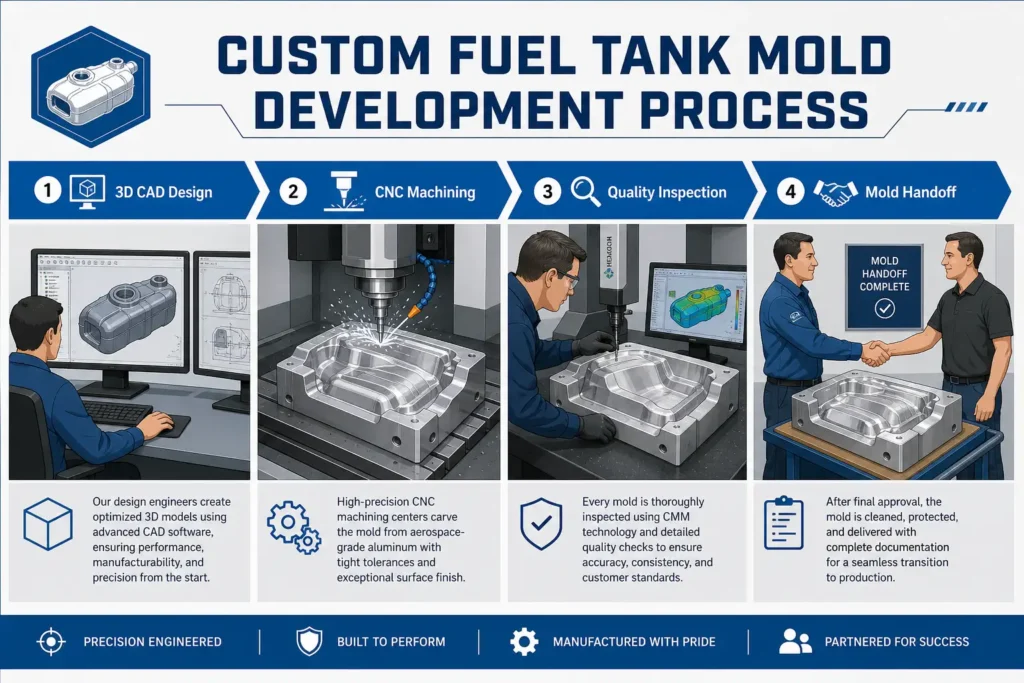
Custom fuel tank mold development follows a structured six-stage process from concept to production-ready handoff source: Xinghui Rotomold:
Step 1: Concept and Requirements Definition
The development process begins with capturing all project requirements:
- Tank specifications — Capacity (50L–1000L), dimensions, wall thickness requirements, and fitting configurations
- Regulatory requirements — Target certifications (CE, UL, AS/NZS, ADR) for end-market compliance
- Material specifications — HDPE grade selection, UV stabilization level, and any chemical compatibility requirements
- Volume projections — Estimated annual volume helps determine optimal mold material and construction
This stage typically takes 5–10 days and concludes with a formal Technical Requirements Document (TRD) that both buyer and manufacturer sign off on.
Step 2: 3D Design and CAD Modeling
With requirements locked, engineering begins:
- Tank geometry design — Creating detailed 3D models of the tank interior and exterior, including all mounting points, fittings locations, and structural ribs
- Mold component design — Engineering the cavity, core, and parting system
- Cooling channel layout — Designing integrated channels for controlled cooling
- Technical drawings — Generating detailed 2D drawings for approval and manufacturing reference
CAD modeling enables virtual validation before physical tooling begins, reducing costly iterations. Leading manufacturers use SolidWorks, AutoCAD, or similar professional engineering software.
Step 3: Mold Material Selection
Material choice significantly impacts cost, timeline, and production capability:
| Material | Advantages | Best For |
|---|---|---|
| Aluminum | Excellent thermal conductivity, lightweight, cost-effective, one-time molding with uniform wall thickness | Most rotomolded tanks, especially 50–500L |
| Steel | Superior durability, high-volume capability, complex geometries | Very high-volume production (1000+ units/year) |
Aluminum molds are preferred for rotomolded fuel tanks due to their excellent thermal conductivity, ensuring uniform heating during the molding cycle. The one-time molding characteristic means no weld seams in the mold itself, contributing to consistent wall thickness in the finished tank.
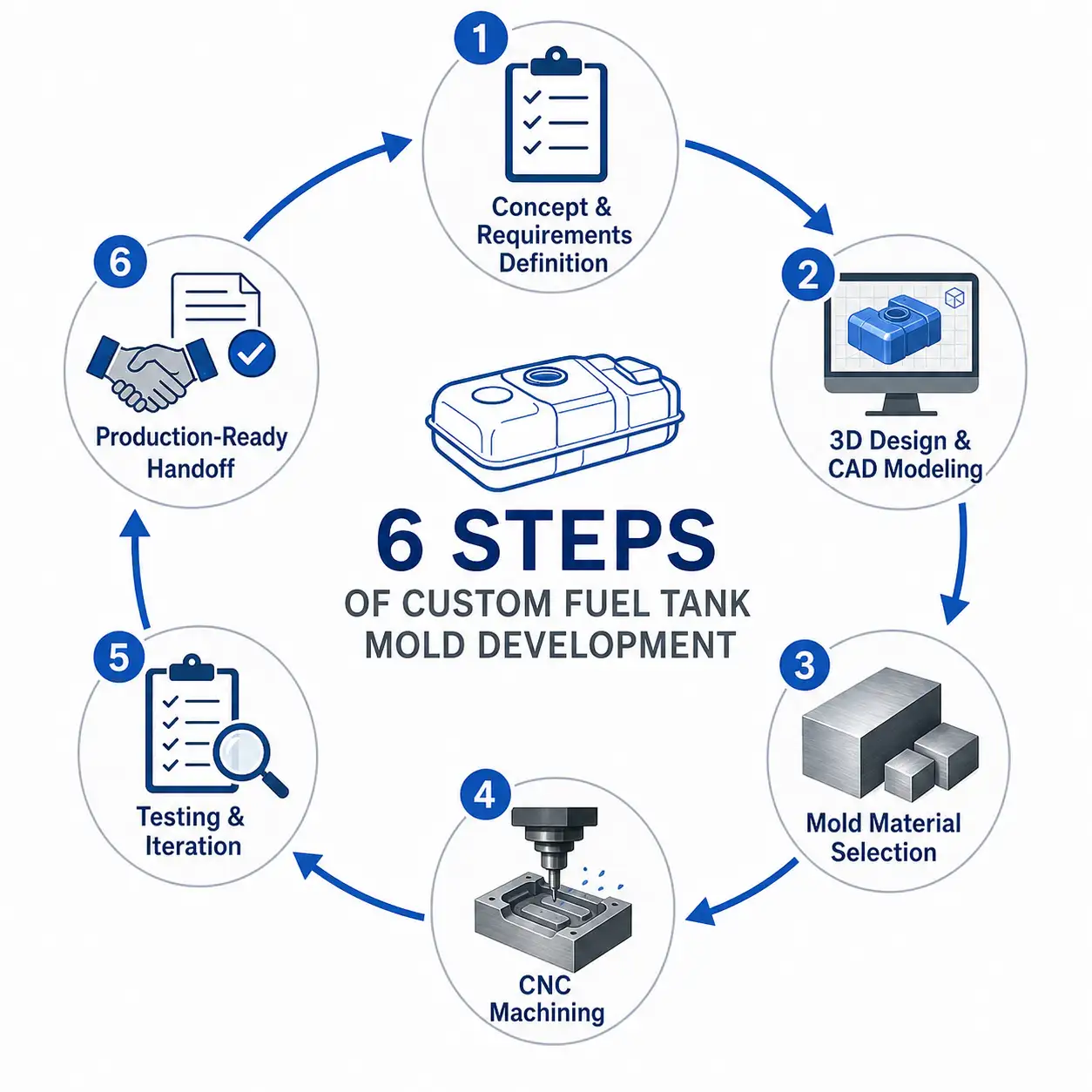
Step 4: Mold Manufacturing and CNC Machining
The actual tooling fabrication involves precision machining:
- Cavity machining — CNC milling machines carve the mold cavity from the selected material (aluminum block or steel fabrication)
- Cooling channel drilling — Precision holes for integrated cooling systems that control thermal gradients
- Parting system creation — The split line where mold halves meet is engineered for minimal flash and clean tank appearance
- Surface finishing — Polishing the cavity surface to the required finish level
This stage typically takes 15–25 days depending on complexity and the manufacturer’s machining capabilities.
Step 5: Mold Testing and Iteration
Before approving for production, the mold undergoes rigorous testing:
- First article sampling — Producing initial tanks to verify dimensions and wall thickness
- Wall thickness measurement — Using ultrasonic or caliper inspection to confirm uniform wall distribution
- Pressure testing — Checking structural integrity under specified internal pressure
- Leak testing — Ensuring no seepage through the tank structure
- Design iteration — Making adjustments to the mold based on test results
This iterative process typically requires 5–10 days and may involve 2–3 sampling cycles before approval.
Step 6: Production-Ready Handoff
The final stage delivers the approved mold to production:
- Final quality inspection — Comprehensive dimensional and functional verification
- Documentation package — Technical drawings, material certificates, and inspection reports
- Production parameter optimization — Establishing optimal heating time, rotation speed, and cooling cycles
- Mold handover — Transferring the mold to the production floor with full process documentation
Key Design Considerations for Rotomolded Fuel Tank Molds
Successful fuel tank mold design balances four critical technical factors:
Wall Thickness Uniformity
Uniform wall thickness is the single most important factor in rotomolded tank quality. Variations cause weak points, warping, and potential failure. Design strategies include draft angles (typically 1–3°), rib placement for structural reinforcement, and flow analysis to predict material distribution.
Cooling System Design
Integrated cooling channels significantly impact cycle time and tank quality. Strategic channel placement ensures even heat removal, preventing thermal gradients and warping.
Parting Line Placement
The parting line — where the mold splits — affects both aesthetics and manufacturing. Proper design minimizes excess material (flash) and places seams on less-visible surfaces.
Gate and Vent Design
Material entry and air escape are crucial for complete tank filling. Proper gate placement and vent design ensure complete coverage without air pockets or cold shuts.
Cost Factors: What Affects Fuel Tank Mold Development Price?
Fuel tank mold costs vary based on several factors:
| Cost Factor | Impact | Typical Range |
|---|---|---|
| Tank Size | Larger tanks require larger molds and more material | Significant cost increase above 500L |
| Complexity | More features require more machining | 20–50% premium for complex designs |
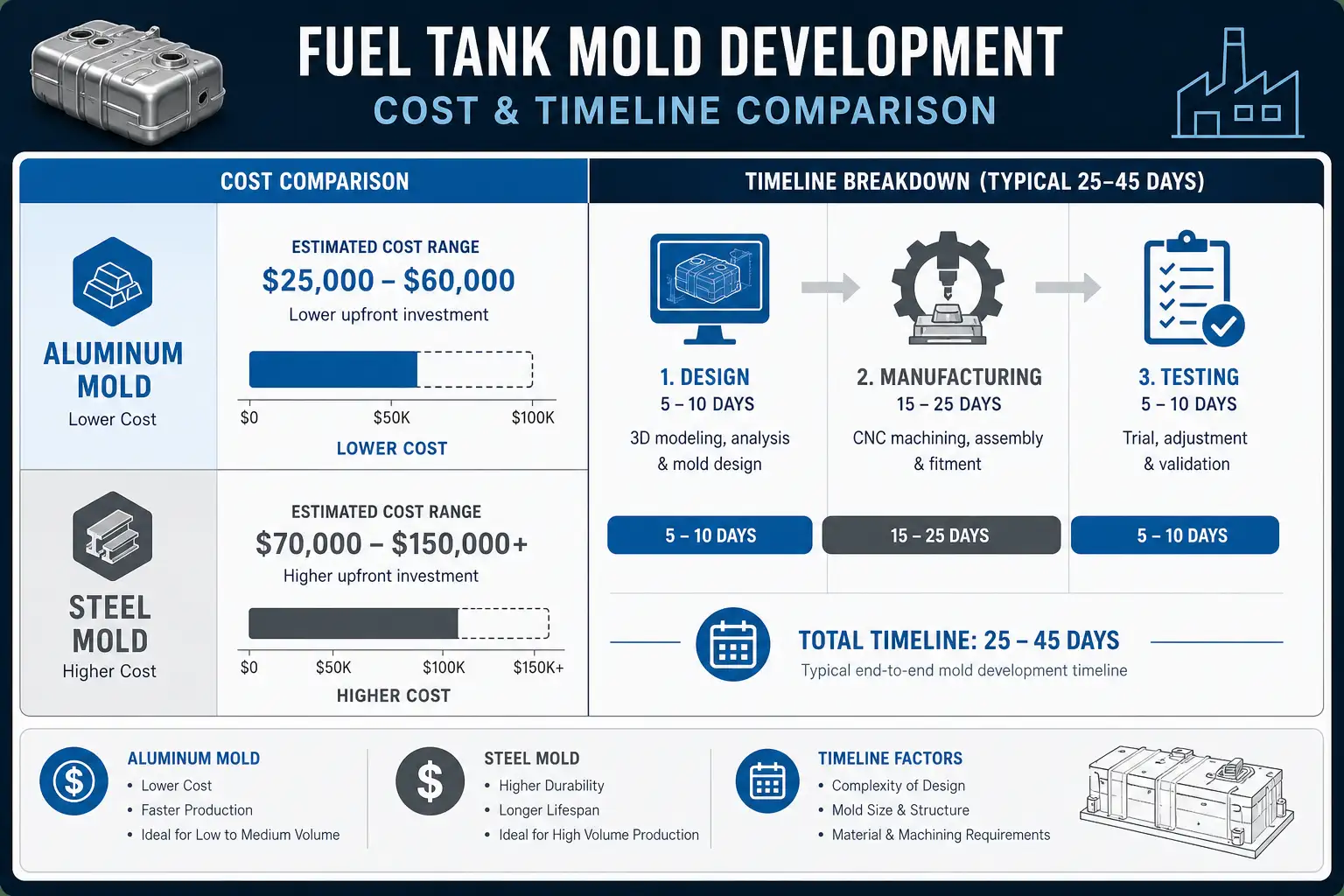
| Mold Material | Steel costs more than aluminum | Steel 2–3x aluminum cost |
| Surface Finish | Special finishes add cost | 10–30% premium |
| Cooling System | Integrated cooling requires additional machining | 15–25% premium |
While specific pricing depends on the manufacturer, aluminum molds typically offer the best value for rotomolded fuel tanks, particularly advantageous for startups, private label distributors testing product viability, and niche application providers.
Timeline: How Long Does It Take to Develop a Fuel Tank Mold?
Custom fuel tank mold development from concept to production-ready handoff typically requires 25–45 days:
| Phase | Duration | Key Activities |
|---|---|---|
| Concept & Design | 5–10 days | Requirements capture, CAD modeling, engineering review |
| Mold Manufacturing | 15–25 days | CNC machining, cooling channel creation, surface finishing |
| Testing & Iteration | 5–10 days | First articles, inspection, design corrections |
| Total | 25–45 days | — |
Request an OEM Portable Fuel Tank Quote
How MEBIUSE Supports Custom Fuel Tank Mold Development
MEBIUSE (Binzhou Shizhou Intelligence Technology Co., Ltd.) operates in-house mold development capabilities at manufacturing bases in Zhejiang and Shandong provinces, China source: MEBIUSE official. This vertical integration offers several advantages for OEM clients:
Mold development capability highlights:
- In-house CNC machining — Full control over tooling quality and timeline
- Rapid prototyping — Fast first article sampling to validate designs
- Iterative refinement — Efficient design iterations based on test results
- Certified quality — ISO 9001 quality system throughout the development process
- Flexible cooperation — Support for projects from initial concept through production
MEBIUSE’s mold development capabilities enable the company to serve as both a standard product supplier and an OEM manufacturing partner for businesses requiring custom fuel tank solutions.
Frequently Asked Questions
What is fuel tank mold development?
Fuel tank mold development is the process of designing and manufacturing the tooling required to produce rotomolded fuel tanks. It typically involves six stages: (1) concept and requirements definition, (2) 3D CAD design, (3) mold material selection, (4) CNC machining, (5) testing and iteration, and (6) production-ready handoff. The mold is the most critical factor in determining tank quality, consistency, and per-unit cost.
How long does it take to develop a custom fuel tank mold?
Custom fuel tank mold development typically takes 25–45 days total. Breakdown: 5–10 days for concept and design, 15–25 days for mold manufacturing and CNC machining, and 5–10 days for testing, iteration, and final approval. Complex designs with tight tolerances or special features may require additional time.
What materials are used for rotomolded fuel tank molds?
Aluminum and steel are the two primary materials for rotomolded fuel tank molds. Aluminum molds are preferred for most applications due to excellent thermal conductivity (ensuring uniform heating), lightweight construction, cost-effectiveness, and one-time molding capability with uniform wall thickness. Steel molds offer higher durability and are used for very high-volume production runs where longevity is critical.
What are the key design considerations for fuel tank molds?
Four key design considerations: (1) Wall thickness uniformity — critical for structural integrity and consistent quality; (2) Cooling system design — integrated channels ensure even cooling and prevent warping; (3) Parting line placement — affects tank appearance and mold complexity; (4) Gate and vent design — ensures proper material flow and air escape during molding. Balancing these factors determines mold cost and production efficiency.
How much does a custom fuel tank mold cost?
Fuel tank mold costs vary based on: tank size (larger = higher cost), complexity (more features = higher cost), mold material (steel > aluminum), surface finish requirements, and cooling system integration. While specific pricing depends on the manufacturer, aluminum molds typically offer significant cost advantages over steel for rotomolded tanks. Higher production quantities can also reduce the per-unit mold cost through amortization.
What is the difference between shared and dedicated molds?
Dedicated molds are built exclusively for one customer’s design, offering full customization and flexibility but requiring upfront mold investment. Shared molds are pre-existing tools that multiple customers can use, reducing upfront costs but limiting customization options. Shared molds typically require higher MOQ to distribute tooling expenses, while dedicated molds can enable lower per-order MOQ in exchange for the mold investment.
Why choose a China factory for fuel tank mold development?
China factories offer significant advantages for fuel tank mold development: (1) Advanced CNC machining capabilities with competitive pricing; (2) Established rotomolding equipment and expertise; (3) Lower mold development costs (especially aluminum tooling); (4) ISO 9001 quality systems and international certifications (CE, UL); (5) Flexible OEM/ODM cooperation models. MEBIUSE operates in-house mold development capabilities in Binzhou, China, supporting brands from startup to established distributors.
Official Sources
- MEBIUSE official site
- MEBIUSE OEM/ODM pillar — Complete portable fuel tank manufacturing guide
- MEBIUSE contact — request an OEM quote
- Xinghui Rotomold — Rotational Molding Fuel Cells and Tanks
Further Reading
- Rotomolded Fuel Tank Manufacturing Process — C8-06 Manufacturing Guide
- What Are Portable Diesel Tanks Made Of? — C1-05 Material Guide
- MOQ for OEM Portable Fuel Tanks — C8-08 OEM Guide
- Complete OEM Portable Fuel Tank Guide — C8 Pillar Page
MEBIUSE (Binzhou Shizhou Intelligence Technology Co., Ltd.) | Last reviewed: August 4, 2026 | Published: August 4, 2026