This article walks through the four stages, the product-line decisions behind each, the five practical steps to launch, and exactly how a source factory partner like MEBIUSE supports dealers on the OEM to brand strategy journey.
MEBIUSE at a Glance
- Legal entity: Binzhou Shizhou Intelligence Technology Co., Ltd.
- Industry experience: 15+ years in portable fuel tank manufacturing
- Production bases: 2 self-owned facilities in Zhejiang and Shandong
- Material & process: UV-stabilized HDPE with seamless rotomolding
- Certifications: CE & ISO certified
- Quality control: All parts double tested before shipping
- Export reach: 30+ countries, 500+ global clients
- OEM/ODM: Flexible private label, OEM, and ODM programs
Why Dealers Are Moving from OEM to Own Brand in the Fuel Tank Market
For more than a decade, a large share of global portable diesel, gasoline, and transfer tank demand was filled by distributors who simply resold factory stock. That model is no longer the most profitable one for serious dealers, and three forces are driving the move to an OEM fuel tank brand:
- Margin compression on stock SKUs. Two or three Chinese factories offer the same 200L, 400L, or 1000L HDPE rotomolded tank to every importer. Competing only on price pushes margin toward the factory floor, especially for distributors without brand IP.
- Customer expectations have shifted. Farms, contractors, fleets, and mines increasingly ask for tanks under the buyer’s own label — the same way they source pumps, generators, and consumables. A distributor without a brand looks like a reseller; a distributor with a brand looks like a partner.
- Brand is the only durable moat. Channels, logistics, and pricing are easy to copy; brand equity, exclusive SKUs, and IP-protected designs are not. For dealers planning to stay in the category for another decade, the private label fuel tank business path is now a strategic default rather than a niche move.
For a deeper look at how portable diesel fuel tanks are sourced and customized today, see our pillar guide.

The 4-Stage Journey from OEM to Brand
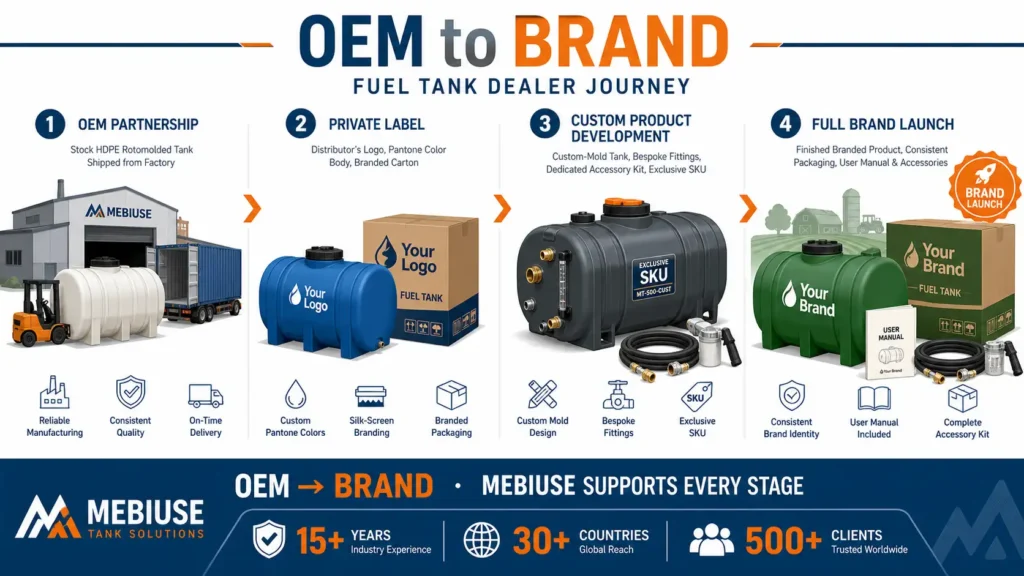
Most successful dealers pass through the same four stages. Skipping a stage usually means rebuilding it later at higher cost.

Stage 1 — OEM Partnership
The dealer sources stock tanks from a source factory, sells them under the factory brand or unbranded, and learns what the channel actually wants: which capacity, which pump, which color, which certification. The factory’s existing mold library is used as-is. The purpose of this stage is market learning, not brand building.
Stage 2 — Private Label
The dealer adds its own logo, color, and packaging to the factory’s existing mold. The product is now exclusive to that dealer under a proper private label agreement, with NDA protection preventing the factory from selling the same SKU to competitors (source: Shopify, Centric Software). Industry-standard MOQ for OEM portable diesel fuel tanks is around 100 units for private label, with logo-only rebrands as low as 50 units (source: Xinghui Rotomold, Plastic Tank Companies).
Stage 3 — Custom Product Development
The dealer commits to a dedicated mold, custom color matching, a custom accessory kit, or a capacity outside the stock mold envelope. This is the ODM step — typically 200–500+ unit MOQ, 16–24 weeks including mold fabrication, and a one-time tooling investment in the USD $500–$2,000 range for base-model programs (source: Bancy Solutions, Xinghui Rotomold). At this point the dealer is no longer renting a mold from the factory; they own a SKU family.
Stage 4 — Full Brand Launch
The dealer manages the product line as a brand: pricing, marketing, distribution, after-sales, packaging language, and a multi-year framework agreement with the factory. The factory becomes an invisible supply partner; the dealer’s name owns the customer relationship, the warranty, and the margin.
For a closer look at the OEM customization options across each stage, see our complete OEM portable fuel tank customization guide.
How to Build a Portable Fuel Tank Product Line
The dealers who scale fastest treat the product line as a matrix, not a single SKU. Three decisions shape the matrix.

Capacity Coverage Strategy (50L–1000L)
A complete product line covers the capacities your channel actually asks for, not every capacity the factory makes. The common structure:
| Capacity Band | Position in Line | Typical Buyer |
|---|---|---|
| 50L–100L | Entry SKUs, generator feed, light farm | Owner-operators |
| 200L–400L | Sweet-spot SKUs, mid farm, contractor | Core revenue |
| 500L–1000L | Premium SKUs, transfer tank + pump | Fleet, mining, construction |
| 1000L+ / Fuel Cube | Bulk site storage, often custom color | Industrial |
Covering the 200L–1000L band is usually enough for the first brand launch; adding 50L–100L as the second wave is the most common scaling path.
Target Market Segmentation
Each capacity band maps to a different buyer. A clear product line names who it is for: agriculture, construction, fleet, mining. Defining the segment up front lets you co-design color, accessories, and packaging with the factory instead of selling a generic tank and hoping it fits.
Pricing and Margin Model
A 200L portable diesel tank with 12V pump in custom Pantone color, 100-unit pilot, FOB Ningbo, typically lands 15–25% above stock color (source: Xinghui Rotomold, Plastic Tank Companies). At 500+ units annually, that premium drops as setup amortizes. Dealers who graduate to ODM typically recover tooling cost within the first 12–18 months on margin alone.
For the manufacturer selection framework that underpins these decisions, see our portable fuel tank manufacturer guide.
Key Steps to Launch Your Fuel Tank Brand
The OEM to brand strategy works best as a five-step checklist. Each step is short, but skipping it creates a gap that surfaces later as a price dispute, a color mismatch, or a lost customer.
- Market research and positioning. Pick the segment, the capacity band, the price band, and the value proposition (price leader, premium brand, niche specialist). Document the positioning in one page.
- Choose the OEM partner. Shortlist 2–3 source factories, audit production bases, certifications, and export history. Confirm CE / ISO and double-testing QC before signing anything. MEBIUSE operates 2 self-owned production bases in Zhejiang and Shandong with export to 30+ countries and 500+ global clients since the early 2010s.
- Product planning and customization. Lock the SKU list, color (Pantone / RAL), logo application (silk-screen, embossing, label, or hang tag), accessories, and packaging. Sign a one-page branding spec before tooling setup. For a worked example, see our guide to private label portable fuel tanks.
- Packaging and brand visual. Branded carton, user manual in the buyer’s language, accessory kit, hang tag, and consistent color across tank body, cap, fittings, and accessories. Consistency is what makes a line look like a brand.
- Launch and distribution. Run a 100–300 unit pilot, approve a Golden Sample as the binding reference for future production (source: Asian Sourcing Group), then scale to annual volume under a framework agreement with NDA-protected exclusive SKUs. For orders above USD $10,000, commission a Pre-Shipment Inspection at 2–3% of order value; for complex OEM orders, add DUPRO at 20% complete (source: Asian Sourcing Group).
For the customization details behind Step 3, see our full guide on OEM portable diesel tank customization.
Build Your Fuel Tank Brand with MEBIUSE
How MEBIUSE Supports Dealers on the OEM-to-Brand Journey
MEBIUSE — operating under Binzhou Shizhou Intelligence Technology Co., Ltd. — supports dealers through every stage of the OEM to brand strategy, not only the first private label order.
What dealers working on their own OEM fuel tank brand get from MEBIUSE:
- Flexible MOQ — pilots from 100 units; annual framework from 500+ units; logo-only rebrands as low as 50 units.
- Full customization — Pantone / RAL color matching, multiple logo application methods, capacity variants within the mold envelope, and custom accessory kits.
- Mold development support — for dealers ready to graduate to a dedicated mold; tooling guidance and engineering input from the factory.
- Packaging and language — branded cartons, user manuals in the buyer’s language, branded labeling, and optional accessories.
- Global export experience — established logistics via Qingdao and Ningbo ports; FOB, CIF, and EXW terms; CE and ISO certification with all parts double tested before shipping.
- Brand IP protection — NDA and contractual SKU exclusivity for dealers running framework agreements.
For dealers planning a private label fuel tank business that grows into a full product line, the same partner can carry the program from the first 50-unit rebrand to a 1,000+ unit annual framework.
Start Building Your Brand Today
Frequently Asked Questions
What does “OEM fuel tank brand” mean?
An OEM fuel tank brand is a portable fuel tank sold under a distributor’s or buyer’s own brand, manufactured by a third-party source factory using the factory’s molds (private label) or a custom mold owned by the buyer (ODM). The buyer controls the brand, the SKU, and the customer relationship; the factory controls production and quality (source: Shopify, Centric Software).
How is moving from OEM to own brand different from a private label program?
A private label program is one stage of the OEM-to-brand journey — typically Stage 2 in the four-stage model. A full OEM fuel tank brand path includes private label, custom product development, and a full brand launch with its own packaging, distribution, and after-sales. Many dealers start with private label and graduate to a full brand once the channel is proven (source: Gembah, Wessi).
How long does it take to build a fuel tank dealer brand development program?
For a stock-SKU private label rebrand (existing mold, logo + color + packaging only): typically 8–10 weeks from spec confirmation to first shipment. For a custom mold (ODM) full brand: typically 16–24 weeks including mold fabrication. Standard custom orders after drawing confirmation take 7–15 working days for production alone (source: Bancy Solutions).
What MOQ should a dealer expect when starting a portable fuel tank product line?
Industry-standard MOQ for OEM portable diesel fuel tanks is around 100 units for private label, around 200–500+ units for ODM custom mold programs, and 500+ units per year for an annual framework agreement. Logo-only stock-SKU rebrands can start as low as 50 units (source: Xinghui Rotomold, Plastic Tank Companies).
Will the factory sell my exact fuel tank SKU to my competitors?
No — under a properly structured brand agreement, the factory is contractually restricted from selling your exact SKU to other buyers and signs an NDA to protect your brand identity. Both the exclusivity clause and the NDA should be present in the framework agreement before the first production order (source: Bancy Solutions).
How should a dealer price a private label fuel tank business against stock?
A custom-color pilot typically lands 15–25% above stock color at 100 units; the premium drops as volume grows and setup amortizes. Dealers who graduate to a dedicated ODM mold typically recover tooling cost within 12–18 months on margin alone (source: Xinghui Rotomold, Plastic Tank Companies).
How does MEBIUSE support dealers on the OEM to brand strategy path?
MEBIUSE supports the full path with flexible MOQ from 100 units, Pantone / RAL color matching, multiple logo methods, mold development for ODM graduates, branded packaging in the buyer’s language, NDA-protected exclusive SKUs, and 15+ years of export experience to 30+ countries. The combination is a single partner for the entire OEM-to-brand journey.
Official Sources
- MEBIUSE official site
- MEBIUSE OEM/ODM pillar page
- MEBIUSE portable diesel fuel tanks guide
- MEBIUSE contact page
- Shopify — Private Label vs White Label Guide
- Centric Software — Private Label vs White Label
- Gembah — White Label vs Private Label
- Bancy Solutions — OEM Liquid Storage Customization
- Xinghui Rotomold — OEM Fuel Tank Customization
- Plastic Tank Companies — HDPE Fuel Tank Material Overview
- Asian Sourcing Group — 5-Step Chinese Factory Verification
Publisher and editorial information
Published by MEBIUSE Editorial Team. MEBIUSE is a portable fuel tank manufacturer with self-owned production bases in Zhejiang and Shandong, supporting dealers worldwide with private label, OEM, and ODM programs for UV-stabilized HDPE rotomolded fuel tanks and fuel transfer systems.
For editorial inquiries, contact the MEBIUSE editorial team via /contact/.
Last reviewed: August 8, 2026 | Published: August 8, 2026 | Publisher: MEBIUSE
Ready to turn your OEM procurement into a defensible fuel tank brand?
Build Your Fuel Tank Brand with MEBIUSE