If you are an importer, brand owner, or distributor looking for a long-term portable diesel fuel tanks supplier, this guide gives you a working evaluation framework you can apply in 30 days. It also shows how MEBIUSE — a source factory with two self-owned production bases in Zhejiang and Shandong — meets each criterion.
MEBIUSE at a Glance
- Legal entity: Binzhou Shizhou Intelligence Technology Co., Ltd.
- Industry experience: 15+ years in portable fuel tank manufacturing
- Production bases: 2 self-owned facilities in Zhejiang and Shandong
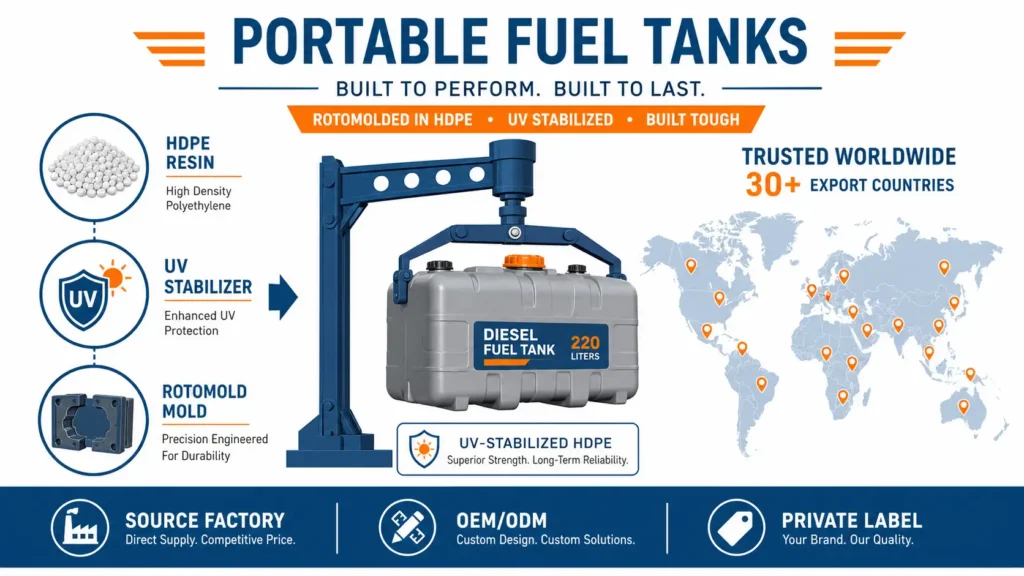
- Material & process: UV-stabilized HDPE with seamless rotomolding
- Certifications: CE & ISO certified
- Quality control: All parts double tested before shipping
- Export reach: 30+ countries, 500+ global clients
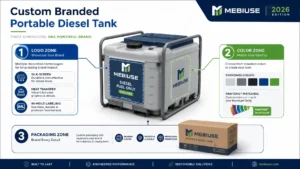
- OEM/ODM: Flexible customization (capacity, mold, color, logo, packaging)
Why Choosing the Right Portable Fuel Tank Manufacturer Matters
Portable fuel tanks are not commodity plastic containers. They hold flammable liquids, must pass regional safety and transportation regulations, and are often used in harsh outdoor environments — farms, construction sites, mines, and remote fleets. A defective tank can cause fuel leaks, environmental contamination, equipment failure, and serious safety liability for the buyer.
This is why a portable fuel tank manufacturer cannot be selected on unit price alone. Three high-cost failure modes show up consistently in the industry:
- Warranty and recall risk. A factory with weak incoming-material inspection or no in-process QC will produce tanks that crack, warp, or leak within 6–18 months. The buyer absorbs the replacement cost.
- Customs and compliance rejection. A factory whose tanks are not certified to the destination market’s standard (for example, CE for Europe, ISO quality systems, or local transport rules) can hold shipments at the port for weeks.
- Lost OEM brand equity. For private label buyers, a poor-quality tank sold under the buyer’s brand damages long-term trust with end users that is expensive to rebuild.
Working with the right portable fuel tank manufacturer protects all three risks at once.
For the broader picture on what a portable fuel tank is and how it works, see our portable diesel fuel tanks pillar guide. For a complete view of the OEM/ODM process, see the complete OEM portable fuel tank guide.
What Is a Portable Fuel Tank Manufacturer?
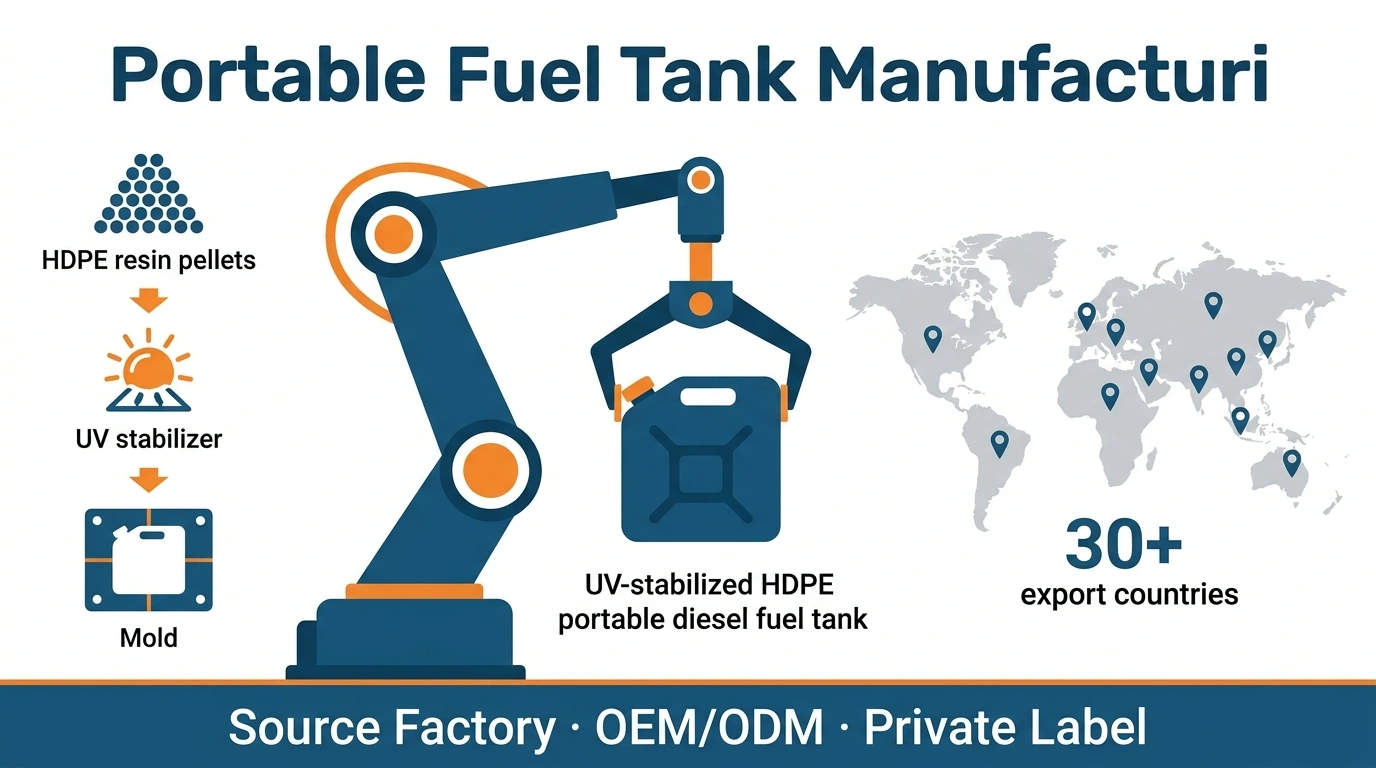
A portable fuel tank manufacturer is the production entity that owns the rotomolding equipment, mold tooling, material supply contracts, and quality control stations used to make the finished tank. The manufacturer differs from a trading company, which buys finished tanks from a factory and resells them under its own brand.
The distinction matters because the manufacturer — not the trading company — is responsible for:
- Tank wall thickness and structural integrity
- Material grade selection (HDPE, XLPE, or specialty resins)
- Mold accuracy and surface finish
- In-process QC and final pressure/leak testing
- Customization capability (capacity, fittings, color, logo)
Buyers who go directly to the manufacturer cut out the trading-company markup and gain direct access to the production team that solves engineering problems.
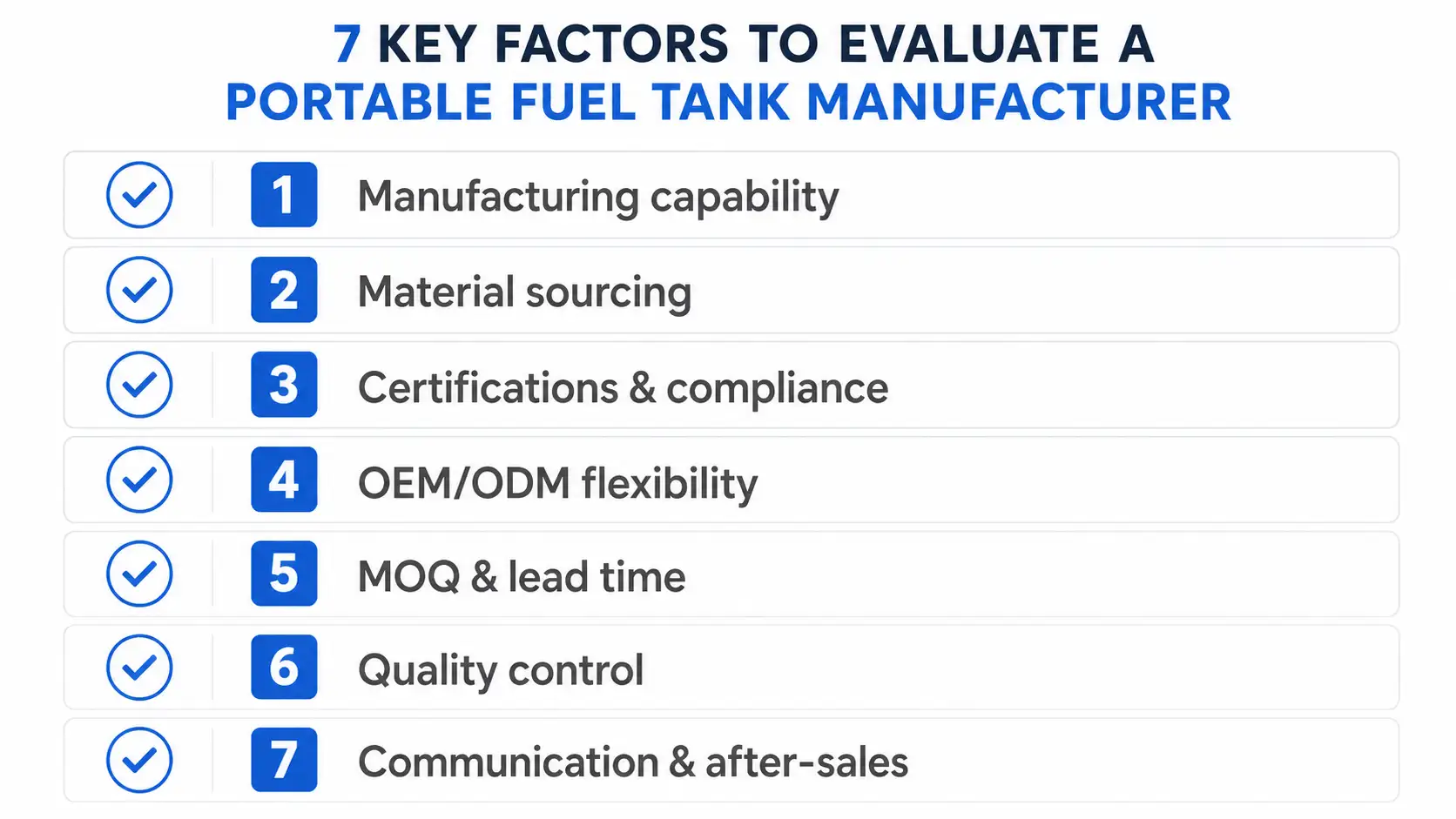
7 Key Factors to Evaluate a Portable Fuel Tank Manufacturer
1. Manufacturing Capability and Process
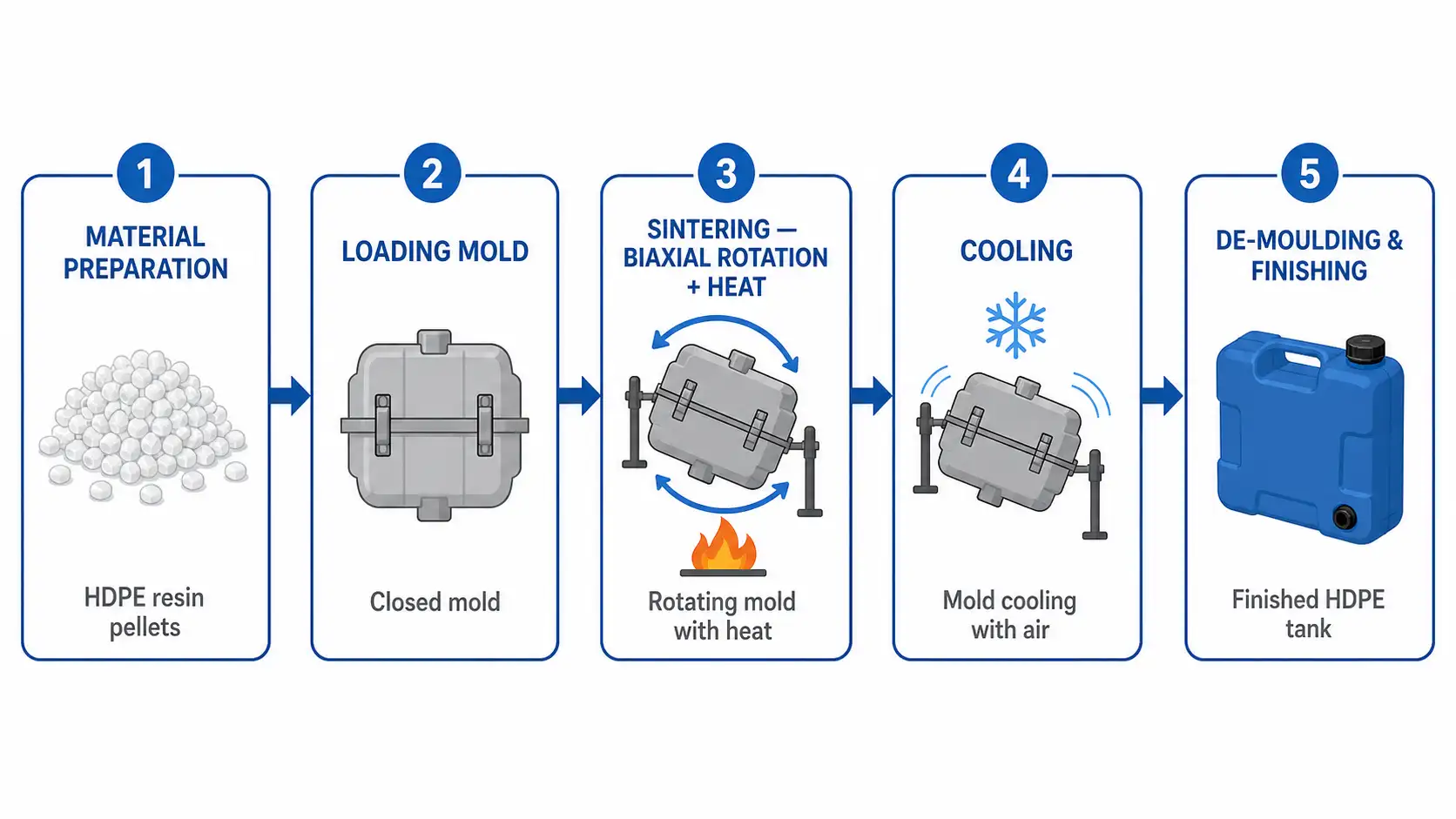
The two dominant processes for portable plastic fuel tanks are rotational molding (rotomolding) and blow molding. Rotomolding is the industry-preferred process for portable diesel and gasoline tanks because it produces a seamless, stress-free, thick-walled tank that integrates fittings during the molding cycle itself (source: LyondellBasell, ExxonMobil Chemical).
A serious portable fuel tank manufacturer should be able to explain:
- Daily production output (units per shift)
- Standard lead time for a stock SKU vs. a custom SKU
- Number of rotomolding machines on the floor and their maximum mold dimensions
- Subcontracting policy (does the factory outsource any production step?)
- Mold storage and traceability (how are customer-owned molds tracked?)
A factory that answers these questions with specific numbers — not vague estimates — is more likely to be the actual producer rather than a sales office.
2. Material Sourcing
UV-stabilized HDPE is the industry standard material for portable fuel tanks because it combines chemical resistance to hydrocarbons, high impact strength, and outdoor UV durability (source: Plastic Tank Companies, ExxonMobil Chemical). A portable fuel tank manufacturer should disclose:
- The HDPE grade and supplier (virgin resin vs. recycled blend)
- UV stabilizer additive type and concentration
- Whether fittings (caps, vents, hose ports) are sourced in-house or subcontracted
Buyers who skip the material conversation often discover the cost savings came from downgraded resin — and the tanks fail in the field.
3. Certifications and Compliance
At minimum, a portable fuel tank manufacturer exporting internationally should hold CE certification for the European Economic Area and ISO 9001 quality management certification with a scope that explicitly covers fuel tanks or pressure vessels (source: LyondellBasell, Asian Sourcing Group).
Critical verification: do not accept a CE or ISO certificate at face value. The scope of certification must cover the specific product category the buyer is ordering. A factory with an ISO 9001 for office furniture cannot use that certificate to claim fuel-tank quality compliance. Always verify the issuing registrar and the certificate scope directly.
4. OEM and ODM Flexibility
For brand owners and distributors, OEM/ODM flexibility is the deciding factor. A portable fuel tank manufacturer with real OEM capability should offer:
- Custom capacity (any volume within the machine envelope)
- Custom mold development for unique shapes or fittings
- Logo printing, embossing, or labeling
- Custom color matching
- Packaging design (private label cartons, user manuals)
MOQ for OEM portable fuel tank orders typically starts at 100 units, though this varies by mold complexity and annual volume commitment (source: Xinghui Rotomold, Plastic Tank Companies).
For a closer look at what MEBIUSE customizes for private-label buyers, see our guide:
5. MOQ, Pricing, and Lead Time
Three commercial metrics reveal a factory’s real position:
| Metric | Healthy Factory Signal | Warning Signal |
|---|---|---|
| MOQ | Transparent, written in quotation; flexible for repeat orders | Refuses to put MOQ in writing |
| Pricing | Itemized with material, mold, labor, packaging breakdown | Single “lump sum” quote with no breakdown |
| Lead Time | Production + shipping timeline given separately | Vague “30–60 days” with no breakdown |
Buyers who receive a clean, itemized quotation within 48 hours usually have a more organized factory behind them than buyers who wait a week for a single-line number.
6. Quality Control Process
A portable fuel tank manufacturer’s QC process should be visible on a live factory video call. Specifically, the buyer should see:
- Incoming material inspection station
- In-process wall-thickness check during rotomolding
- Final leak test (pressure or vacuum)
- Visual and dimensional inspection before packing
- Traceability: each tank linked to a production batch and date
Factories that allow only pre-recorded promotional videos and refuse live walkthroughs are a known red flag (source: Sinospect, Zignify).
7. Communication and After-Sales Support
OEM relationships are long-term. A portable fuel tank manufacturer that responds within 24 hours during quotation, names a dedicated account manager, and provides a written defect-handling policy is signaling that it intends to keep the relationship after the first shipment.
The same test applied during sourcing reveals how the factory will behave when a real warranty issue arises in month 8.
China vs Other Manufacturing Hubs
Portable fuel tanks are made in several regional hubs, each with different strengths:
| Hub | Typical Strength | Typical Limitation |
|---|---|---|
| China (Zhejiang, Shandong) | High production capacity, integrated rotomolding lines, competitive OEM pricing, mature export logistics | Need to verify individual factory due to wide quality variance |
| USA | Strict domestic compliance, fast shipping for North American buyers | Limited portable fuel tank specialists; higher unit cost |
| Germany / EU | Premium engineering, strict CE / DIN compliance | Highest unit cost; long lead times for OEM |
| Australia | Strong ute / tray-back tank designs for local market | Small production scale; limited export reach |
For B2B buyers ordering 500+ units annually with custom branding, Chinese factories — particularly those in Zhejiang and Shandong — offer the strongest combination of capacity, customization, and price. The buyer’s job is to verify the specific factory, not the country (source: synthesis across Asian Sourcing Group, Sinospect, Zignify).
5 Common Red Flags When Sourcing a Portable Fuel Tank Manufacturer
Buyers evaluating a new factory should treat the following as disqualifying signals:
- Business license scope only lists wholesale or import-export — the entity is a trading company, not a factory (source: Asian Sourcing Group, Sinospect).
- No export license or refuses to provide one — the factory cannot ship directly, adding hidden agent commissions.
- Hesitates or refuses a live video factory walkthrough — usually because there is no production floor to show (source: Sinospect, Zignify).
- Product test reports do not match the SKU/model being quoted — a common form of certificate laundering.
- No reference clients in the buyer’s destination market — the factory will be learning on the buyer’s order, and that learning curve becomes the buyer’s risk (source: Zignify).
A factory that triggers two or more of these red flags should be removed from the shortlist, regardless of how competitive the quotation looks.
Why MEBIUSE Is a Trusted Portable Fuel Tank Manufacturer
MEBIUSE — operating under Binzhou Shizhou Intelligence Technology Co., Ltd. — has been a producer and exporter of portable fuel tanks and mobile energy support equipment since the early 2010s (source: MEBIUSE official site). The company focuses on R&D of portable fuel tanks with self-operated production bases in Zhejiang and Shandong, giving buyers direct factory pricing without trading-company markup.
Key facts that matter to B2B buyers:
- 15+ years of industry experience in portable fuel tank manufacturing
- 30+ countries exported to, with 500+ global clients served
- UV-stabilized HDPE material with seamless rotomolding — the same process used by leading European and North American tank makers
- CE and ISO certified, with all parts double-tested before shipping (source: MEBIUSE official site)
- Flexible OEM/ODM service covering capacity, mold development, color, logo, and packaging
For buyers comparing portable fuel tank manufacturers, MEBIUSE offers the combination of factory-direct pricing, established export experience, and the OEM flexibility that private-label buyers need to scale.
Frequently Asked Questions
What is a portable fuel tank manufacturer?
A portable fuel tank manufacturer is the production entity that designs, molds, and tests portable fuel tanks — typically using UV-stabilized HDPE via rotomolding. Unlike a trading company, the manufacturer owns the production equipment, molds, and quality control process, and is directly accountable for tank performance.
How do I verify a portable fuel tank manufacturer is a real factory and not a trading company?
Ask for the Chinese business license and check the National Enterprise Credit Information Publicity System. The registered business scope must explicitly include “Production / Manufacturing / Processing.” If the scope lists only “Wholesale / Retail / Import-Export,” you are talking to a trading company (source: Asian Sourcing Group, Sinospect).
What MOQ should I expect from an OEM portable fuel tank manufacturer?
Industry-standard MOQ for OEM portable fuel tank orders is typically around 100 units, though this varies by mold complexity and annual volume. Larger capacities and custom mold development usually carry a higher MOQ or a separate tooling fee (source: Xinghui Rotomold, Plastic Tank Companies).
What certifications should a portable fuel tank manufacturer have?
At minimum: CE certification for the European market and ISO 9001 with a scope covering fuel tanks or pressure vessels. Always verify the issuing registrar and confirm the certificate scope matches the product category you are buying (source: LyondellBasell, Asian Sourcing Group).
Can a portable fuel tank manufacturer do private label branding?
Yes. Most OEM portable fuel tank manufacturers offer private label services including logo printing or embossing, custom color matching, branded packaging, and user manual design. MOQ for private label typically starts at 100 units (source: Xinghui Rotomold).
How long does it take to receive an OEM order from a portable fuel tank manufacturer?
For a stock SKU, expect 15–30 days for production plus 25–40 days for ocean freight to most destinations. For a custom mold, add 30–60 days for mold development and sample confirmation before mass production begins (source: industry synthesis).
Why choose MEBIUSE as a portable fuel tank manufacturer?
MEBIUSE combines 15+ years of manufacturing experience, two self-owned production bases in Zhejiang and Shandong, CE and ISO certification, and proven export to 30+ countries. Direct factory pricing and flexible OEM/ODM service make MEBIUSE a practical choice for importers and brand owners sourcing portable fuel tanks (source: MEBIUSE official site).
Official Sources
- MEBIUSE official site
- MEBIUSE OEM/ODM pillar page
- MEBIUSE contact page
- Plastic Tank Companies — HDPE fuel tank material overview
- LyondellBasell — Icorene rotomolding powders for fuel tanks
- ExxonMobil Chemical — HDPE resin guide for rotomolding
- Xinghui Rotomold — OEM fuel tank customization
- Asian Sourcing Group — 5-step Chinese factory verification
- Sinospect — Chinese industrial supplier qualification
- Zignify — verifying Chinese manufacturers
Publisher and editorial information
Published by MEBIUSE Editorial Team. MEBIUSE is a portable fuel tank manufacturer with production bases in Zhejiang and Shandong, exporting UV-stabilized HDPE rotomolded fuel tanks and fuel transfer systems to 30+ countries.
For editorial inquiries, contact the MEBIUSE editorial team via /contact/.
Last reviewed: July 31, 2026 | Published: July 31, 2026 | Publisher: MEBIUSE
Ready to source from a portable fuel tank manufacturer with 15+ years of OEM experience?
Request an OEM Portable Fuel Tank Quote