A portable diesel tank delivery inspection creates a record of what arrived and whether it matches the order. Start with the packaging, then check the visible equipment and supplied accessories against the agreed documents. Keep receiving checks separate from installation and commissioning: accepting a delivery does not establish that a tank is ready to fill or operate.
Prepare the order information before delivery
Have the purchase order, final quotation, packing list and agreed configuration available to the person receiving the shipment. Include any approved drawing and the latest correspondence about changes. If the order covers several versions, prepare a separate line for each model rather than using one checklist for the entire shipment.
Nominate a contact who can answer questions about substitutions or missing items. A warehouse team should not have to guess whether an unfamiliar nozzle or a different label was an agreed change.
Record the packaging before unpacking
Photograph the shipment as received, including the overall package, identification labels and any visible damage. Count packages against the packing list. Record crushed corners, torn wrapping, wet areas or displaced contents without deciding their cause from appearance alone.
Keep the original packaging and relevant delivery records while a discrepancy is being reviewed. Follow your agreed receiving and carrier-reporting process. A dated, clearly labelled photograph is more useful than an image sent later without an order reference.
Match the supplied configuration
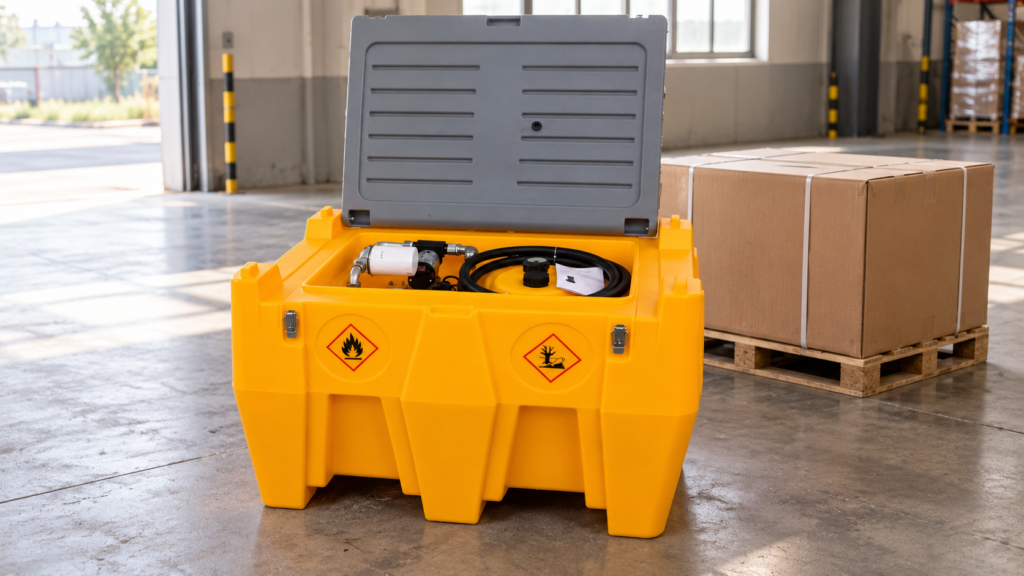
After unpacking in accordance with the supplier’s handling instructions, compare the visible equipment with the approved order. Record the model or identifying label, tank colour, lid arrangement and included pump, hose and nozzle. Note which components are fitted and which are supplied separately.
- Does the equipment identification match the purchase order?
- Are the expected accessories present in the stated quantities?
- Do supplied documents refer to the delivered configuration?
- Are loose components clearly identified for the installation team?
- Are there visible cracks, distortion, loose items or other concerns that require review?
Do not infer the permitted fill volume, electrical requirements or lifting method from a photograph. Read the model-specific documentation and ask the supplier to resolve any mismatch before use.
Create a useful photo record
A small, organised set of photographs is usually easier to review than dozens of unrelated close-ups. Capture the complete unit, its identification label, the accessories laid out together and a close view of any issue. Add a short explanation of where the detail sits on the equipment.
For example, “Order reference ABC, item 2: hose supplied separately; packing list shows one hose assembly” gives the supplier something concrete to investigate. Avoid describing an item as missing until all packages and the agreed scope have been checked.
Hand over to the responsible installation team
Separate findings into three groups: items matched to the order, questions awaiting clarification and visible concerns requiring assessment. Assign an owner and a next action to each unresolved point. Keep the equipment out of service where a concern could affect its suitability or safe operation.
The receiving checklist should lead to the manufacturer’s commissioning process, not replace it. Any electrical connection, testing or repair must follow the supplied instructions and be carried out by appropriately qualified personnel.
A simple receiving record
- Order reference, delivery date and receiving person.
- Package count and packaging observations.
- Equipment model and identifying information.
- Accessories and documentation received.
- Photograph references and unresolved questions.
- Person responsible for the next review or handover.
Frequently asked questions
Is an undamaged carton enough to accept the equipment for use?
No. Packaging condition is only one observation. The delivered configuration, documents and any required commissioning checks still need to be reviewed.
Should the receiver test the pump immediately?
Receiving inspection is not an instruction to energise equipment. Follow the manufacturer’s procedure for the exact configuration and involve the responsible installation team.
See our portable fuel tanks and refuelling workflow guide. To clarify a proposed supply package, contact MEBIUSE with your order or application details.