Key Takeaways
- Core formula: Daily diesel use (L/day) × refill interval (days) × 1.15 (safety buffer) = recommended tank capacity
- 50–100L tanks suit small farms, backup generators, and single-ute fleets — typically 1–2 people can handle them
- 200–400L tanks are the most versatile medium-duty range, fitting most tractors, small-to-medium construction equipment, and service trucks
- 500–1,000L tanks serve heavy-duty construction, mining, and multi-machine operations where site access for refueling is limited
- HDPE rotomolded tanks at 200–400L weigh roughly 32–60 kg empty and 200–400 kg full — manageable with 2 people or a forklift (source: MEBIUSE specifications)
- Diesel shelf life is 6–12 months indoors; always add a safety margin so fuel does not sit unused for more than 6 months
- OEM buyers with 3+ sites should consider bulk standardization across 200L or 400L SKUs for simpler logistics and reduced spare-part inventory
MEBIUSE at a Glance
- Product range: 50L portable diesel tank to 1,000L heavy-duty transfer tank
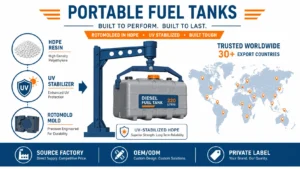
- Material: UV-stabilized HDPE, seamless rotational molding (rotomolded)
- Certifications: CE, ISO 9001
- Pump options: 12V DC / 24V DC / AC 110V / AC 220V / manual rotary
- OEM MOQ: ~50 units for custom logo, color, or configuration
- Production lead time: 15–25 days + shipping
- Markets served: Australia, New Zealand, UK, Europe, Southeast Asia, North America
- Contact: Request a Quote
How to Determine the Right Diesel Tank Size
Choosing the right portable diesel tank size is not about buying the biggest tank available — it is about matching capacity to your actual workflow. A tank that is too small forces frequent refueling trips, increasing logistics cost and downtime risk. A tank that is too large means diesel sits in storage for months, risking fuel degradation and microbial contamination.
The Three-Step Capacity Decision Framework
Step 1 — Calculate daily diesel consumption
Identify each piece of equipment that will draw from the tank and estimate its hourly fuel consumption:
| Equipment type | Typical fuel consumption | Notes |
|---|---|---|
| 50 HP tractor (medium load) | 12–18 L/hr | Most common small-to-medium farm tractor |
| 100 HP tractor (full load) | 25–35 L/hr | Large row-crop or contracting tractor |
| 20-tonne excavator | 15–25 L/hr | Standard mid-size excavator |
| Bulldozer (medium) | 30–50 L/hr | Variable by blade size and ground conditions |
| 5 kW diesel generator | 1.5–2 L/hr | 50% load assumption |
| 20 kW diesel generator | 5–7 L/hr | 75% load assumption |
| Light-duty diesel ute/pickup | 0.08–0.12 L/km | Highway vs off-road varies |
| Service truck | 0.15–0.25 L/km | Depends on load and terrain |
Multiply the hourly consumption by the number of hours each machine operates per day:
Daily diesel use (L/day) = Equipment A (L/hr) × Hours A + Equipment B (L/hr) × Hours B + …
Step 2 — Set your preferred refill interval
How often can you realistically return to a fuel source? Site remoteness, operating hours, and logistics cost all affect this decision:
| Refill situation | Recommended interval |
|---|---|
| Urban or semi-rural site with daily fuel access | Every 1–3 days |
| Rural farm with weekly town trips | Every 5–7 days |
| Remote construction site (limited access) | Every 7–14 days |
| Mining or offshore operation | Every 14–30 days |
Step 3 — Apply the capacity formula
Recommended capacity (L) = Daily diesel use (L/day) × Refill interval (days) × 1.15 (safety buffer)
The 1.15 multiplier adds a 15% safety buffer — equivalent to 10–20% extra capacity — to cover measurement errors, unexpected overtime, or a missed refill appointment.
Worked example: Mixed farm operation
A mixed farm runs one 75 HP tractor for 8 hours/day and one ute for 60 km/day:
- Tractor: 15 L/hr × 8 hr = 120 L/day
- Ute: 60 km × 0.10 L/km = 6 L/day
- Total: ~126 L/day
- At a twice-weekly refill interval: 126 × 2 × 1.15 = 290 L → recommend a 300–400L tank
Key factors that shift your capacity decision
Beyond the basic formula, these practical variables matter:
- Site remoteness: Every hour of travel to reach a fuel depot adds cost — remote sites justify larger tanks
- Peak season vs off-season: Agricultural operations vary dramatically; size for your busiest 4–6 weeks
- Multiple machines sharing one tank: Add all consumption; this is where 400L+ tanks become cost-effective
- Diesel shelf life: A tank that stays below 20% full for months invites condensation and microbial growth
Internal linking context
The formula above gives you a starting number. Use it to narrow down to one of three MEBIUSE product tiers — 200L, 400L, or 500L+ — and then cross-reference with the detailed application guides:
- 200L portable diesel tank with pump — medium-duty sweet spot
- 400L diesel transfer tank — heavy-duty farm and construction
- 500L heavy-duty diesel transfer tank — industrial and mining
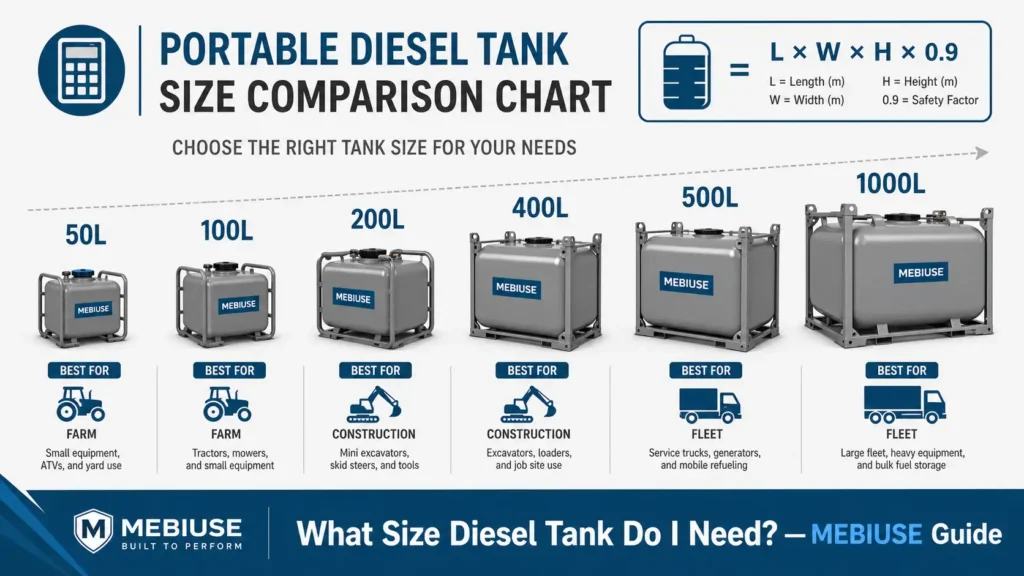
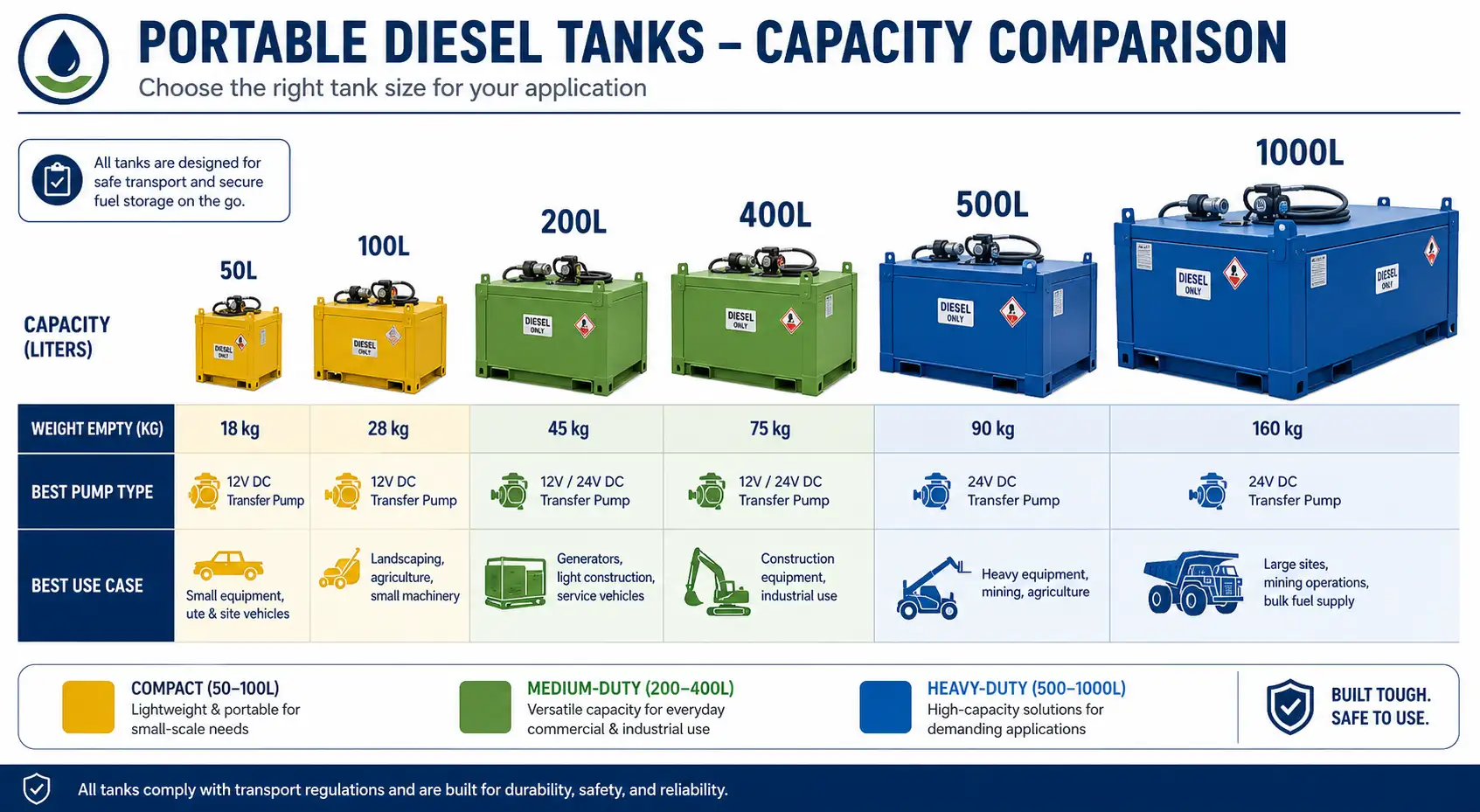
Diesel Tank Capacity Overview — From 50L to 1,000L
The portable diesel tank market clusters around six primary capacity tiers. Each tier has distinct handling characteristics, typical price positioning, and ideal use cases:
| Capacity | Empty weight (HDPE) | Full weight (HDPE) | Typical pump | Best for | Considerations |
|---|---|---|---|---|---|
| 50L | ~8 kg | ~50 kg | Manual rotary | Emergency reserve, garden tractors, home backup generators | 1-person lift; fits in car trunk |
| 100L | ~15 kg | ~100 kg | 12V DC | Small farms, single ute, home backup | 1–2 people; fits on back of single-cab ute |
| 200L | ~32 kg | ~201 kg | 12V / 24V / AC | Medium tractors, service trucks, generators | 2 people or forklift; most versatile SKU |
| 400L | ~60 kg | ~398 kg | 24V / AC | Large tractors, excavators, multi-machine sites | Forklift required; weekly refill cycle |
| 500L | ~75 kg | ~498 kg | 24V / AC | Heavy construction, mining, long-interval sites | Forklift required; 2-week+ refill viable |
| 1,000L | ~120 kg | ~965 kg | AC 220V | Multi-machine mining, port operations, remote depots | Crane or forklift; bulk depot standard |
HDPE vs steel weight difference: HDPE rotomolded tanks (source: Rotovia) are approximately 25–30% lighter than equivalent steel tanks at the same capacity. A 200L HDPE tank at ~32 kg empty can be handled by two adults without a forklift; the steel equivalent at ~45 kg empty may require mechanical assistance. This weight advantage matters significantly on remote sites without forklift access.
Capacity ladder logic: Think of tank capacity as a discrete investment ladder rather than a continuous spectrum. Most buyers find that the jump from 100L to 200L delivers the strongest return on investment — because it covers the widest range of medium-duty applications without requiring forklift infrastructure. The jump from 200L to 400L is justified when you operate more than one diesel machine simultaneously or work at remote sites where fuel delivery is expensive.
Matching Tank Size to Your Application
Farm and agricultural operations
Agriculture is the single largest end-market for portable diesel tanks (source: Australian Trucking Association Farm Logistics Report). Farm fuel management has unique constraints: wide distances between fields, seasonal demand spikes during harvest, and limited fuel delivery frequency in remote rural areas.
| Farm type | Equipment mix | Daily consumption | Recommended tank |
|---|---|---|---|
| Small hobby / lifestyle farm | 1 compact tractor (<50 HP) | 40–80 L/day | 100–200L |
| Mixed crop farm | 1–2 tractors (50–100 HP) + utility vehicle | 100–250 L/day | 200–400L |
| Broadacre / large-scale farm | 2–4 large tractors + header | 400–1,000+ L/day | 400–1,000L |
| Livestock station | Tractors + semis + generators | 200–600 L/day | 400–1,000L |
For Australian and New Zealand farmers, the farm diesel refueling guide covers full best practices including on-farm storage compliance and safe refueling procedures.
Construction and earthmoving
Construction sites face a specific challenge: equipment sits in one location for weeks or months, and fuel delivery logistics can be expensive. A correctly sized portable tank reduces fuel run costs significantly.
| Site type | Equipment | Daily consumption | Recommended tank |
|---|---|---|---|
| Residential subdivision | 1–2 excavators + loader | 150–400 L/day | 200–400L |
| Commercial construction | 2–4 machines + generators | 400–800 L/day | 400–500L |
| Civil / infrastructure | 4–8 machines + support vehicles | 800–2,000 L/day | 500–1,000L |
| Mining / quarry | Multiple heavy machines | 1,000–5,000+ L/day | Multiple 1,000L tanks or bulk depot |
Construction sites also have regulatory considerations. OSHA regulations (source: OSHA 29 CFR 1910.106) require that portable fuel containers meet specific construction standards when used on federally regulated job sites. Check your local work health and safety authority — in Australia, Safe Work Australia sets similar requirements for mobile refueling equipment.
For detailed construction refueling guidance, see construction site refueling best practices.
Ute, pickup truck, and fleet operations
For pickup trucks, utes, and service fleets, the capacity question is less about absolute volume and more about operational pattern — how far are your vehicles from the home base fuel supply?
| Operation type | Use case | Recommended tank |
|---|---|---|
| Single ute, daily return to base | Day tank for off-road work | 50–100L |
| Service truck, regional coverage | Multi-stop service calls | 100–200L |
| Fleet of 3–5 vehicles | Site-based refueling for fleet | 200–400L |
| Mobile workshop / comms van | Generator + vehicle fuel | 100–200L |
A key practical note for ute and pickup users: most dual-cab utes have a payload limit of 800–1,000 kg. A 200L tank full of diesel weighs ~169 kg (diesel density ≈ 0.845 kg/L, source: Rotovia), which fits comfortably within payload limits with one passenger. A 400L full tank at ~338 kg requires careful weight distribution and may exceed single-axle payload on some vehicles — always check your vehicle’s GVM (Gross Vehicle Mass) rating.
What Happens If You Choose the Wrong Size?
Getting tank capacity wrong in either direction has real operational consequences:
Choosing a tank that is too small
| Problem | Impact | Frequency |
|---|---|---|
| Running out mid-shift | Machine downtime, lost productivity, emergency fuel call-out at 3× normal cost | Common |
| Excessive refueling trips | Labour hours lost, fuel truck mobilization cost, vehicle wear | Very common |
| Rushing refueling processes | Safety shortcuts — skipping pre-checks, overfilling | Common |
| Frequent fuel exposure | More handling events = higher spill risk | Moderate |
Choosing a tank that is too large
| Problem | Impact | Frequency |
|---|---|---|
| Diesel degradation | Diesel stored more than 6–12 months indoors (source: OSHA Diesel Fuel Storage Guidelines) degrades — gum up filters, damage injectors | Common in low-utilization scenarios |
| Condensation buildup | Partially filled tanks in outdoor or temperature-cycling environments accumulate water at the bottom — perfect environment for microbial growth | Common in outdoor tanks |
| Excessive upfront cost | Paying for capacity you use 30% of the time | Moderate |
| Handling difficulty | 400L+ tanks require forklift or mechanical assistance — adds logistics complexity on small farms | Moderate |
The 6-month rule: As a practical heuristic, if your planned tank capacity means diesel will sit unused for more than 6 months, step down to a smaller tank and increase your refill frequency. Diesel fuel stability degrades predictably; the most reliable defense is keeping fuel fresh through turnover.
For comprehensive safety guidance on storing diesel on-site, see the portable diesel tank safety checklist.
Seasonal and Growth Considerations
Agricultural seasonality
Farming is inherently seasonal, which means “daily consumption” is not a fixed number — it varies dramatically:
| Season | Typical daily consumption | Tank implication |
|---|---|---|
| Peak harvest (6–8 weeks) | 2–4× normal | Size for peak, accept slower turnover in off-season |
| Normal fieldwork (8–10 months/year) | Baseline | Tank appropriate for baseline use |
| Off-season / idle | Near zero | Risk of stale fuel if tank is left full |
Practical tip: During off-season, either run the tank down to near-empty before storing, or add a diesel fuel stabilizer to extend shelf life to 12+ months. Never leave a tank sit full through winter without treatment.
Equipment growth and business expansion
Buying a tank today for your current fleet means the same tank may be undersized in 2–3 years as your operation grows. Consider:
- Standardization advantage: If you anticipate growing from 1 to 3 machines in 3 years, buying three 200L tanks now and replacing them with 400L tanks later is more expensive than buying three 400L tanks from the start
- Fleet standardization: Standardizing on 200L across your fleet simplifies spare parts, fuel management, and operator training — even if each site does not fully utilize the 200L capacity
- Modular approach: Some MEBIUSE buyers purchase multiple 200L tanks rather than one 400L tank — this gives flexibility to move tanks between sites without dedicating a permanent tank to each location
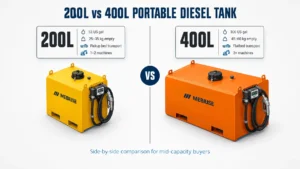
For buyers comparing whether to commit to 200L or 400L, the detailed 200L vs 400L comparison covers flow rates, handling requirements, and cost-per-litre considerations.
OEM and Bulk Ordering for Multi-Site Operations
If you manage fuel infrastructure across multiple farms, construction sites, or fleet depots, buying portable diesel tanks in bulk offers both cost and operational advantages:
Benefits of volume procurement
- Unit price reduction: OEM orders at 50+ units typically receive 10–20% volume discounts
- Configuration standardization: All tanks can be ordered with identical pump specs, hose lengths, and nozzle types — simplifying operator training and spare parts
- Branding consistency: Logo and color standardization across your tank fleet improves site safety compliance and asset tracking
- Supply chain simplification: One PO, one factory, one QC inspection, one shipping arrangement
Standardization recommendations by operation type
| Operation type | Recommended standard SKU | Rationale |
|---|---|---|
| 5–20 site farm operation | 200L with 12V DC pump | Most versatile; manageable by 1–2 operators at each site |
| 20+ site fleet/construction | 400L with 24V DC pump | Handles multi-machine sites; fits on standard flatbed |
| Remote mining/depot | 1,000L with AC pump | Maximum interval between refills; requires fixed infrastructure |
| Service truck fleet | 100L with 12V DC pump | Fits single-ute payload; sufficient for daily route |
For detailed guidance on OEM customization options, MOQ requirements, and supplier evaluation, see the portable fuel tank manufacturer guide.
Before placing a bulk order, review the portable diesel tank buying guide with 15 questions — it covers certification requirements, warranty terms, and QC inspection checkpoints that matter at volume.
Frequently Asked Questions
What size portable diesel tank do I need for my farm?
For a typical mixed farm with one 50–100 HP tractor running 6–10 hours per day, a 200–400L tank is the most common recommendation. Use the formula: Daily consumption (L/day) × refill interval (days) × 1.15. A 75 HP tractor consuming 15 L/hr over 8 hours = 120 L/day; at a twice-weekly refill: 120 × 2 × 1.15 = 276L → round up to the nearest standard size (300L or 400L). If you have two tractors or a combine harvester, scale up to 400–1,000L. (source: Australian Trucking Association Farm Logistics Report)
How do I calculate diesel tank size for construction equipment?
For construction equipment, calculate based on the combined consumption of all machines on-site. A 20-tonne excavator at 20 L/hr running 8 hours = 160 L/day. If you have two excavators and a loader on the same site: 160 + 160 + 120 = 440 L/day. At a weekly refill interval: 440 × 7 × 1.15 = 3,542L — for which you would deploy a combination of 1,000L + 500L tanks, or set up a dedicated fuel depot. (source: OSHA 29 CFR 1910.106)
What is the best portable diesel tank size for a pickup truck or ute?
For a single ute or pickup truck used in field service, a 100–200L tank is most practical. The 100L fits comfortably on a standard dual-cab ute tray (full weight ≈ 100 kg + tank weight ≈ 15 kg = 115 kg total, within most ute payload limits). A 200L tank is viable if the ute has a GVM rating above 3,500 kg and you frequently operate at remote sites where fuel is unavailable. (source: MEBIUSE specifications)
How long can diesel fuel be stored in a portable tank?
Diesel fuel stored indoors at room temperature remains usable for 6–12 months. Outdoor storage in direct sunlight or temperature-cycling environments reduces this to 3–6 months due to accelerated oxidation and condensation. Always add a diesel fuel stabilizer if storage exceeds 3 months, and never store diesel in a tank that sits below 20% full for extended periods — the large air space accelerates moisture condensation and microbial growth. (source: OSHA Diesel Fuel Storage Guidelines)
What are the legal limits for transporting portable diesel fuel?
Transport regulations vary by country and state. In Australia, the National Transport Commission (NTC) regulates the transport of dangerous goods, and portable diesel fuel in volumes up to 450L across containers of no more than 250L each is generally covered under standard dangerous goods transport requirements. In the United States, OSHA 29 CFR 1910.106 governs flammable liquid storage, and DOT regulations apply to transport on public roads. Always verify with your local transport authority and ensure your tank carries appropriate certification (UN31H1 for plastic jerry cans, or the equivalent for larger tanks). (source: OSHA 29 CFR 1910.106; Safe Work Australia)
Is a 200L or 400L diesel tank better for daily farm use?
For daily farm use with one to two tractors, a 200L tank is typically sufficient if you refill every 1–3 days. A 400L tank is the better choice if: (a) you operate more than two diesel machines simultaneously, (b) your farm is remote from the nearest fuel depot (making each delivery trip expensive), or (c) you want to minimize the number of annual refueling events. The handling trade-off is real — a 200L HDPE tank at ~32 kg empty is manageable by two adults; a 400L tank at ~60 kg empty requires forklift or mechanical assistance on most farms. (source: MEBIUSE specifications)
What size diesel tank do I need for a backup generator?
For standby or backup generators, size the tank to cover your planned runtime between refills. A 10 kW generator at 75% load consumes approximately 3–4 L/hr. For a typical backup scenario covering 24–48 hours of outage: 3.5 L/hr × 24 hr = 84L → recommend a 100–200L tank. For critical facilities (hospitals, data centers, telecom towers) where outage duration is unpredictable: size for 72–168 hours (3–7 days) of continuous operation. (source: MEBIUSE generator tank specifications)
Can I get a custom-sized portable diesel tank for my fleet?
Yes — most manufacturers including MEBIUSE offer OEM customization on capacity, pump type, hose length, nozzle configuration, wheel kit, and branding at MOQ of approximately 50 units. Standard MEBIUSE capacities range from 50L to 1,000L in 50L increments. Capacities between standard sizes (e.g., 250L or 350L) may require custom tooling and higher MOQ. For custom branding, logo, and color (including custom Pantone matching), lead time is typically 20–30 days plus shipping. (source: MEBIUSE official; Xinghui Rotomold OEM guidelines)
Official Sources
- MEBIUSE official site
- MEBIUSE Portable Fuel Tank Manufacturer Guide — C8-01 OEM hub
- MEBIUSE contact page
- Rotovia — Rotational Molding Technology — HDPE rotomolding process and material properties
- Plastic Tank Companies — HDPE Tank Material Guide — HDPE chemical compatibility and durability data
- OSHA 29 CFR 1910.106 — Flammable and Combustible Liquids — US workplace diesel storage regulations
- Safe Work Australia — Storage and Handling of Dangerous Goods — Australian workplace fuel storage requirements
- Australian Trucking Association — Agricultural fuel consumption benchmarks and farm logistics
MEBIUSE (Binzhou Shizhou Intelligence Technology Co., Ltd.) | Last reviewed: August 1, 2026 | Published: August 1, 2026
Disclaimer: Specifications and consumption figures in this article are typical industry benchmarks. Actual fuel consumption varies by machine model, load conditions, terrain, and operating environment. Always verify equipment-specific data from your machinery manufacturer before making purchasing decisions.