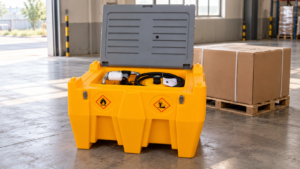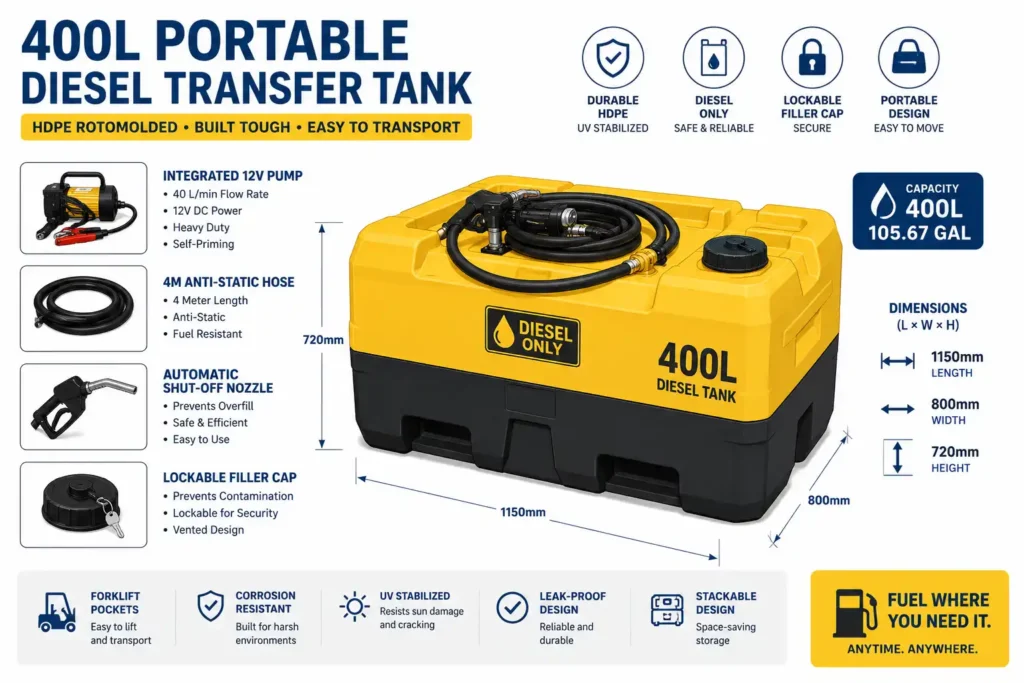
A 400L diesel transfer tank is a portable, UV-stabilized HDPE (high-density polyethylene) fuel storage vessel with a built-in 12V/24V/AC pump, designed for mobile refueling on farms and construction sites. At 400 liters (105.67 US gallons), it represents the “sweet spot” capacity for operators who need more than a 200L tank but want to avoid the logistics complexity of 500L+ units.
The 400L capacity provides approximately 380 liters of safe fill (95% for thermal expansion), weighs roughly 53 kg empty, and typically measures 1150 mm × 800 mm × 720 mm. For most mid-sized farm operations or job sites running 3–5 pieces of equipment, a 400L tank delivers 7–14 days of fuel autonomy without requiring daily trips to a bulk tank.
This guide covers 400L tank specifications, best applications for farms versus job sites, pump selection, safety regulations, and an OEM buying checklist.
400L Diesel Tank Specifications
Understanding the specifications of a 400L portable diesel tank helps buyers match the product to their operational requirements. The following tables summarize the key technical parameters.
Capacity and Dimensions
| Specification | Value |
|---|---|
| Nominal Capacity | 400 L (105.67 US gal) |
| Safe Fill Level | 380 L (95% — accounts for thermal expansion) |
| Weight (empty) | ~53 kg |
| Weight (full with diesel) | ~391 kg |
| Dimensions (L × W × H) | 1150 mm × 800 mm × 720 mm |
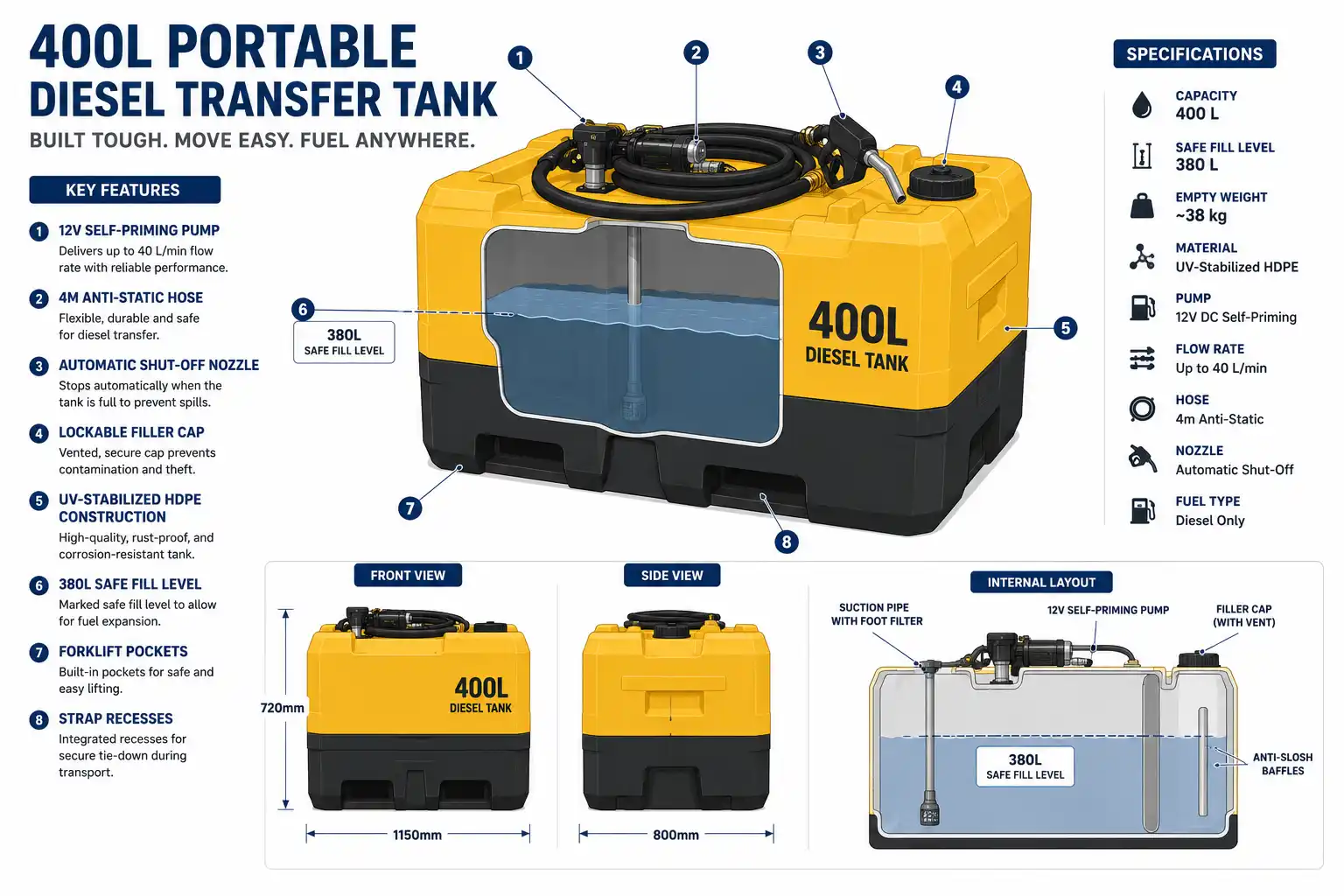
The empty weight of approximately 53 kg makes a 400L tank manageable for two-person positioning, though mechanical assistance (forklift or pallet jack) is recommended when the tank is full. Most models include four forklift pockets on the base and six integrated strap recesses for secure tie-down during transport.
Material and Construction
| Property | Detail |
|---|---|
| Material | UV-stabilized HDPE (LLDPE option) |
| Process | Rotational molding (seamless, stress-free) |
| Wall Thickness | 8–10 mm |
| Working Temperature | -20°C to +60°C |
Rotational molding produces a seamless tank wall with uniform thickness, eliminating weld points that could become leak paths over time (source: Rotovia). UV stabilizers added to the raw HDPE resin protect the tank from degradation when stored outdoors in direct sunlight—a common scenario on farms and remote job sites.
Standard Pump Package
| Component | Specification |
|---|---|
| Pump Type | 12V DC / 24V DC / AC 110V / AC 220V / Manual rotary |
| Flow Rate (electric) | 40–60 L/min |
| Flow Rate (manual) | 25–30 L/min |
| Hose | 4 m anti-static diesel hose, 3/4″ |
| Electric Cable | 4 m with battery clamps (12V/24V models) |
| Nozzle | Automatic shut-off (aluminum body) |
| Filler Cap | 2″ lockable bayonet with breather vent |
The 12V self-priming pump is the most common configuration for farm and job site use because it draws power directly from a vehicle battery or standalone 12V battery setup (source: Silvan Australia). The automatic shut-off nozzle prevents overfilling—a practical safety feature when fueling in wind, on uneven ground, or while multitasking.
Key Features of a 400L Portable Diesel Tank
A well-designed 400L portable diesel tank incorporates several features that differentiate it from smaller portable containers or improvised solutions. Understanding these features helps buyers evaluate whether a given model meets their operational needs.
1. Seamless Rotomolded HDPE Construction
Unlike steel tanks that can corrode over time, HDPE tanks are inherently rust-proof. The rotational molding process creates a one-piece, seamless vessel with consistent wall thickness, reducing stress concentrations that can lead to cracking or leaks (source: Rotovia).
2. ADR/DOT Transport Compliance
Under the Australian Dangerous Goods Code (ADR 1.1.3.1 C), a 400L portable diesel tank can be transported on a pickup truck or van when properly secured and when the tank is not being used as the vehicle’s fuel tank (source: Dymac Global). This exemption eliminates the need for specialized fuel transport vehicles for many on-farm and on-site refueling scenarios.
3. 12V Self-Priming Pump
A self-priming pump eliminates the need to manually fill the suction line before each use. For operators moving between multiple pieces of equipment throughout the day, this feature significantly reduces downtime and frustration.
4. Automatic Shut-Off Nozzle
Automatic shut-off nozzles stop fuel flow when the target tank reaches capacity. This feature reduces operator error, minimizes spillage, and protects against overfill that could contaminate soil or equipment.
5. Lockable Fill Cap and Pump Cover
Tamper-resistant caps and lockable pump covers deter unauthorized fuel use—a practical consideration for equipment stored in unsecured areas. The lockable filler cap also prevents debris, dust, and rainwater from entering the tank during storage.
6. Integrated Tie-Down Points
Most 400L tanks include six integrated strap recesses and D-ring attachment points. These allow operators to secure the tank to a truck bed or trailer without additional mounting hardware, reducing movement and potential damage during transport.
7. Forklift Pockets
Four forklift pockets on the tank base enable mechanical lifting for repositioning when the tank is full. This feature is essential for operations that load and unload tanks frequently.
8. Multi-Voltage Pump Options
From 12V DC for battery-powered portability to AC 220V for fixed-site installations, the availability of multiple pump voltage options means a 400L tank can serve diverse operational contexts—from remote field refueling to warehouse fueling stations.
Best Applications: Farms vs Job Sites
The 400L capacity serves two primary market segments: agricultural operations and construction/industrial sites. Each segment has distinct operational patterns that make the 400L tank an ideal fit.
Farm Applications
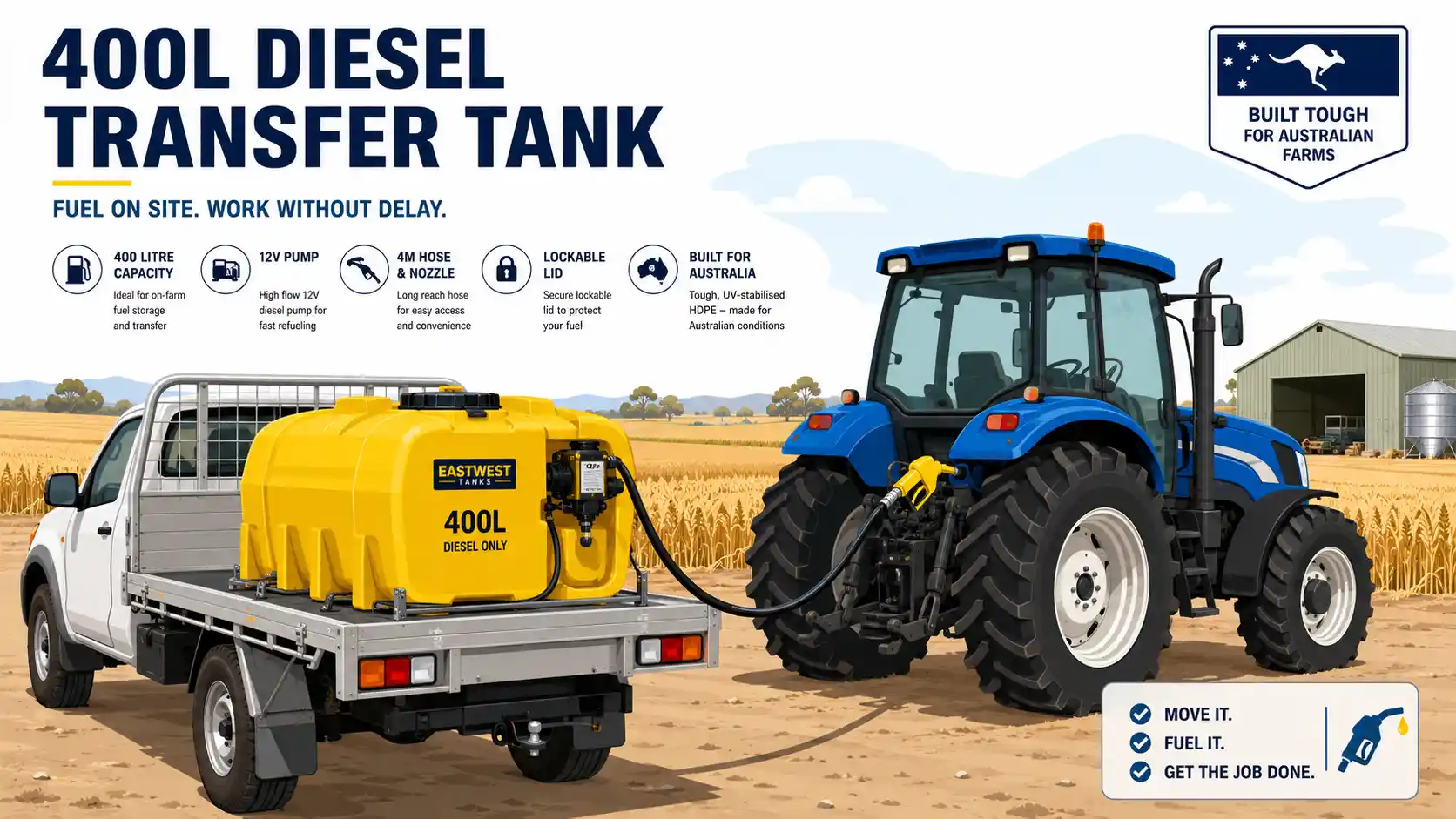
On farms, a 400L diesel transfer tank typically supports:
- Tractor fleets (3–5 units): A 100–200 HP tractor burns approximately 8–15 liters per hour under load. With a 400L tank providing 380L of safe capacity, a single tank delivers 25–47 hours of combined runtime across the fleet before requiring a refill.
- Combine harvesters: Larger harvesting equipment may consume 20–30 L/hr during peak harvest season. A 400L tank provides 13–19 hours of operation—enough for most full-day harvesting sessions without refueling.
- Irrigation pumps: Stationary irrigation pumps typically run 5–10 L/hr, giving a 400L tank 38–76 hours of runtime for seasonal water management.
- Generator backup: A 20–50 kW standby generator might consume 3–8 L/hr, providing 47–126 hours of backup power from a single 400L tank.
Job Site Applications
On construction and industrial sites, the 400L tank serves:
- Excavators and loaders: A 150–300 HP excavator burns approximately 12–20 L/hr. A full 400L tank (380L usable) provides 19–31 hours of operation—covering most full-shift requirements.
- Skid steers and telehandlers: Smaller equipment consuming 5–10 L/hr can operate 38–76 hours on a single tank, reducing trips to bulk fuel storage.
- Mobile service trucks: Service vehicles equipped with a 400L tank can perform multiple refueling stops across a job site without returning to a central fuel point.
- Remote generators: For generators at remote locations without grid power, a 400L tank provides sufficient fuel autonomy for 2–7 days depending on load.
Decision Framework: 400L vs Alternatives
| Factor | Choose 400L | Consider Alternatives |
|---|---|---|
| Equipment count | 3–5 units on-site | <3 units → 200L; >5 units → 500L+ |
| Daily runtime | 8–20 hours combined | <8 hours → 200L; >20 hours → 500L |
| Refill frequency | Every 7–14 days | <7 days → larger; >14 days → smaller |
| Transport method | Pickup truck / trailer | ADR limits apply |
| Budget | Mid-range investment | Premium → 500L with advanced features |
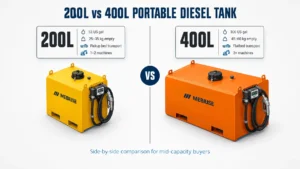
400L vs 200L vs 500L: Which Capacity Do You Need?
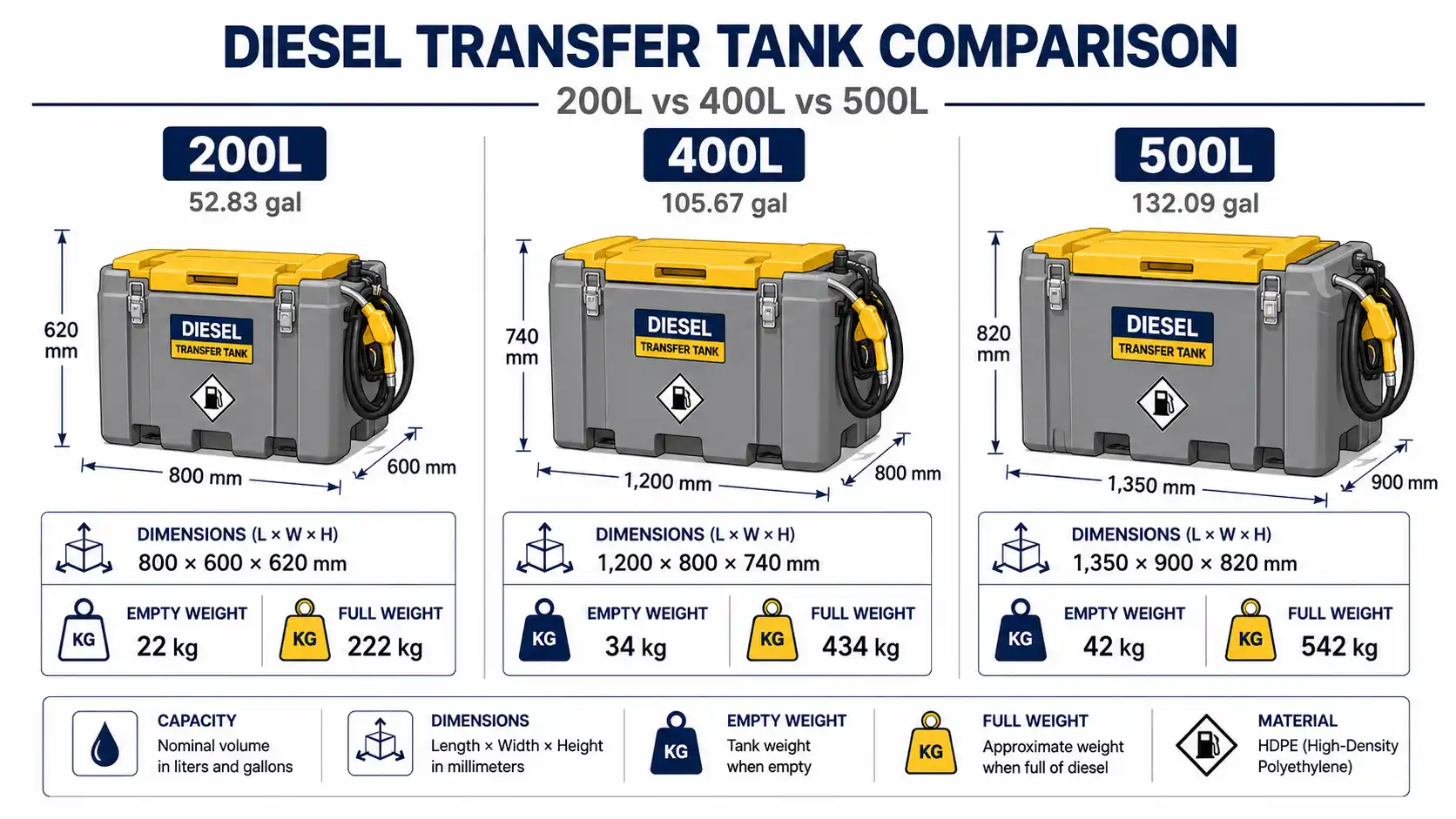
Choosing the right capacity depends on understanding how tank size translates to operational fit. The following comparison table clarifies the trade-offs.
Capacity Comparison Table
| Factor | 200L | 400L | 500L |
|---|---|---|---|
| US Gallons | 52.83 gal | 105.67 gal | 132.09 gal |
| Safe Fill | 190L | 380L | 475L |
| Empty Weight | ~32 kg | ~53 kg | ~65 kg |
| Full Weight | ~201 kg | ~391 kg | ~487 kg |
| Dimensions (mm) | 1100×700×600 | 1150×800×720 | 1200×850×750 |
| Best For | 1–3 small units | 3–5 mid-size units | 5+ heavy-duty units |
| Refill Frequency | 3–5 days | 7–14 days | 14–21 days |
| Forklift Required | No | Recommended | Yes |
| Typical OEM MOQ | 50 units | 30 units | 20 units |
| Lead Time | 15–25 days | 20–30 days | 25–35 days |
| OEM Price Range | $380–550 | $650–900 | $850–1,200 |
The 400L tank hits a practical middle ground: enough capacity for week-long autonomy on most mid-size operations, while remaining light enough for two-person positioning and ADR-compliant transport on standard vehicles.
For operators who are still deciding between 200L and 400L, the key question is: How many pieces of equipment will this tank serve in a typical week, and how far are they from a bulk fuel source? If the answer involves more than three units or distances exceeding practical round-trips, the 400L is the better investment.
Compare 200L and 400L Tank Options
Pump Options for 400L Diesel Tanks
Selecting the right pump configuration affects operational efficiency and compatibility with existing equipment. The following comparison outlines the four main options.
Pump Comparison Table
| Factor | 12V DC | 24V DC | AC 110/220V | Manual Rotary |
|---|---|---|---|---|
| Power Source | Vehicle/standalone battery | Commercial truck system | Grid/generator | None (hand-powered) |
| Flow Rate | 40–50 L/min | 45–60 L/min | 50–60 L/min | 25–30 L/min |
| Best For | Farm, mobile service | Mining, fleet | Fixed-site station | Emergency backup |
| Portability | Excellent | Good | Limited | Excellent |
| Duty Cycle | Intermittent | Intermittent to continuous | Continuous | N/A |
The 12V DC pump is the most versatile option for operators who move the tank between locations. It draws power from a standard vehicle battery or a small 12V deep-cycle battery, eliminating the need for generators or fixed power infrastructure.
Note that “open flow” ratings (e.g., 40 L/min) represent pump output under ideal conditions. Actual dispensing flow is affected by hose length, hose diameter, fittings, filters, and battery voltage. A slightly slower but consistent flow typically proves more reliable in field conditions (source: Diesel Tanker Buyer Guide).
Safety and Regulations: ADR and DOT Compliance
Transporting diesel fuel, even in an approved portable tank, involves regulatory compliance. Understanding the key requirements prevents fines and ensures safe operation.
ADR Exemption (Australia/EU)
The ADR 1.1.3.1 C exemption permits the transport of portable fuel tanks on vehicles without triggering full dangerous goods transport requirements—provided certain conditions are met (source: Dymac Global):
- The tank must be designed for portable use (not permanently installed)
- The tank must be secured against movement during transport
- The transport must be incidental to the primary use of the equipment being fueled
- The tank capacity must not exceed the limits specified for the exemption category
Under this exemption, a 400L tank can be transported on a pickup truck bed or trailer to reach remote equipment without requiring a dedicated fuel transport vehicle.
General Safety Practices
Regardless of regulatory exemptions, operators should follow these practical safety guidelines (source: OSHA Diesel Storage guidance):
- Inspect before each use: Check hose condition, nozzle operation, and fitting integrity. Replace worn components before they fail.
- Control static: Keep the nozzle in contact with the fill neck during fueling to dissipate static charge.
- Plan for spills: Keep absorbent materials on hand; avoid fueling near drains or waterways.
- Secure during transport: Use integrated strap recesses and D-rings to prevent tank movement. A 400L tank full of diesel weighs approximately 391 kg—unsecured, it becomes a serious hazard during braking or cornering.
- Store properly: Keep tanks in shaded areas when possible; UV-stabilized HDPE resists degradation but prolonged direct sun exposure accelerates surface wear.
Buying Checklist for 400L Diesel Transfer Tanks
Before placing an order, verify the following checklist with your supplier:
| # | Checklist Item | Why It Matters |
|---|---|---|
| 1 | Capacity matches weekly fuel consumption | Avoid overfilling (use 95% rule) or frequent refills |
| 2 | HDPE/LLDPE grade stated clearly | Ensures diesel compatibility and longevity |
| 3 | Wall thickness ≥8 mm | Affects impact resistance and durability |
| 4 | ADR/DOT exemption documentation | Confirms legal road transport |
| 5 | Pump voltage matches your power source | 12V vs 24V vs AC are not interchangeable |
| 6 | Flow rate stated (L/min) | Compare across suppliers; check if “open flow” or “working flow” |
| 7 | Hose length ≥4 m | Reach equipment without repositioning tank |
| 8 | Automatic shut-off nozzle included | Prevents overfill spills |
| 9 | Lockable cap and cover | Deters tampering and contamination |
| 10 | Forklift pockets and tie-down points | Enables safe handling and transport |
| 11 | CE/ISO 9001 certification | Required for EU markets and tenders |
| 12 | OEM customization available | MOQ, lead time, branding options |
| 13 | Warranty and spare parts access | 12+ months warranty preferred |
Frequently Asked Questions
How many gallons is a 400L diesel tank?
A 400L diesel tank holds approximately 105.67 US gallons (87.99 Imperial gallons). The safe fill capacity, accounting for thermal expansion, is 380L (about 100.4 US gallons).
How long does a 400L tank last on a tractor?
For a 100–200 HP tractor burning 8–15 liters per hour, a 400L tank (380L usable) provides 25–47 hours of combined runtime. Actual duration depends on engine load, field conditions, and duty cycle.
Can a 400L diesel tank be transported on a truck?
Yes. Under ADR 1.1.3.1 C exemption, a properly secured 400L portable diesel tank can be transported on a pickup truck or van without specialized fuel transport certification. Always use integrated tie-down points and strap recesses to secure the tank during transport.
What pump comes with a 400L diesel tank?
Most 400L tanks include a 12V DC self-priming pump delivering 40 L/min as standard. Optional upgrades include 24V DC, AC 110V/220V, and manual rotary pumps. The 12V option is most common for farm and job site use because it operates from standard vehicle batteries.
Is HDPE better than steel for a portable diesel tank?
HDPE offers advantages in weight (lighter), corrosion resistance (no rust), and impact absorption (better for rough handling). Steel tanks remain preferred for fixed installations where weight is less of a concern. For portable applications, HDPE’s durability-to-weight ratio typically makes it the preferred choice (source: Plastic Tank Companies).
What is the lead time for OEM 400L diesel tanks?
For custom branding orders (color, logo, packaging), typical lead times are 20–30 days for production plus shipping. Standard models from stock may ship faster. Custom color matching adds 3–5 days; custom packaging adds 5–7 days.
How do I prevent diesel contamination?
Use a foot screen filter on the suction line, keep all caps and seals closed when not in use, and consider adding a particulate filter at the dispensing point. Modern diesel engines with high-pressure fuel injection systems are sensitive to water and particulate contamination—clean fuel practices protect both the tank and the equipment.
What is the minimum order quantity for OEM 400L tanks?
OEM orders for 400L portable diesel tanks typically start at 30 units for standard configurations. Custom colors or branding may require higher minimums or affect pricing. For small-quantity branded orders, consult with the supplier on available options.
OEM Customization Options
For distributors, dealers, and fleet operators seeking branded solutions, most manufacturers offer OEM customization across several dimensions.
Available Customization Options
| Option | Details | Impact on MOQ | Lead Time Impact |
|---|---|---|---|
| Color | Standard black/yellow/blue/green or custom Pantone | None | +3–5 days |
| Logo Printing | Screen print, heat transfer, or sticker (≤3 colors) | None | +2–3 days |
| Pump Upgrade | Change voltage, flow rate, or brand | None | Stock dependent |
| Hose Length | 4m standard; 6m or 8m available | None | +1–3 days |
| Flow Meter | Digital or mechanical meter kit | +10% | +5 days |
| Packaging | Branded carton, user manual, warranty card | +10% | +5–7 days |
| Wheel Kit | Add 2 or 4 fixed wheels | +5% | +3 days |
| Tool Tray | Integrated accessory tray beside pump | +5% | +5 days |
For operators seeking a reliable Chinese manufacturer for portable diesel tank OEM orders, refer to our OEM portable fuel tank guide or request a quote for specific requirements.
Official Sources
- MEBIUSE official site
- MEBIUSE OEM/ODM pillar
- MEBIUSE contact page
- Silvan Australia — 400L DieselPower product specs
- Dymac Global — Poly Mobile 400L specifications
- Nqpetro — 400L Portable Diesel Tank
- Diesel Tanker — 400L Buyer Guide for Farms and Ranches
- Plastic Tank Companies — HDPE Fuel Tank Material Overview
- Rotovia — Custom HDPE Tanks Manufacturing Process
- OSHA — Diesel Fuel Storage Safety
- EPA — Nonroad Diesel Fuel Storage
Published by MEBIUSE Editorial Team
Last reviewed: July 01, 2026 | Published: July 01, 2026 | Publisher: MEBIUSE
Ready to source a 400L portable diesel tank for your operation? Contact MEBIUSE for OEM pricing, customization options, and lead time quotes.