If you are looking at portable diesel tanks for a farm, contractor site, or small fleet, you’ve probably narrowed it down to two options: a 200L or a 400L portable diesel tank. These are the two most popular mid-capacity sizes in the market, accounting for the majority of farm and contractor purchases worldwide.
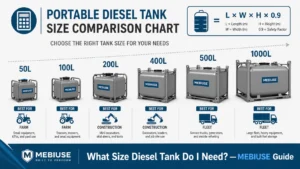
The right choice depends on five factors: your daily diesel consumption, equipment count, handling capacity, transport method, and how often you want to refill. This guide walks through each factor with a side-by-side comparison so you can decide with confidence. For a broader view of portable diesel tank sizes from 50L to 1000L, the portable diesel tank size guide compares every tier, and the C2-01 what size portable diesel tank guide introduces the full 5-factor sizing framework that this article builds on.
Why 200L and 400L Are the Two Most Popular Mid-Capacity Choices
Mid-capacity portable diesel tanks — generally defined as 100L to 500L — are the workhorse tier for portable fuel storage. They sit between small portable tanks (50–100L, used for ATVs, single equipment, marine) and large bulk tanks (500L+, used for mining, harvest, and remote sites).
Within mid-capacity, 200L and 400L dominate for three reasons:
- 200L is the practical lower limit for serious farm and contractor use. It holds enough diesel for a few days of typical operation, fits in a pickup bed, and can be carried by two people when empty. It is the most popular “starter” mid-capacity tank.
- 400L is the practical upper limit before handling becomes a problem. It still fits in a flatbed trailer or reinforced pickup, and many sites can deploy it without permanent installation. It is the most popular “step-up” mid-capacity tank.
- Both fall under the EU ADR 450L exemption for diesel transport on public roads, meaning no dangerous goods marking required for typical use. This makes them easier to ship and deploy than 500L+ tanks.
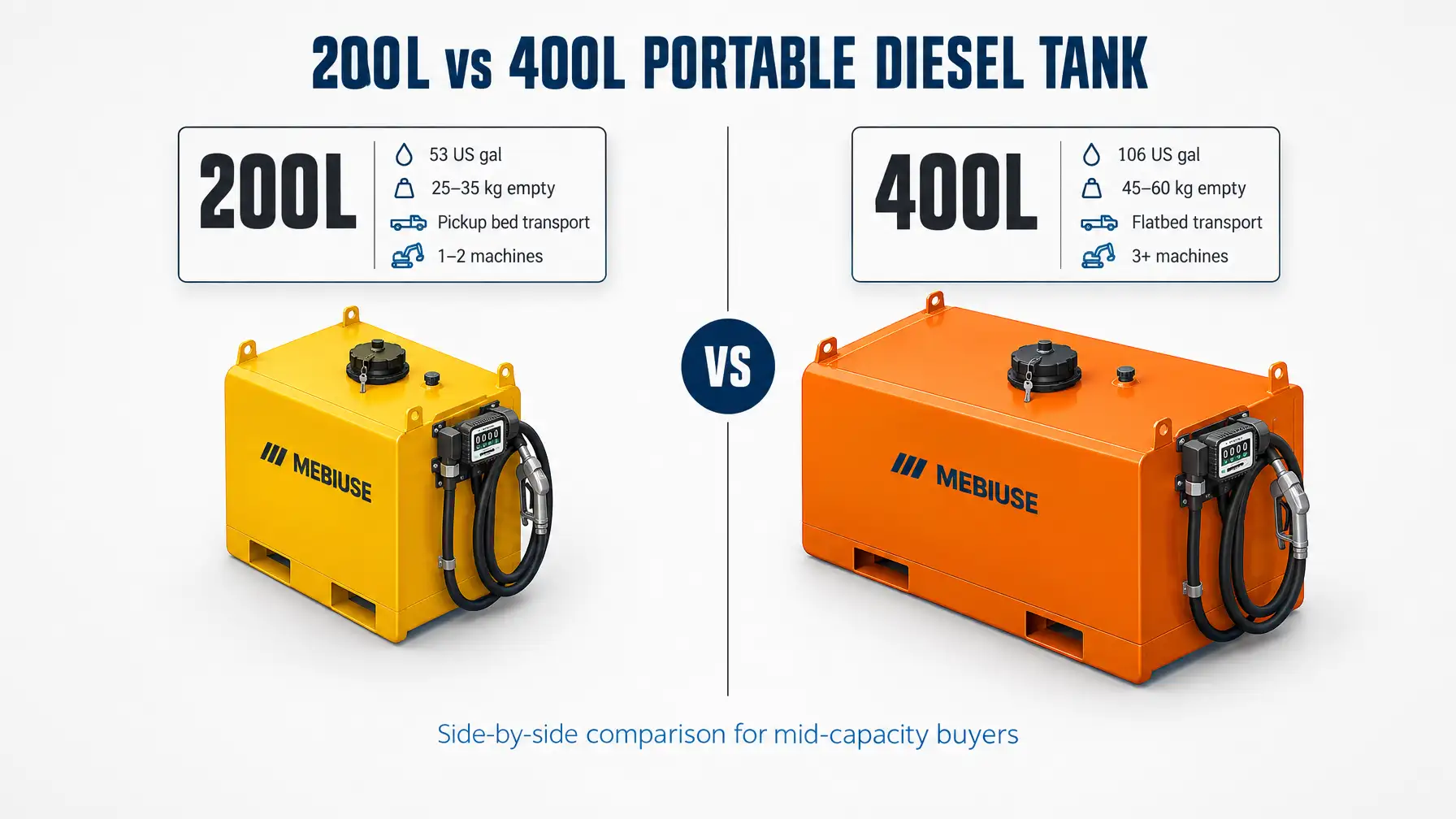
The 5 Decision Dimensions for Choosing Between 200L and 400L
Use these five dimensions to land on the right size for your use case.
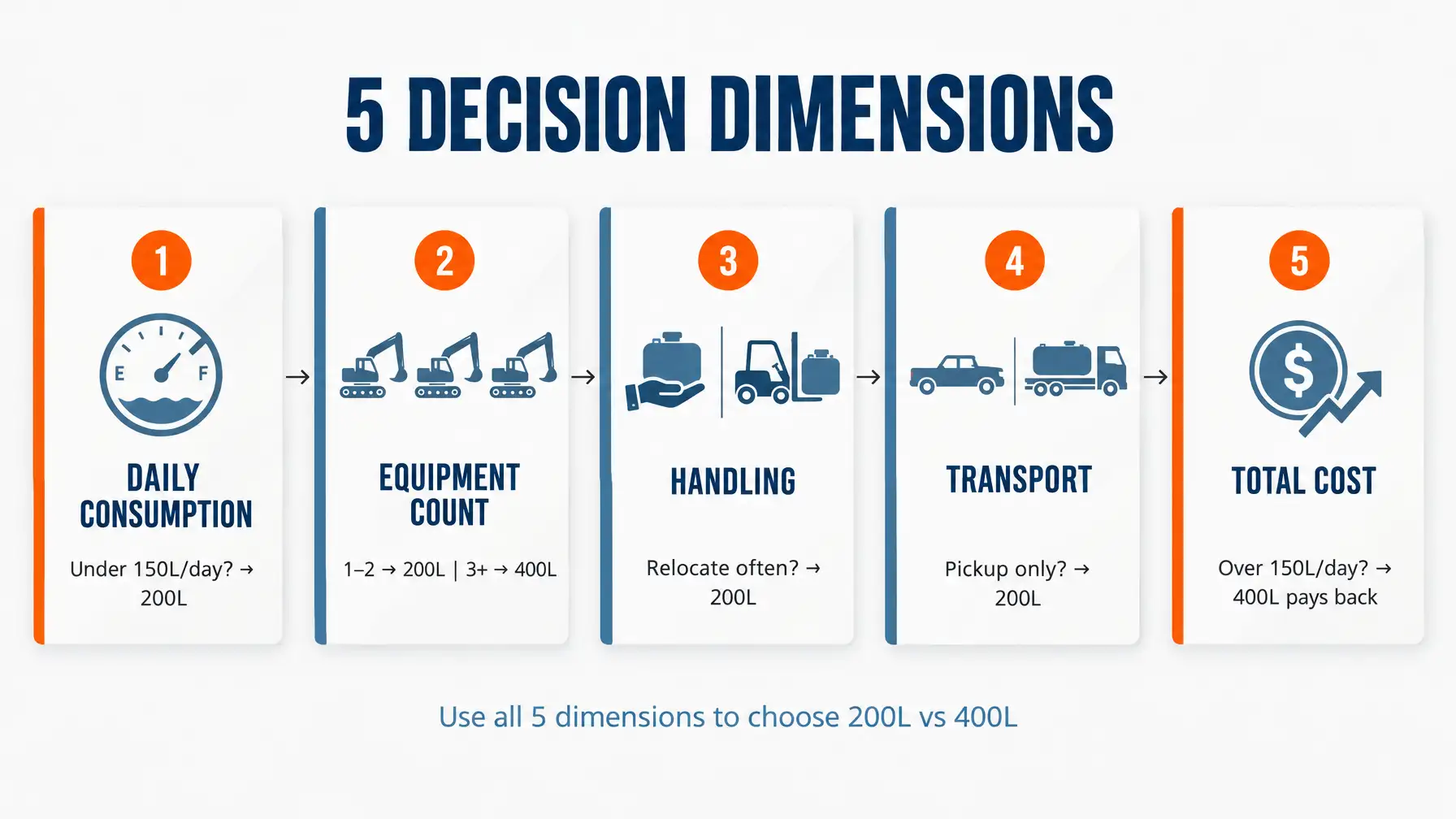
Dimension 1: Daily Diesel Consumption
Your daily diesel consumption is the single most important factor.
- 200L tank supports daily consumption up to about 150L (typical 2–3 day refill cycle).
- 400L tank supports daily consumption up to about 300L (typical 1–2 day refill cycle for high-use sites).
Quick rule: if you consume under 150L per day, 200L is enough. Between 150–300L, 400L is the better fit. Above 300L, consider 500L or 1000L.
Dimension 2: Equipment Count and Refueling Frequency
How many machines need refueling, and how often?
- 200L is ideal for 1–2 machines on a typical work cycle. A single excavator with a 300L tank can be refueled twice from a 200L storage tank before the storage tank needs refilling.
- 400L is ideal for 3+ machines or a fleet running short shifts. A row of 3–5 vehicles can be refueled from a 400L tank without the operator needing to refill the storage tank mid-day.
Dimension 3: Handling and Relocation
How often will you move the tank, and what equipment do you have?
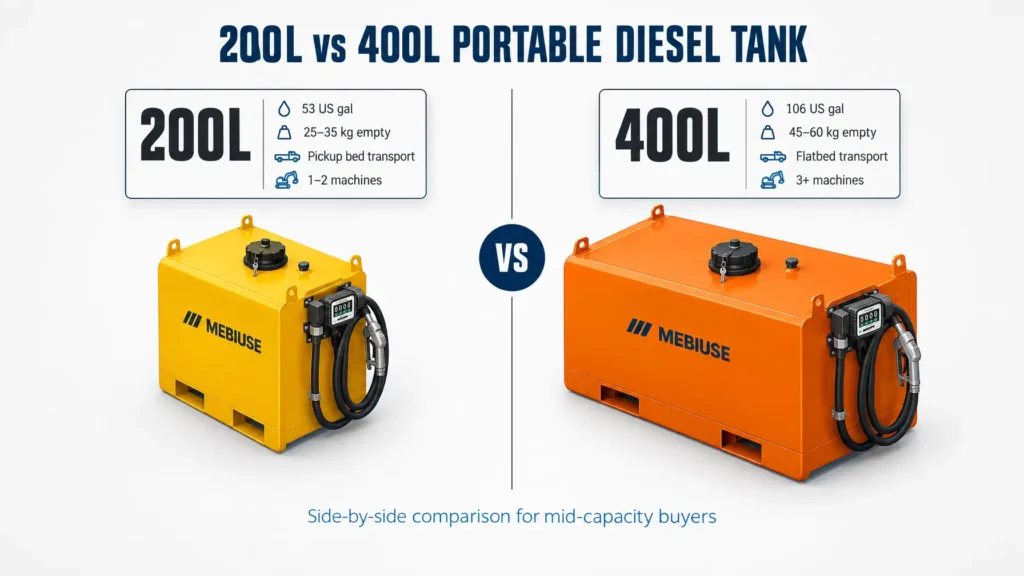
- 200L weighs 25–35 kg empty and can be carried by two people or moved with a hand truck. It is comfortable for daily or weekly relocation.
- 400L weighs 45–60 kg empty and 445–460 kg when full. Moving it requires a forklift, pallet jack, or trailer. It is best for sites where you deploy the tank once and leave it for weeks.
If your operation requires frequent tank relocation (e.g., between fields, between job sites), 200L is the more practical choice. If you have a semi-permanent setup, 400L is fine.
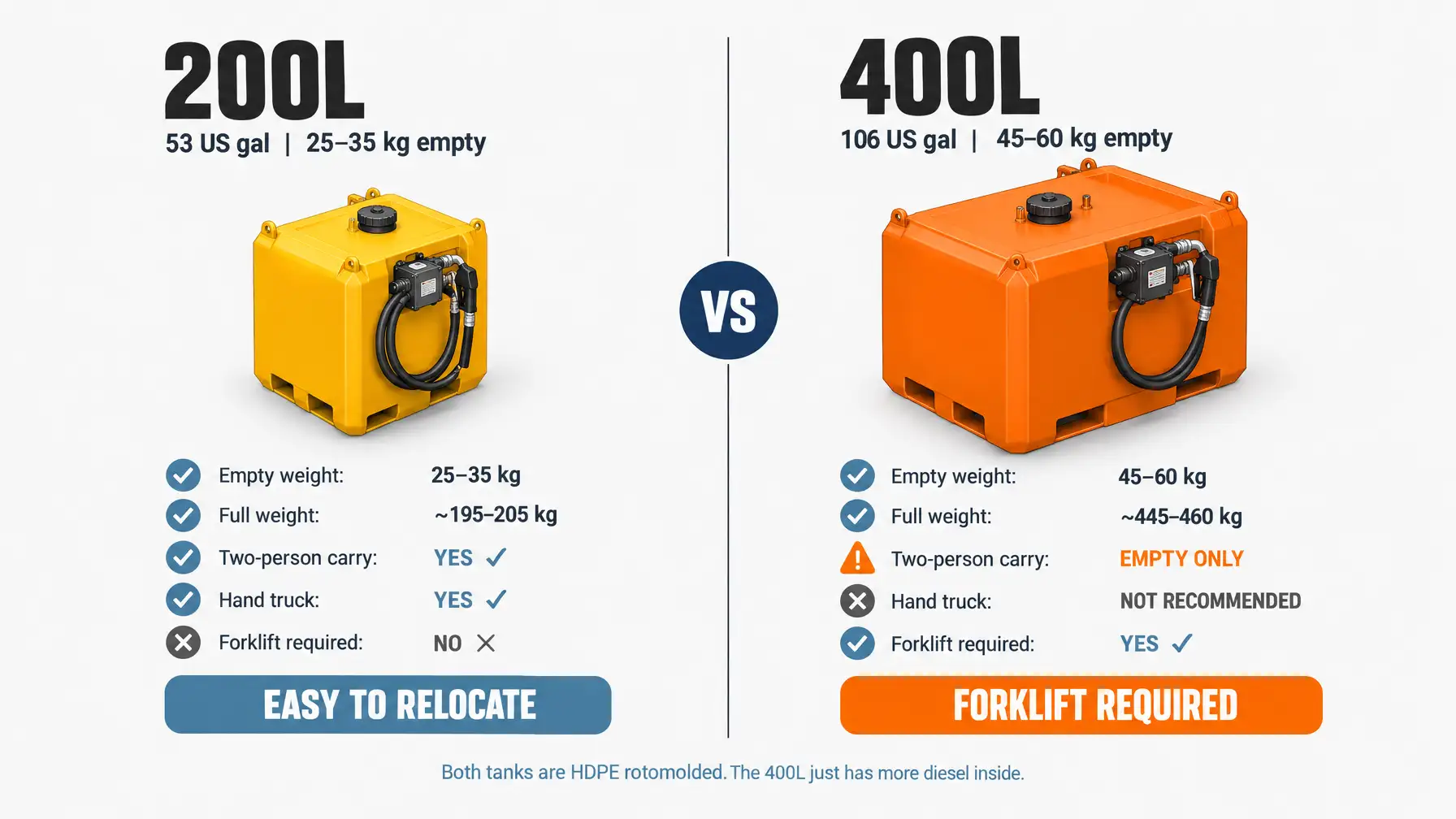
Dimension 4: Transport and Road Rules
How will you get the tank to the site?
- 200L fits in a standard pickup bed and can be transported without special permits in most jurisdictions. The total weight (tank + diesel) is around 200 kg, well within most pickup payload limits.
- 400L weighs 445–460 kg when full, requiring a flatbed trailer or a pickup with reinforced suspension. It still falls under the EU ADR 450L exemption for diesel transport, so no dangerous goods marking required.
Both tanks can be shipped internationally in standard containers when empty (nested or palletized).
Dimension 5: Upfront Cost vs Total Cost
The cost calculus is more nuanced than it looks.
- 200L has a lower upfront cost (typically 55–60% the cost of a 400L tank) and is the budget-friendly choice for first-time buyers.
- 400L has a higher upfront cost but lower cost-per-liter of capacity. If your daily consumption exceeds 150L, the 400L tank saves money on fuel truck delivery fees within 6–12 months — enough to justify the higher upfront cost.
The rule: under 150L/day = 200L is more cost-effective; over 150L/day = 400L pays for itself.
200L Portable Diesel Tank: Strengths and Best Use Cases
A 200L portable diesel tank is the most popular mid-capacity choice globally. It strikes the right balance between capacity, handling, and cost for the majority of small-to-mid operations.
Strengths:
- Lower upfront cost (~55–60% of a 400L tank)
- Easy to handle — two-person carry when empty, fits on a standard pallet
- Fits in a pickup bed for transport
- Lower MOQ (50–100 units typical) — easier for smaller buyers
- Adequate capacity for 2–3 day refill cycle under typical use
Best use cases:
- Single-tractor farms (1 tractor, low-to-moderate daily use)
- Weekend contractors and small construction sites
- Single excavator or generator backup
- 1–2 vehicle small fleets
- Agricultural cooperatives with low daily consumption
Limitations:
- Requires refilling every 2–3 days under typical use (or daily at high consumption)
- Not enough for 3+ machine sites or large farm operations
For detailed specs and ordering information, see the 200L portable diesel tank with pump guide.
400L Portable Diesel Tank: Strengths and Best Use Cases
A 400L portable diesel tank is the practical upgrade when daily consumption or equipment count outgrows a 200L tank. It is the most popular step-up choice for mid-size operations.
Strengths:
- Roughly doubles your fuel reserve between refills vs 200L
- Lowers refilling frequency — fewer fuel truck deliveries
- Cost-per-liter of capacity is lower than 200L
- Adequate for multi-machine sites and small fleets
Best use cases:
- Mid-size farms running 2–3 tractors or one harvester
- Construction sites with 3+ excavators or loaders
- Small fleets (3–5 vehicles) with central fuel point needs
- Agricultural cooperatives with moderate daily consumption
- Industrial sites with multiple generators
Limitations:
- Higher upfront cost
- Requires forklift or pallet jack for relocation
- Full tank weighs 445–460 kg — not practical to move by hand
- Larger footprint — needs more storage space
For detailed specs and ordering information, see the 400L diesel transfer tank guide.
Side-by-Side Comparison (200L vs 400L)
| Specification | 200L | 400L |
|---|---|---|
| Nominal capacity | 200 L (53 US gal) | 400 L (106 US gal) |
| Empty weight | 25–35 kg | 45–60 kg |
| Full weight (with diesel) | ~195–205 kg | ~445–460 kg |
| Material | UV-stabilized HDPE, rotomolded | UV-stabilized HDPE, rotomolded |
| Wall thickness | 6–10 mm | 8–12 mm |
| Dimensions (typical L × W × H) | ~1100 × 600 × 700 mm | ~1400 × 800 × 850 mm |
| Relocation method | Two-person carry / hand truck | Forklift / pallet jack / trailer |
| Transport | Pickup bed | Flatbed trailer / reinforced pickup |
| Road rules (EU ADR) | Under 450L exemption | Under 450L exemption |
| Pump flow rate (typical) | 40–60 L/min | 40–60 L/min |
| Daily consumption sweet spot | Up to 150L/day | 150–300L/day |
| Refill frequency (typical use) | Every 2–3 days | Every 1–2 days |
| Best for | 1–2 machines, simple handling | 3+ machines, fewer refills |
| MOQ (standard config) | 50–100 units | 50–100 units |
| Lead time (standard config) | 15–25 days | 15–25 days |
| Per-unit cost (relative) | ~55–60% of 400L | 100% (baseline) |
| Cost per liter of capacity | Higher | Lower |
| Upgrade path | Can pair with second 200L tank | Upgrade to 500L or 1000L when needed |
When to Upgrade from 200L to 400L
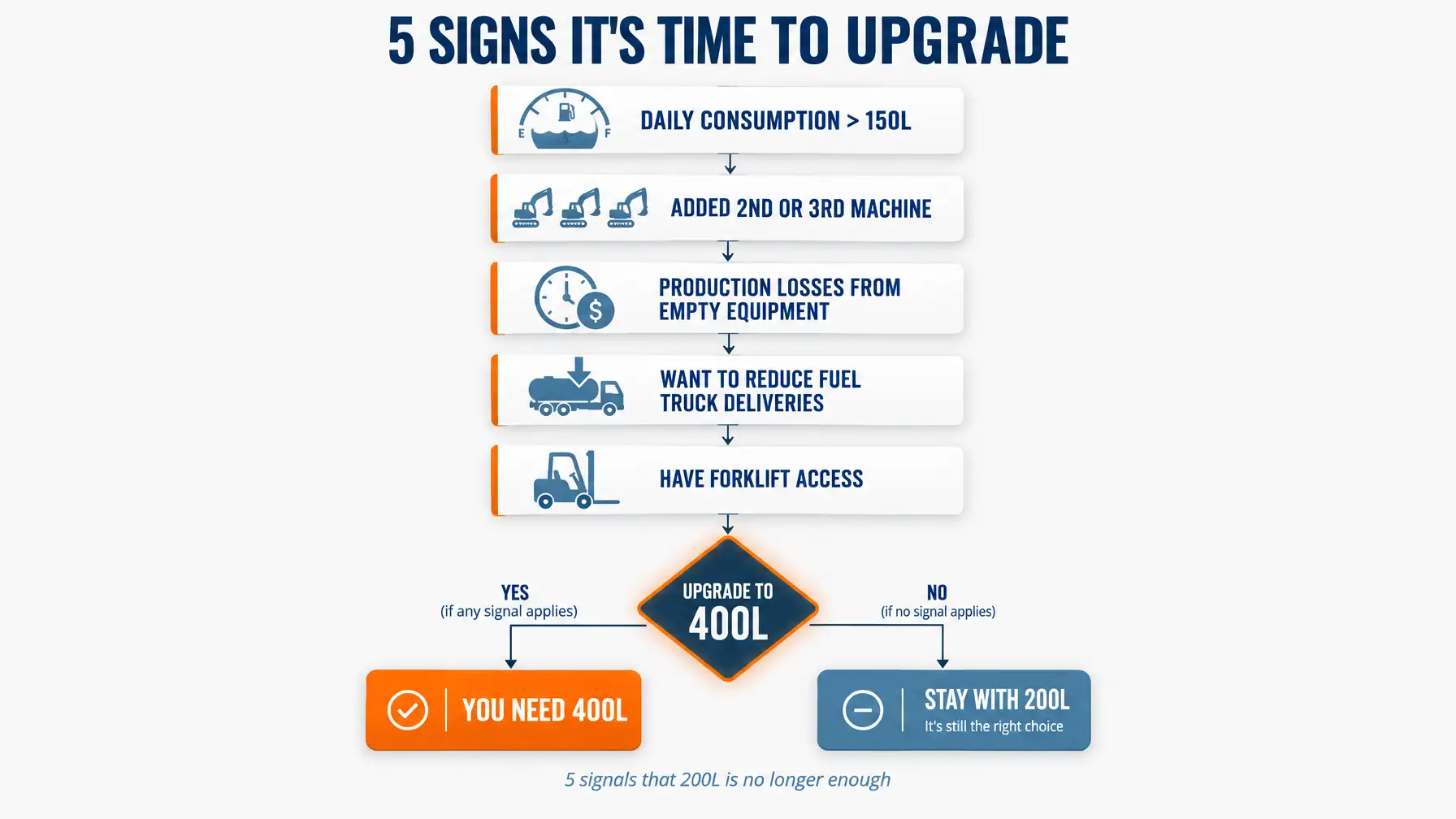
Five concrete signals tell you it’s time to upgrade from 200L to 400L:
- Daily consumption crosses 150L. You’re refilling the 200L tank every day or every other day, and the cost of refill trips adds up.
- You added a second or third piece of equipment. Two or three machines on a 200L tank creates a daily refill cycle that’s hard to sustain.
- Production losses from empty equipment become noticeable. Operators spend time driving to the fuel source instead of working, or equipment runs out of fuel mid-shift.
- You want to reduce fuel truck deliveries. A 400L tank typically halves the number of deliveries vs a 200L tank, which saves delivery fees and reduces site disruption.
- You have forklift access. If your site has a forklift or pallet jack, the 400L tank’s handling limitations disappear, making it a practical upgrade.
If none of these signals apply, your 200L tank is still the right choice — don’t upgrade just because a bigger tank exists.
For a broader view of capacities below 200L, see our 50L vs 100L portable diesel tank guide. For pump and accessory comparisons across sizes, see the portable diesel tank pump comparison.
How MEBIUSE Supports Both Choices
MEBIUSE has manufactured portable diesel tanks for 15+ years and supplied customers in 30+ countries. For buyers choosing between 200L and 400L, MEBIUSE offers:
- 200L standard SKU — ready-to-ship configurations in standard colors (black, yellow, white) with pump and meter options pre-installed.
- 400L standard SKU — same color and configuration options, designed for mid-size operations.
- OEM customization — custom color, logo printing, branded packaging, and accessory bundling across both sizes. See the OEM portable diesel tank customization guide for details.
- Flexible MOQ — sample units for evaluation, standard MOQ for production orders, fleet-contract terms for repeat buyers.
- Global export support — UN certification, MSDS, and shipping documentation for cross-border orders.
For pricing, MOQ confirmation, or OEM scoping, contact our sales team with your specifications and target quantity.
Frequently Asked Questions
Is a 200L or 400L portable diesel tank better?
Neither is universally better — it depends on your daily consumption and equipment count. A 200L tank is the right choice for daily diesel use up to about 150L (e.g., single tractor, small contractor, single excavator site). A 400L tank is the right choice for daily consumption between 150–300L (e.g., mid-size farm with multiple tractors, 3+ equipment site, small fleet). The decision framework is: 200L = simpler handling + lower cost; 400L = fewer refills + more uptime. Use the portable diesel tank size guide or C2-01 what size portable diesel tank guide for a full sizing framework, or contact MEBIUSE for a recommendation.
What’s the difference between a 400L and 200L portable diesel tank?
The main differences are capacity, weight, handling, and refill frequency. A 200L tank holds 200L of diesel and weighs 25–35 kg empty — it can be carried by two people and fits on a standard pallet. A 400L tank holds 400L and weighs 45–60 kg empty — it requires a forklift or pallet jack for relocation. Both have the same approximate dimensions in width and height, but the 400L is longer to accommodate the extra capacity. The 400L tank roughly doubles your fuel reserve between refills, which is the main practical advantage. For detailed specs, see the 200L portable diesel tank with pump guide and the 400L diesel transfer tank guide.
Is a 200L diesel tank enough for a mid-size farm?
For a mid-size farm running 1–2 tractors and a small amount of other equipment, a 200L tank is typically sufficient if daily diesel use stays under 150L. That gives you a 2–3 day refill cycle under typical use. If your farm runs multiple tractors, a harvester, irrigation pumps, or grain dryers, you’ll likely need a 400L tank or even larger. The general rule is that 200L works for farms with up to about 1,500–2,000L of monthly diesel consumption. Above that, step up to 400L. The farm diesel transfer tank buying guide walks through farm sizing in detail.
Does a 400L portable diesel tank need a forklift?
Yes, in most cases. A 400L tank weighs 45–60 kg empty and 445–460 kg when full of diesel (diesel density ~0.85 kg/L). Moving a full 400L tank requires a forklift, pallet jack, or trailer. Moving it empty can sometimes be done by two people on a flat surface using the integrated forklift slots, but it’s not comfortable for regular handling. By comparison, a 200L tank weighs 25–35 kg empty and can be carried by two people comfortably, even when partially full. If your site requires frequent relocation, the 200L tank is the more practical choice. If you can deploy the tank once and leave it, the 400L is fine.
Can a 200L or 400L portable diesel tank be transported on public roads?
Yes, in most jurisdictions both 200L and 400L tanks fall under the EU ADR 450L exemption for diesel transport, meaning they do not require full dangerous goods marking for public road transport. They are typically transported in a pickup bed (200L) or flatbed trailer / pickup with reinforced suspension (400L). Always confirm local rules before transport — in some countries or states, additional placards or driver certifications may apply. For international shipping, UN-certified tanks with proper MSDS documentation are required. MEBIUSE provides transport documentation for all orders and can advise on cross-border requirements.
Is it worth upgrading from a 200L to a 400L portable diesel tank?
Upgrading from 200L to 400L makes sense when daily consumption exceeds 200–250L, you have multiple pieces of equipment that need refueling, or you’re spending too much time on daily refills. The 400L tank roughly doubles your fuel reserve between refills, which reduces fuel truck delivery fees, refueling downtime, and production losses from empty equipment. The trade-off is higher upfront cost, harder handling (forklift required), and larger footprint. A common upgrade pattern is to buy a 200L tank first and add a 400L tank 6–12 months later when operations scale. Both tanks can be deployed in parallel for very high-consumption sites.
What’s the MOQ for 200L or 400L portable diesel tanks?
MOQ for both 200L and 400L standard-configuration portable diesel tanks is typically 50–100 units, with 15–25 day lead time after order confirmation. Custom configurations (OEM color, logo, branded packaging, custom pump specifications) typically require MOQ 50–100 units and add 10–20 days to lead time. For first-time buyers, sample units (1–5 pcs) are usually available at a higher per-unit cost to verify quality before committing to full MOQ. MEBIUSE offers flexible MOQ terms for repeat buyers and fleet contracts. For specific MOQ and lead time, contact our sales team with your size and configuration requirements.
Which is more cost-effective, a 200L or 400L portable diesel tank?
Cost-effectiveness depends on what you’re measuring. Per-unit cost is typically 70–85% higher for a 400L tank than a 200L tank — so if you only need 200L of capacity, the 400L is “wasted money” in upfront terms. But cost-per-liter is lower for a 400L tank, and if you refill less often, you save on delivery fees and labor. The break-even calculation: if your daily consumption is over 150L, the 400L tank saves you enough on refill trips to justify the higher upfront cost within 6–12 months. Below 150L/day, the 200L tank is more cost-effective. The portable diesel tank buying guide: 15 questions covers full cost analysis.
Official Sources
- MEBIUSE Official Website
- MEBIUSE C2 Pillar: Portable Diesel Tank Size Guide
- MEBIUSE C1 Pillar: Portable Diesel Fuel Tanks Guide
- MEBIUSE C8 Pillar: OEM/ODM Portable Fuel Tanks
- MEBIUSE C2-01 Hub: What Size Portable Diesel Tank
- MEBIUSE C2-05: 200L Portable Diesel Tank with Pump
- MEBIUSE C2-08: 400L Diesel Transfer Tank Guide
- MEBIUSE C2-09: 500L Heavy-Duty Diesel Transfer Tank
- MEBIUSE C2-10: 1000L Portable Fuel Storage Tank
- MEBIUSE C3 Hub: Farm Diesel Transfer Tank
- MEBIUSE C4 Hub: Construction Site Diesel Tank
- MEBIUSE Contact / Request Quote
- Plastic Tank Companies — Plastic Fuel Tanks Overview
- LyondellBasell — Rotomolding Resin Technology
- ExxonMobil Chemical — HDPE Resin Guide
- Asian Sourcing Group — How to Verify Chinese Factories
This guide is published by MEBIUSE, a portable diesel tank manufacturer with 15+ years of experience supplying HDPE fuel storage solutions to customers in 30+ countries. MEBIUSE specializes in portable diesel tanks from 50L to 1000L, custom OEM configurations, and global export support. For sizing recommendations, OEM scoping, or distributor pricing, contact MEBIUSE.