What Is a 300L Farm Diesel Tank?
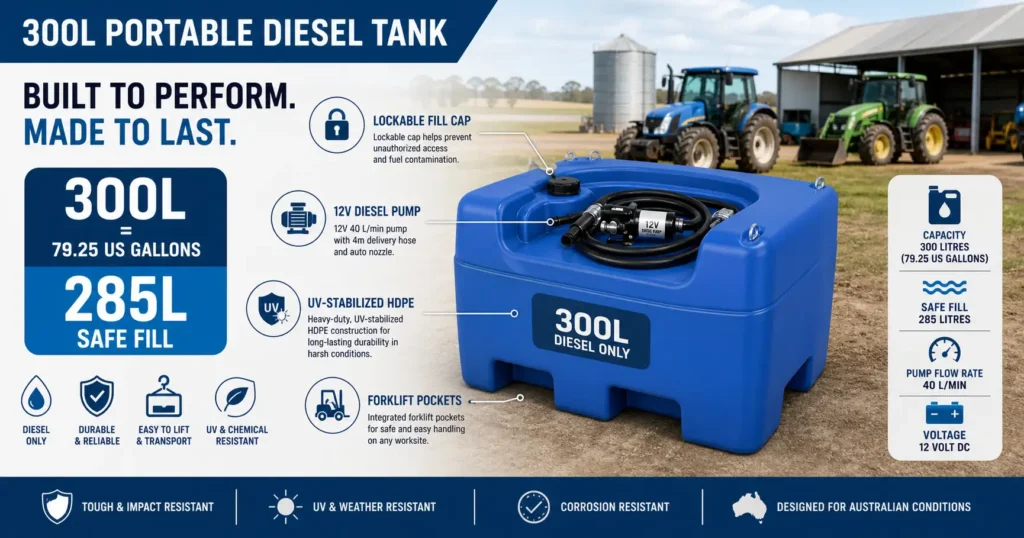
A 300L farm diesel tank is a portable fuel storage vessel designed for small-to-medium agricultural operations, sitting between compact 200L units and mid-range 400L tanks. At 300 liters (79.25 US gallons / 65.99 Imperial gallons), it provides a practical balance of capacity and portability for farms running 2–4 pieces of equipment — tractors, generators, and irrigation pumps — within typical daily runtime patterns.
The 300L tank delivers approximately 285 liters of safe fill capacity (95% for thermal expansion), weighs roughly 42 kg empty (HDPE construction), and commonly measures 1000 mm × 700 mm × 650 mm. When fully fueled it weighs approximately 327.5 kg — manageable for manual positioning on level ground when empty, but requiring two people or forklift access when full.
This guide covers when a 300L farm diesel tank is the right choice, compares it against 200L and 400L alternatives for agricultural use, and provides a decision checklist to match tank capacity to your specific farm equipment, acreage, and refueling logistics.
When Does 300L Make Sense for Your Farm?
Choosing the right capacity means matching tank size to your specific operational patterns. The 300L tier fills a critical gap for farmers who find 200L too small but don’t need the step-up to 400L.
Decision Criteria for 300L Selection
Choose 300L when your farm meets these conditions:
| Factor | 300L Ideal Range | Notes |
|---|---|---|
| Farm size | 50–300 acres (20–120 hectares) | Australia, North America |
| Equipment count | 2–4 machines simultaneously | Tractors, generators, pumps |
| Equipment HP range | 50–200 HP | Typical small-to-medium farm |
| Daily runtime | 2–8 hours combined | Full work cycle coverage |
| Bulk fuel distance | Within 30 minutes | Not remote; bulk supply accessible |
| Primary power source | 12V vehicle battery | Most farm vehicles |
Avoid 300L when:
- Your operation exceeds 500 acres with 5+ heavy machines
- Equipment runs above 200 HP for full shifts
- Bulk fuel supply is more than 1 hour away (consider larger tank)
- You run multiple combine harvesters during peak harvest
Typical 300L Farm Profile
A farm that benefits most from 300L capacity typically runs:
- 1–2 main tractors (80–150 HP class)
- 1 standby generator (10–30 kW)
- 1 irrigation pump (50–100 HP)
Combined consumption of 15–25 L/hr means 300L (285L safe fill) covers 11–19 hours — sufficient for one to two full workdays without refilling.
Real-World Scenario: Mixed Crop Farm
Consider a 200-acre mixed crop farm in Queensland, Australia:
- John Deere 6155M (155 HP, 18 L/hr)
- Case IH Farmall 95 (95 HP, 12 L/hr)
- 20 kW standby generator (5 L/hr)
Daily combined consumption: 18 + 12 + 5 = 35 L/hr
300L coverage: 285L ÷ 35 L/hr = 8.1 hours
This farm can run a full workday with power to spare. The 300L tank means one refill covers the work week — not daily trips.
300L vs 200L vs 400L: Farm Capacity Comparison
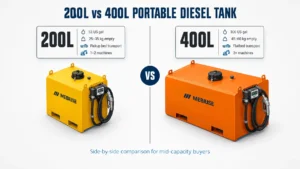
The 300L sits between compact and mid-range options. Understanding the differences helps you select the right capacity for your operation.
Capacity Comparison Table
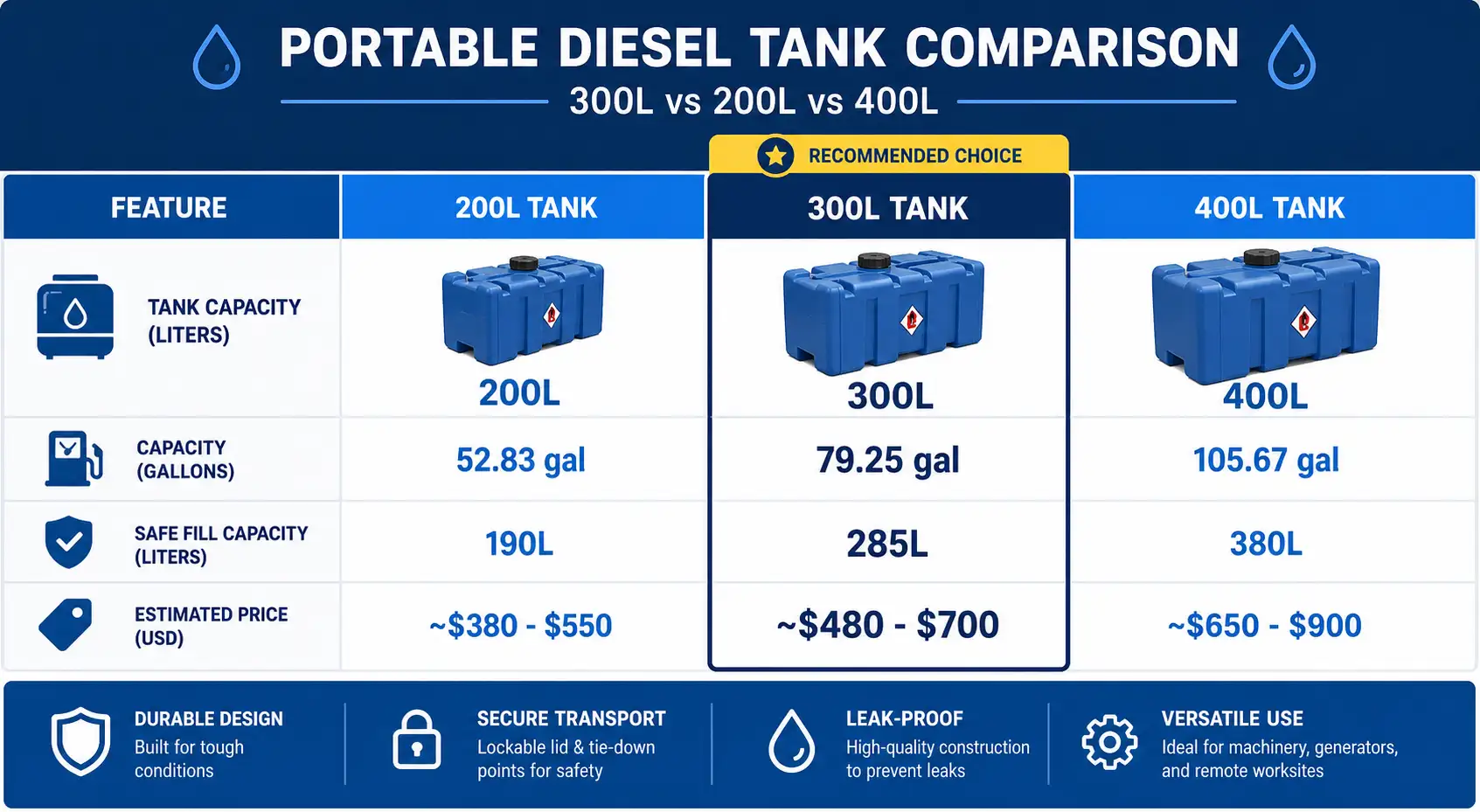
| Factor | 200L Tank | 300L Tank | 400L Tank |
|---|---|---|---|
| US Gallons | 52.83 gal | 79.25 gal | 105.67 gal |
| Safe Fill (95%) | 190 L | 285 L | 380 L |
| Empty Weight | ~32 kg | ~42 kg | ~53 kg |
| Full Weight | ~201 kg | ~327.5 kg | ~391 kg |
| Best for | <100 HP, single tractor | 50–200 HP, 2–4 machines | 150–300 HP, 4–6+ machines |
| Refill frequency | 3–5 days | 5–10 days | 7–14 days |
| Recommended pump | 12V / 40 L/min | 12V / 40 L/min | 24V / 60 L/min |
| OEM FOB China | $380–550 | $480–700 | $650–900 |
For detailed 200L specifications, see our 200L portable diesel tank with pump guide. For larger operations, our 400L diesel transfer tank guide covers mid-range capacity options.
Why Not Just Go Bigger?
A common question: why not choose 400L instead of 300L for extra capacity?
Arguments for 400L:
- Less frequent refilling
- Better for larger operations
Arguments for 300L:
- 40–50% lower cost
- Easier manual positioning
- Adequate for typical small-to-medium farms
- No need for 24V pump infrastructure
The 300L is not about compromise — it’s about right-sizing for your actual operational profile. If your daily consumption genuinely exceeds 40 L/hr, 400L makes sense. For most small-to-medium farms, 300L hits the sweet spot.
Best Farm Applications for 300L Tanks
Tractor Refueling: The Core Use Case
The 300L tank excels at keeping tractors fueled without constant refueling trips. With equipment ranging from compact 50 HP tractors to mid-range 150 HP machines, a 300L tank covers most single-day operations.
Runtime by tractor class:
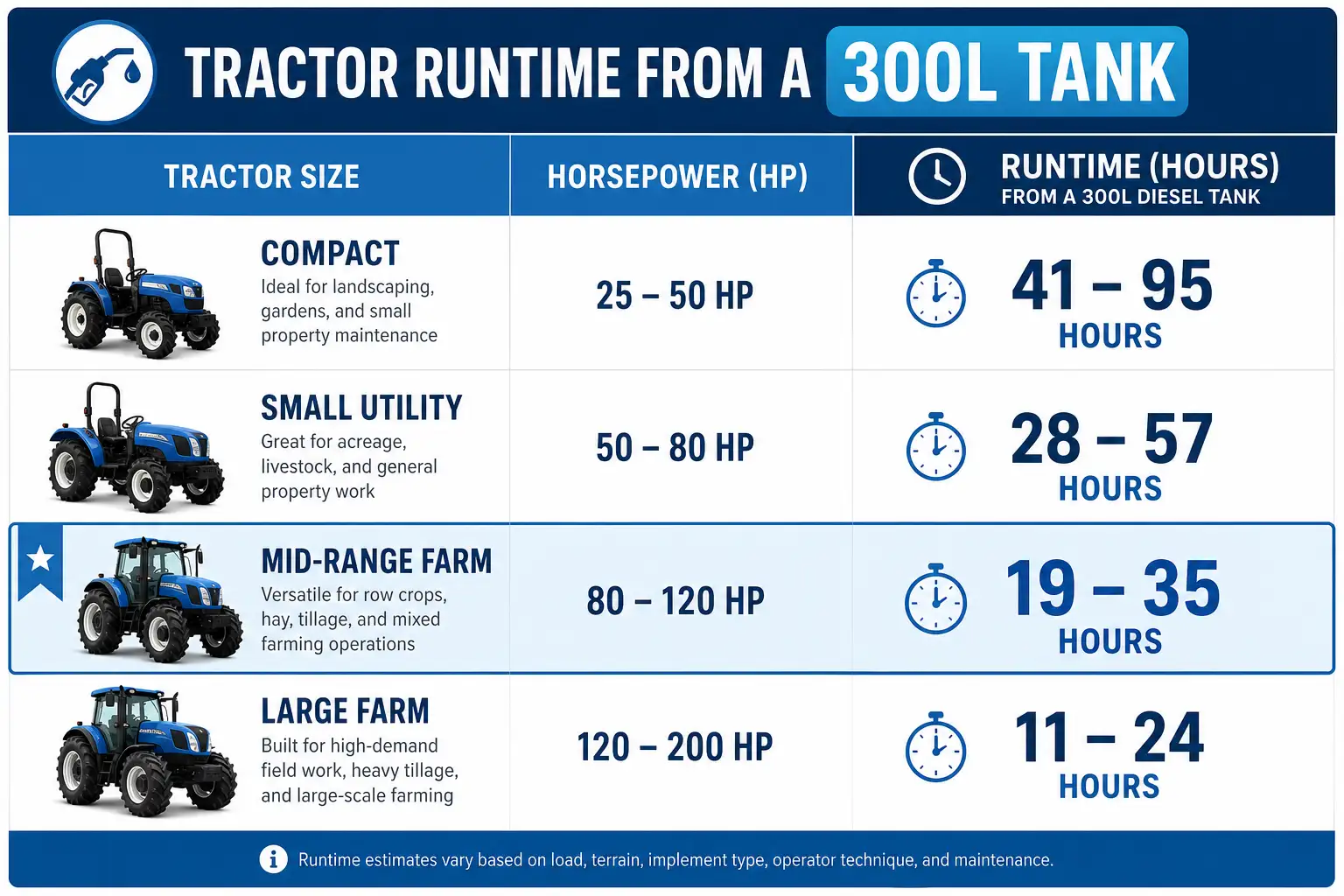
| Tractor Class | HP Range | Typical Consumption | 300L Runtime |
|---|---|---|---|
| Compact / Sub-compact | 25–50 HP | 3–7 L/hr | 41–95 hours |
| Small utility | 50–80 HP | 5–10 L/hr | 28–57 hours |
| Mid-range farm | 80–120 HP | 8–15 L/hr | 19–35 hours |
| Large farm | 120–200 HP | 12–25 L/hr | 11–24 hours |
For the majority of Australian and North American small-to-medium farms running 80–150 HP tractors, 300L provides full-day to multi-day coverage.
Generator and Irrigation Pump Support
Farms with standby generators or irrigation systems benefit from dedicated 300L tanks positioned at these fixed locations. A 20–30 kW generator consuming 5–8 L/hr can run 35–57 hours on a single 300L fill.
For irrigation pumps in the 50–100 HP range (10–20 L/hr consumption), 300L delivers 14–28 hours of continuous operation — covering most single-day irrigation schedules.
Seasonal Harvest Operations
During harvest, combined equipment operation increases fuel demand significantly. A 300L tank works well when:
- Running one main harvester or combine (150–180 HP)
- Supporting grain carts and tractors (100–150 HP each)
- Backup generator running for grain drying
The 300L won’t replace a bulk tank during peak harvest, but it reduces bulk refill frequency and provides operational flexibility across the property.
Key Features to Look for in a Farm Diesel Tank
When selecting a 300L tank for farm use, prioritize these features:
Essential Features
| Feature | Why It Matters |
|---|---|
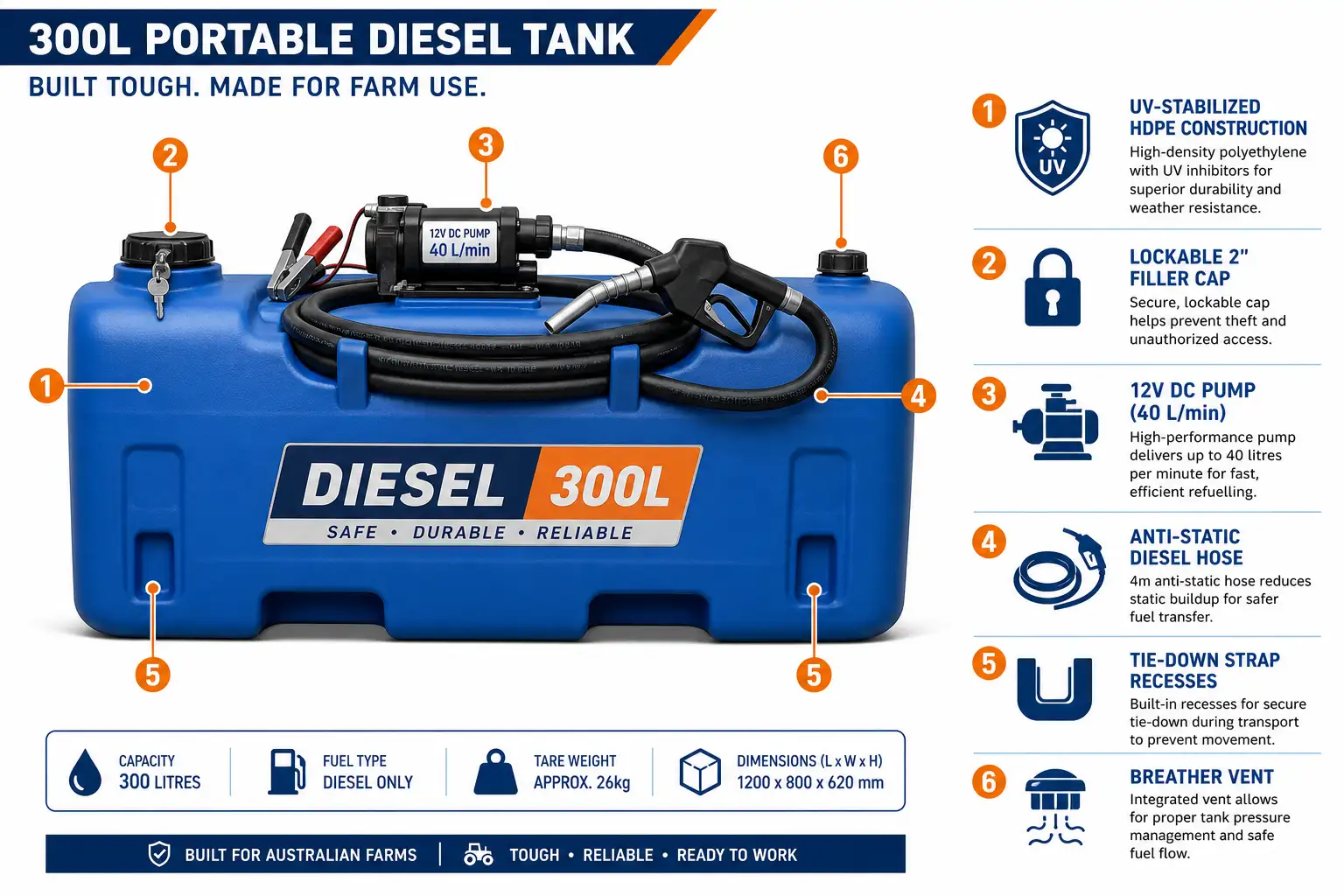
| UV-stabilized HDPE construction | Farms typically store tanks outdoors; UV protection prevents degradation |
| Lockable 2″ filler cap | Security against fuel theft — a genuine concern on rural properties |
| 12V DC pump (40 L/min) | Compatible with standard farm vehicle batteries |
| Anti-static diesel hose | Prevents static discharge during refueling |
| Breather vent | Prevents vacuum locks and pressure buildup |
| Tie-down strap recesses | Secure transport on truck beds or trailers |
Recommended Features
| Feature | Why It Helps |
|---|---|
| 2-side forklift pockets | Allows mechanical repositioning when needed |
| Lockable pump cover | Protects dispensing equipment from weather and tampering |
| Built-in handles | Eases manual positioning on flat surfaces |
| Earth strap connection point | Grounding during fill operations |
Certifications to Confirm
- CE marking for European markets
- ISO 9001 quality management certification
- ADR compliance if transporting diesel on European roads (>450L triggers regulations)
For Australian farmers, verify compliance with Safe Work Australia guidelines for fuel storage on agricultural properties (source: Safe Work Australia).
OEM Customization and Quote Request
For distributors, agricultural cooperatives, and large-scale farming operations purchasing 300L tanks in volume, MEBIUSE supports OEM customization including Pantone color matching, logo integration, and branded packaging options.
Typical OEM parameters for 300L tanks:
| Parameter | Specification |
|---|---|
| MOQ | ~50 units |
| Lead time | 15–25 days |
| Custom colors | Full Pantone range |
| OEM FOB China | USD $480–700 per unit |
For a complete procurement walkthrough covering farm tank selection, bulk order pricing, and delivery logistics, see our portable fuel tank manufacturer guide or request a custom quote for 300L farm diesel tank specifications and volume pricing.
Frequently Asked Questions
How many gallons is a 300L diesel tank?
A 300L diesel tank holds approximately 79.25 US gallons or 65.99 Imperial gallons. With a 95% safe fill capacity accounting for thermal expansion, you have 285 liters (75.3 US gallons) of usable fuel. At a typical mid-range tractor consumption of 10–15 L/hr, this provides 19–28 hours of operation (source: NIST standard conversion factors).
Is 300L enough for a small farm?
For farms running 2–4 pieces of equipment (50–200 HP tractors, generators, irrigation pumps) with daily combined runtime of 2–8 hours, 300L covers one full work cycle without daily refilling. A 300L tank is ideal for properties in the 50–300 acre range in Australia and North America. If your operation exceeds 500 acres with heavy equipment running full shifts, consider upgrading to 400L.
What’s the difference between 200L and 300L for farm use?
The key difference is 95 liters of additional safe capacity (285L vs 190L). A 200L tank works best for single small tractors under 100 HP and ute-mounted portable use. A 300L tank better serves operations with 2–4 machines in the 50–200 HP range, reducing refill frequency by roughly 50%.
What size tractor can a 300L tank fuel?
A 300L tank with 285L safe fill can fuel tractors from 25 HP to over 200 HP. For the most common farm tractors (80–150 HP, consuming 8–15 L/hr), you get 19–35 hours of operation. Smaller 50–80 HP tractors at 5–10 L/hr receive up to 57 hours of coverage.
Can a 300L diesel tank be moved by one person?
Empty, a 300L tank (~42 kg) can be moved by one person on level ground. However, when filled with diesel (total ~327.5 kg), two people or forklift access is required. Always use proper lifting technique and never attempt to move a full tank alone.
What pump do I need for a 300L farm diesel tank?
For most farm operations, a 12V DC pump at 40 L/min is the standard choice — compatible with vehicle batteries, delivering a full 285L refill in approximately 7 minutes. If you run commercial equipment with 24V power systems or need faster fill times, upgrade to a 24V model.
Is 300L the right size for irrigation pumps?
Yes — a 300L tank is well-suited for irrigation pump support on small-to-medium farms. For 50–100 HP irrigation pumps consuming 10–20 L/hr, 300L provides 14–28 hours of continuous operation, covering most single-day irrigation cycles.
Official Sources
- MEBIUSE official site
- MEBIUSE Portable Diesel Tank Size Guide (C2 Pillar)
- 200L Portable Diesel Tank with Pump (C2-05)
- 400L Diesel Transfer Tank Guide (C2-08)
- MEBIUSE OEM/ODM Portable Fuel Tanks (C8-01)
- MEBIUSE Contact
- Safe Work Australia — Farm Safety Guidelines
- TTi DieselCadet — Australian Diesel Tank Specifications
- Plastic Tank Companies — HDPE Fuel Tank Material Overview
Further Reading
- Diesel Transfer Tank for Farm Equipment: Complete Buying Guide (C3-01) — Farm-specific purchasing guidance
- Portable Fuel Tank for Small Farms (C3-04) — Small farm capacity selection
- Farm Diesel Refueling Safety Checklist (C3-10) — Safety best practices for farm refueling
- How to Choose the Right Portable Fuel Tank Manufacturer (C8-01) — OEM sourcing guidance
MEBIUSE (Binzhou Shizhou Intelligence Technology Co., Ltd.) | Last reviewed: July 22, 2026 | Published: July 22, 2026
This article is part of the MEBIUSE Portable Diesel Tank Size Guide cluster. For questions about 300L farm diesel tanks, bulk orders, or OEM customization, contact our team.