If you are a distributor, brand owner, or wholesale buyer evaluating private label portable fuel tanks as a new revenue line, this guide walks through the 6-step workflow, MOQ / lead time / cost benchmarks, what can and cannot be customized, and how MEBIUSE — a source factory in Zhejiang and Shandong with 15+ years of OEM/ODM experience — supports distributors running their own brand.
MEBIUSE at a Glance
- Legal entity: Binzhou Shizhou Intelligence Technology Co., Ltd.
- Industry experience: 15+ years in portable fuel tank manufacturing
- Production bases: 2 self-owned facilities in Zhejiang and Shandong
- Material & process: UV-stabilized HDPE with seamless rotomolding
- Certifications: CE & ISO certified
- Quality control: All parts double tested before shipping
- Export reach: 30+ countries, 500+ global clients
- OEM/ODM: Flexible private label, white label, and ODM programs
What Are Private Label Portable Fuel Tanks?
Private label portable fuel tanks are diesel, gasoline, or transfer tanks manufactured by a third-party factory but sold under a retailer’s or brand owner’s own label. The factory designs, molds, and tests the tank; the buyer applies branding, color, and packaging, and owns the customer relationship end-to-end (source: Shopify).
Two adjacent models are often confused:
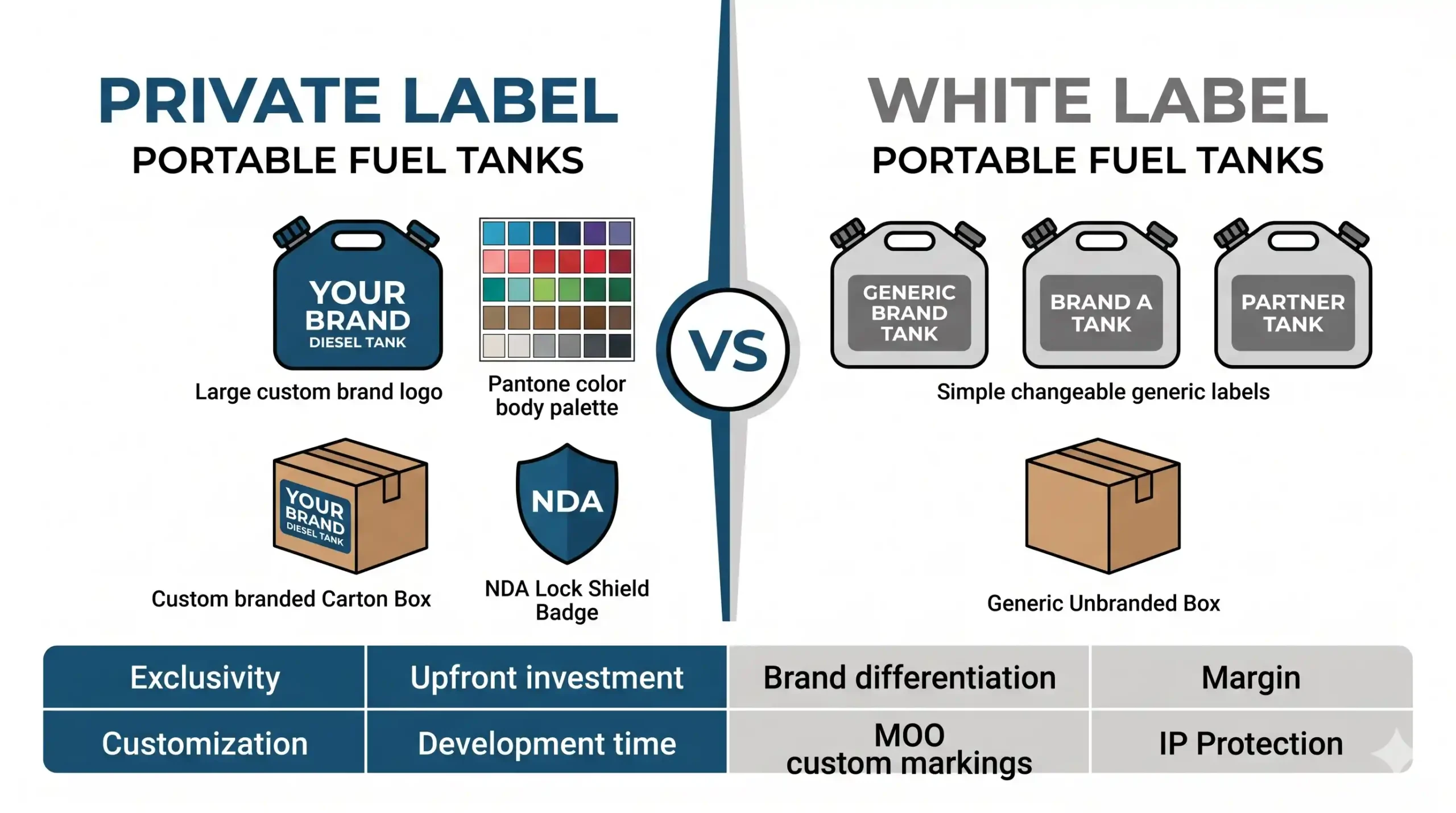
- Private label: product exclusive to one retailer, specifications controlled by that retailer. Higher upfront investment, longer development, stronger differentiation and higher margins (source: Centric Software, Gembah).
- White label: product generic and sold to multiple retailers — only labels and packaging change. Lower cost, faster time-to-market, limited differentiation (source: Shopify, Gembah).
| Attribute | Private Label | White Label |
|---|---|---|
| Exclusivity | Exclusive to one retailer | Sold to multiple retailers |
| Customization | High (specs, branding, packaging) | Branding only (labels, packaging) |
| Upfront investment | Higher (R&D, tooling) | Lower (no R&D) |
| Development time | Longer (8–24 weeks) | Shorter (2–6 weeks) |
| Brand differentiation | Strong | Weak |
| Typical MOQ | ~100 units+ | 50–100 units |
| Pricing margin | Higher margin potential | Lower margin potential |
| IP protection | NDA + contractual exclusivity | None (shared product) |
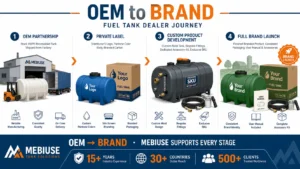
For most distributors with an existing channel in agriculture, construction, fleet, or fuel-handling, private label portable fuel tanks is the stronger route: you own the brand, control specs, and keep the margin otherwise paid to a third-party brand. A common hybrid pattern is to start with stock SKUs or white label, then graduate to private label once volume justifies the mold investment (source: Gembah). See our portable diesel fuel tanks pillar guide and complete OEM guide.
Who Should Consider a Private Label Fuel Tank Program?
A private label program works best for distributors who already have a channel and need a defensible brand asset rather than just inventory:
| Buyer Profile | Why Private Label Makes Sense |
|---|---|
| Regional fuel equipment distributor | Already sells pumps, hoses, fittings; adds higher-margin brand extension. |
| Agricultural / construction retailer | Customers ask for tanks under the store name; private label captures margin. |
| Wholesaler serving overseas markets | Needs exclusive product to compete locally — white label is sold to competitors too. |
| Brand extension from adjacent products | Sells generators, compressors, pressure washers; fuel tank is a logical line. |
If testing demand for the first time, start with stock SKUs or white label; graduate to private label once you have proven repeat orders.
The 6-Step Private Label Portable Fuel Tanks Workflow
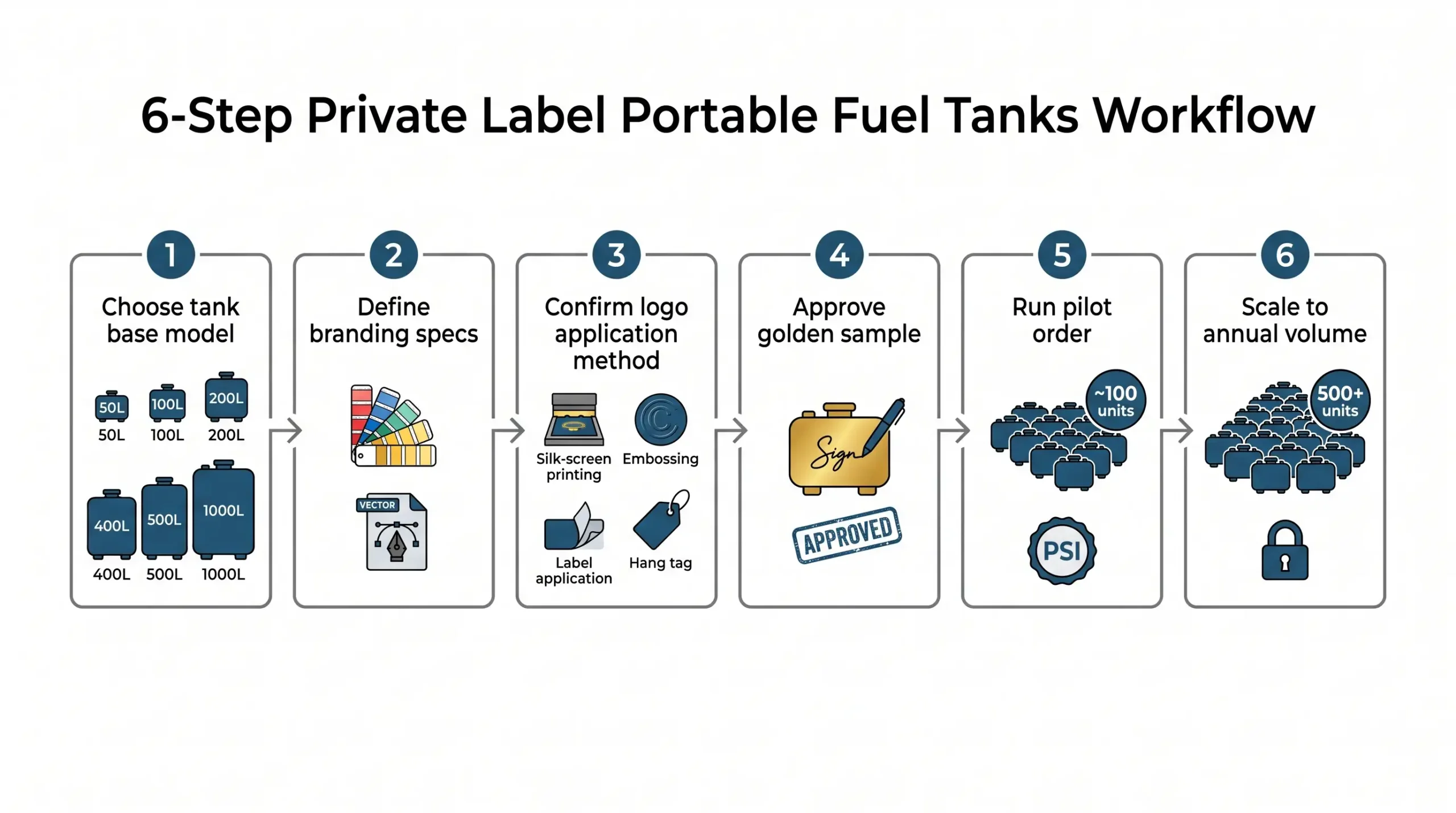
A private label portable fuel tanks program follows 6 sequential stages. Skipping any step creates a gap that surfaces as a production dispute, a color mismatch, or a logo-position argument mid-batch.
Step 1 — Choose Your Tank Base Model
Select a base tank from the manufacturer’s existing mold library — common configurations are 50L, 100L, 200L, 400L, 500L, and 1000L, with or without integrated pump and meter. Existing mold means no mold development cost and faster time-to-market; unique capacity or shape moves to ODM.
For a broader view of the available tank range, see our portable diesel fuel tanks guide. For specific product options, see our 200L portable diesel tank with pump guide — a common base for private label programs.
Step 2 — Define Your Branding Specs
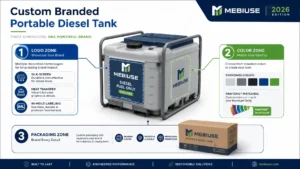
The factory needs a written branding spec covering: tank body color (Pantone / RAL), logo file (vector AI / EPS / PDF with PMS color codes), logo placement, capacity marking, and accessory color. A 1-page spec signed before tooling setup is the cheapest insurance in the workflow.
Step 3 — Confirm Logo Application Method
Four methods apply your logo to a rotomolded HDPE tank:
| Method | Durability | Cost Tier |
|---|---|---|
| Silk-screen printing | High (UV, fuel, abrasion-resistant) | Low–medium |
| Molded-in embossing | Highest (becomes part of tank wall) | Medium |
| Adhesive label | Medium (replaceable) | Low |
| Hang tag / sleeve | Low (replaceable) | Lowest |
Most distributors running their first program start with silk-screen plus a branded hang tag, then upgrade to molded-in embossing once volume supports the engraving investment.
Step 4 — Approve the Golden Sample
The factory produces a pre-production sample (1–5 units) before mass production. The buyer approves this as the “Golden Sample” — the binding reference for all future production. Once signed off, subsequent production is measured against it, giving the buyer contractual grounds to reject any batch that drifts in wall thickness, color ΔE tolerance, or logo position (source: Asian Sourcing Group).
Step 5 — Run the Pilot Order
MOQ for OEM portable diesel fuel tanks is typically around 100 units (source: Xinghui Rotomold, Plastic Tank Companies); a pilot of 100–300 units is the common start. For pilot orders exceeding USD $10,000, engage a third-party for Pre-Shipment Inspection (PSI) — typically 2–3% of order value. For complex OEM orders, DUPRO (During Production) catches defects at 20% complete (source: Asian Sourcing Group).
Step 6 — Scale to Annual Volume
Scale to annual volume under a framework agreement that locks in unit price, capacity reservation, mold ownership terms, QC sampling rate, and packaging continuity. For 500+ units annually, the framework agreement is also when you negotiate brand IP protection: an NDA preventing the factory from selling your exact SKU to other buyers (source: Bancy Solutions). See also our portable fuel tank manufacturer selection framework and diesel fuel tank manufacturer in China buyer checklist.
MOQ, Lead Time, and Cost Structure for Private Label
A private label program has three dimensions: MOQ, lead time, and landed cost.
MOQ Benchmarks
| Program Type | Typical MOQ | Notes |
|---|---|---|
| Stock-SKU rebrand (logo only) | 50–100 units | Fastest path to market |
| Custom color on existing mold | 100–200 units | Includes Pantone / RAL color matching |
| Custom mold (ODM) | 200–500+ units | Includes mold development cost |
| Annual framework agreement | 500+ units / year | Locked pricing, capacity reservation |
Lead Time Breakdown
| Stage | Duration | Notes |
|---|---|---|
| Branding spec preparation | 1–2 weeks | Artwork file prep, color codes |
| Golden Sample approval | 2–3 weeks | 1–5 pre-production units |
| Mass production after Golden Sample | 4–8 weeks | Standard custom orders after drawing confirmation: 7–15 working days (source: Bancy Solutions) |
| Sea freight (China to destination) | 3–5 weeks | Varies by port |
| Total: Stock-SKU private label | ~8–10 weeks | Spec confirmation to first shipment |
| Total: ODM private label | ~16–24 weeks | Including mold fabrication |
Landed Cost Formula
Landed cost = tooling/setup fee (typically USD $500–$2,000 one-time for base-model programs) + unit FOB price + packaging + 2–3% PSI/DUPRO (if order > USD $10,000) + freight + duty.
A 200L portable diesel tank with 12V pump in custom Pantone color, 100-unit pilot, FOB Ningbo, typically lands 15–25% above stock color. At 500+ units annually, the premium drops as setup amortizes (source: Xinghui Rotomold, Plastic Tank Companies).
MEBIUSE supports FOB, CIF, and EXW shipping terms; experienced distributors typically request CIF or DDP to lock in landed cost (source: MEBIUSE official site).
What Can (and Cannot) Be Customized Under a Private Label Program?
A common misconception is that “private label” means “anything you want.” It does not. The scope depends on whether you use the factory’s existing mold (private label proper) or develop a new mold (ODM).
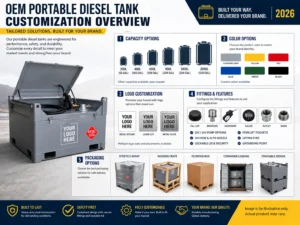
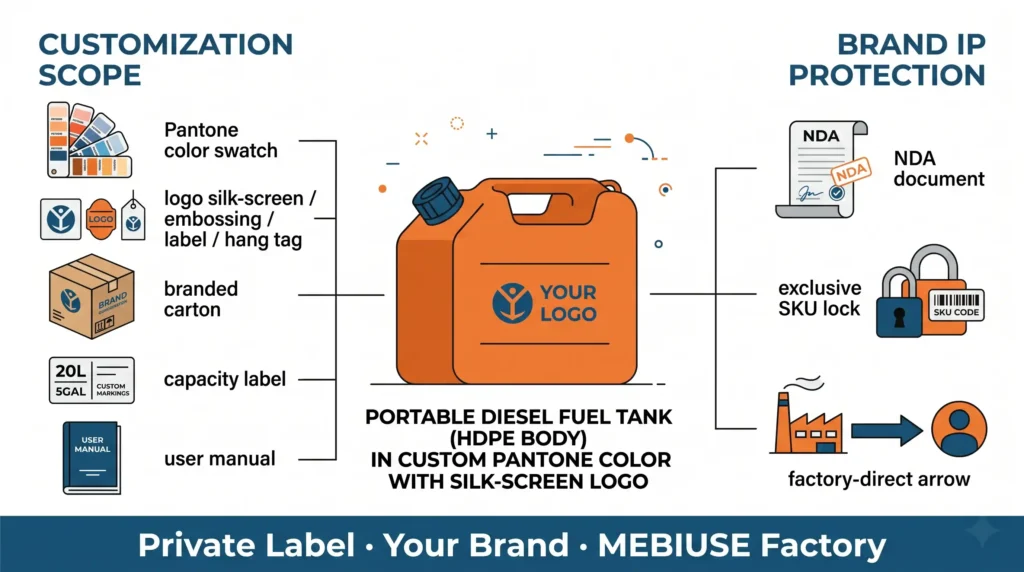
Customizable under a standard private label program:
- Tank body color (Pantone / RAL matching)
- Logo application (silk-screen, adhesive label, molded-in embossing, hang tag)
- Capacity label and warning text in buyer’s language
- Outer packaging (branded carton design)
- Inner accessories (fittings, hose clips, valve options)
- Capacity within the existing mold envelope (e.g., 180L–220L from a 200L base mold)
- User manual in buyer’s language
NOT customizable without ODM / mold development:
- Tank shape outside the existing mold envelope
- New fitting locations or thread types
- Capacity outside the mold’s designed range (typically ±10–15% of nominal)
- Material switch (e.g., HDPE to XLPE)
For items in the second list, the project moves into ODM mold development — longer lead times, higher upfront tooling cost, typically 200–500+ unit MOQ. MEBIUSE supports both pathways; the conversation usually starts with private label and graduates only if volume justifies tooling.
For a closer look at what OEM customization is available, see our guide on OEM portable diesel tank customization:
Discuss Your Customization Options
Why MEBIUSE Is the Right Private Label Partner for Distributors
MEBIUSE — operating under Binzhou Shizhou Intelligence Technology Co., Ltd. — has supported distributors running their own fuel tank brand since the early 2010s, with 2 self-owned production bases in Zhejiang and Shandong, exporting to 30+ countries and serving 500+ global clients (source: MEBIUSE official site).
Key facts for distributors evaluating MEBIUSE as a private label partner:
- 15+ years of portable fuel tank manufacturing experience
- UV-stabilized HDPE material with seamless rotomolding — the same process used by leading European and North American tank makers
- CE and ISO certified, with all parts double-tested before shipping
- Flexible MOQ: pilots from 100 units; annual frameworks from 500+ units
- Pantone / RAL color matching for tank body and accessories
- Multiple logo methods: silk-screen, adhesive label, molded-in embossing
- Capacity variants within the mold envelope (e.g., 180L–220L from a 200L base mold)
- Custom packaging: branded outer carton, user manual in buyer’s language, branded labeling, optional accessories kit
- NDA and brand IP protection for exclusive SKUs under framework agreement
- Factory-direct pricing, established export logistics via Qingdao and Ningbo ports
For distributors comparing private label portable fuel tank programs, MEBIUSE offers the combination of proven OEM experience, flexible customization, and the export infrastructure that brand owners need to scale internationally.
Request a Private Label Fuel Tank Quote
Frequently Asked Questions
What is a private label portable fuel tanks program?
A third-party factory designs, molds, and tests HDPE rotomolded fuel tanks, then sells them to a distributor or brand owner who resells under their own brand. The product is exclusive to that distributor — other buyers cannot purchase the same SKU. Private label differs from white label, where the same generic product is sold to multiple retailers (source: Shopify, Centric Software).
How is private label different from white label for portable fuel tanks?
Private label = product designed exclusively for one distributor with custom color, logo, packaging; factory contractually restricted from selling the same SKU to competitors. White label = generic product sold to multiple distributors — only labels and packaging change. Private label requires higher upfront investment but offers stronger differentiation and higher margins (source: Shopify, Gembah).
What MOQ should I expect for a private label portable fuel tanks order?
Industry-standard MOQ for OEM portable diesel fuel tank orders is typically around 100 units, though exact minimums vary by mold complexity and whether you use the factory’s existing mold (lower MOQ) or commission a new mold (higher MOQ). For stock-SKU rebrands with logo-only changes, MOQ can be as low as 50 units (source: Xinghui Rotomold, Plastic Tank Companies).
How long does it take to launch a private label portable fuel tanks program?
For a stock SKU private label (existing mold, logo + color + packaging only): typically 8–10 weeks from spec confirmation to first shipment. For a custom mold (ODM) private label: typically 16–24 weeks including mold fabrication. Standard custom orders after drawing confirmation typically take 7–15 working days for production alone (source: Bancy Solutions).
What can I customize under a private label portable fuel tanks program?
Under a standard program on the factory’s existing mold: tank body color (Pantone / RAL), logo application (silk-screen, embossing, label, or hang tag), capacity label and warning text, outer packaging, inner accessories, and capacity within the mold’s design range. Tank shape changes or new fitting locations require ODM mold development.
Will the factory sell my exact SKU to my competitors?
No — under a properly structured private label agreement, the factory is contractually restricted from selling your exact SKU to other buyers. This is typically paired with an NDA to protect your brand identity and IP. Confirm both the exclusivity clause and the NDA are in the framework agreement before signing (source: Bancy Solutions).
Should I start with white label or jump straight to private label?
For first-time distributors without proven demand, starting with white label or stock SKUs is lower risk and lets you validate demand before committing to mold and tooling investment. For established distributors with proven volume and clear brand positioning, going straight to private label is usually stronger because it captures margin and differentiation white label cannot. Many follow a hybrid path: white label to validate → private label to scale (source: Gembah).
Why choose MEBIUSE for a private label portable fuel tanks program?
MEBIUSE combines 15+ years of portable fuel tank manufacturing experience, 2 self-owned production bases in Zhejiang and Shandong, CE and ISO certification, and proven export to 30+ countries with 500+ global clients. The factory supports flexible MOQ, custom Pantone color matching, multiple logo methods, branded packaging in buyer’s language, and NDA-protected exclusive SKUs — a practical partner for distributors launching their own portable fuel tank brand (source: MEBIUSE official site).
Official Sources
- MEBIUSE official site
- MEBIUSE OEM/ODM pillar page
- MEBIUSE contact page
- Shopify — Private Label vs White Label Guide
- Centric Software — Private Label vs White Label
- Gembah — White Label vs Private Label
- Bancy Solutions — OEM Liquid Storage Customization
- Xinghui Rotomold — OEM Fuel Tank Customization
- Plastic Tank Companies — HDPE Fuel Tank Material Overview
- Asian Sourcing Group — 5-Step Chinese Factory Verification
Publisher and editorial information
Published by MEBIUSE Editorial Team. MEBIUSE is a portable fuel tank manufacturer with self-owned production bases in Zhejiang and Shandong, supporting distributors worldwide with private label portable fuel tanks, OEM, and ODM programs for UV-stabilized HDPE rotomolded tanks and fuel transfer systems.
For editorial inquiries, contact the MEBIUSE editorial team via /contact/.
Last reviewed: June 28, 2026 | Published: June 28, 2026 | Publisher: MEBIUSE
Ready to launch your own private label portable fuel tank brand with 15+ years of OEM experience?
Request a Private Label Fuel Tank Quote