What Is MOQ and Why Does It Matter for OEM Fuel Tank Orders?
MOQ (Minimum Order Quantity) is a policy set by manufacturers to ensure each production order generates sufficient revenue to cover the fixed costs of setting up a production run source: Shopify B2B Guide. These fixed costs include:
- Machine setup — Preparing rotomolding equipment for the specific tank configuration
- Mold installation — Installing and calibrating the tank mold
- Quality inspection — QC procedures for each production batch
- Packaging and labeling — Custom packaging setup per order
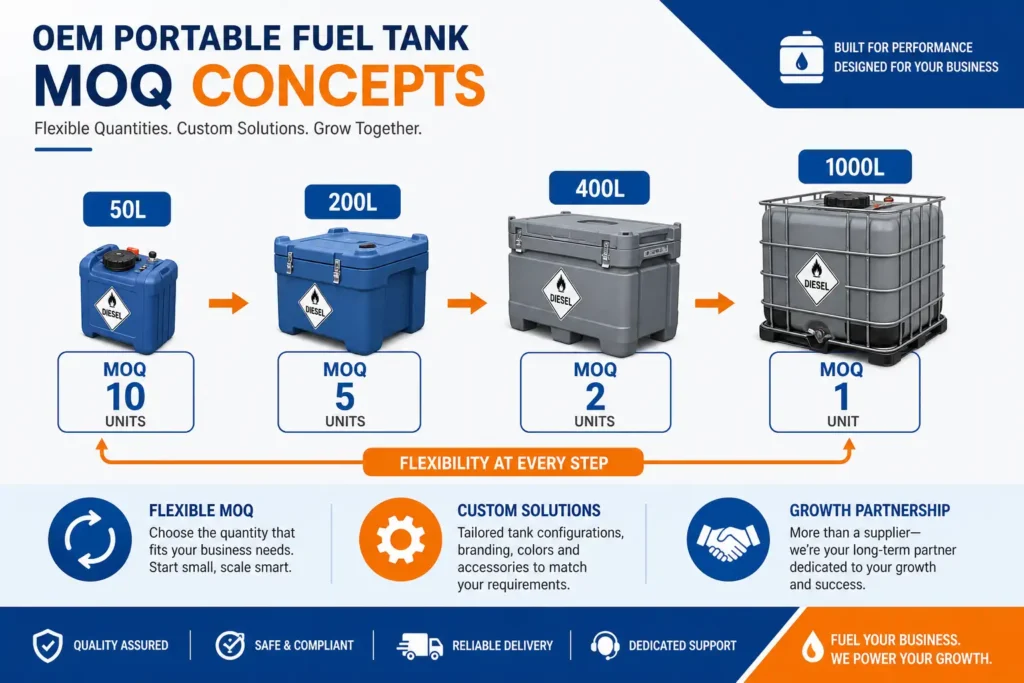
Without MOQ, small orders would make each unit so expensive that neither party benefits. For OEM portable fuel tanks, MOQ typically ranges from 20–100 units depending on tank size, customization level, and manufacturer.
Why MOQ matters for your business:
- Inventory planning — MOQ determines your minimum investment per order
- Cash flow — Higher MOQ requires more capital upfront
- Storage requirements — Larger orders need adequate warehousing
- Lead time planning — MOQ affects order frequency and scheduling
Understanding MOQ factors helps you negotiate better terms and optimize your supply chain.
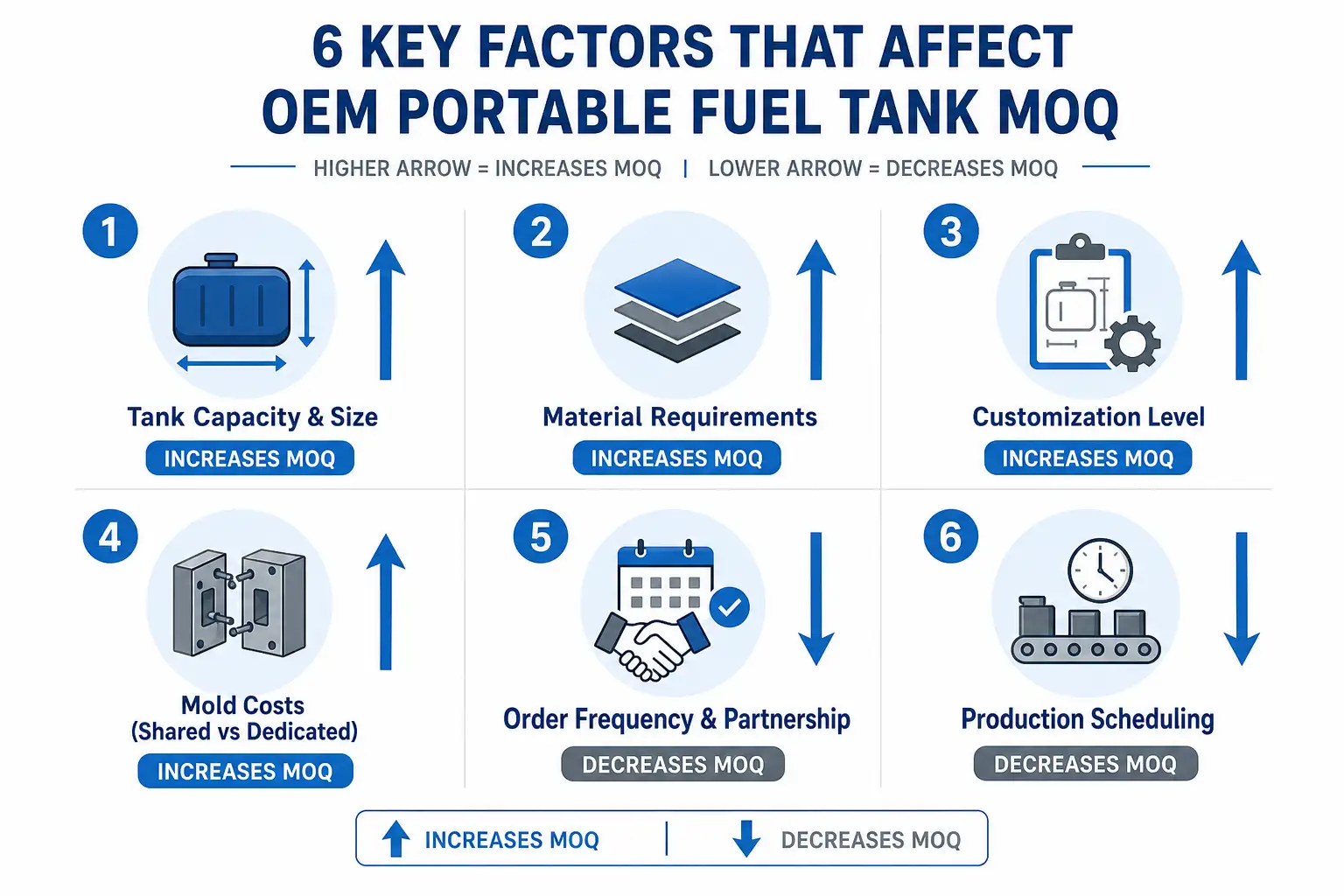
6 Key Factors That Affect OEM Portable Fuel Tank MOQ
Six interconnected factors determine the MOQ for any given OEM fuel tank order:
Factor 1: Tank Capacity and Size
Larger tanks require more material, longer production cycles, and more warehouse space:
| Tank Size | Typical MOQ Range | Reasoning |
|---|---|---|
| 50–100L | 50–100 units | Smaller footprint, efficient batch production |
| 200–400L | 30–50 units | Moderate material and handling requirements |
| 500–1000L | 20–30 units | Larger footprint limits batch size |
Factor 2: Material Requirements
Material specifications affect MOQ through material procurement and processing:
- Standard HDPE grades — Lower MOQ, readily available
- UV-stabilized formulations — May require minimum batches for color consistency
- Specialty polymers — Higher MOQ due to procurement and changeover costs
Factor 3: Customization Level
Customization directly impacts MOQ requirements:
| Customization Type | MOQ Impact |
|---|---|
| Logo printing | +10–20% MOQ premium |
| Color matching (Pantone) | Setup fees may apply |
| Custom packaging | Separate production runs required |
| Special fittings | Assembly time increases |
Factor 4: Mold Costs (Shared vs. Dedicated)
The mold arrangement significantly affects MOQ:
| Mold Type | MOQ | Upfront Cost | Best For |
|---|---|---|---|
| Shared mold | Higher (50–100+ units) | None | Testing market, small distributors |
| Dedicated mold | Lower (20–50 units) | Full mold investment | Established brands, high volume |
Shared molds spread tooling costs across multiple customers, requiring higher MOQ to compensate. Dedicated molds give you exclusive use, enabling lower per-order MOQ in exchange for the upfront investment.
Factor 5: Order Frequency and Partnership
Long-term relationships unlock MOQ flexibility:
- Regular buyers — Consistent orders justify lower per-order MOQ
- Annual commitments — Volume guarantees enable better terms
- Growth stage alignment — Start with higher MOQ, negotiate down as you prove volume
Factor 6: Production Scheduling
Manufacturing efficiency affects minimum viable orders:
- Batch production — Manufacturers run tanks in batches; smaller orders mean underutilized capacity
- Seasonal demand — Low season may offer more MOQ flexibility
- Production capacity — Popular sizes may have higher effective MOQ due to capacity constraints
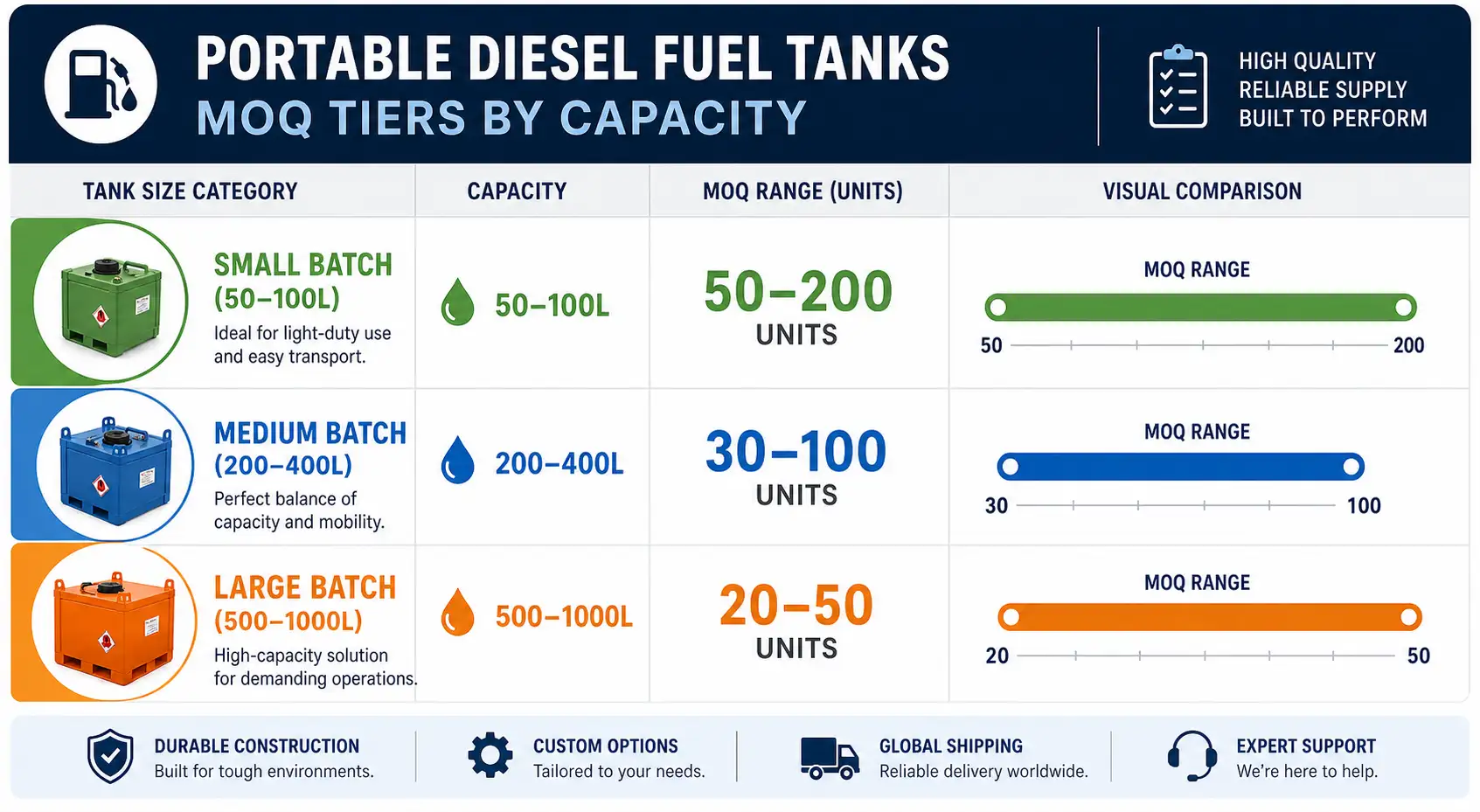
Typical MOQ Ranges for Portable Diesel Fuel Tanks
Understanding industry benchmarks helps you evaluate manufacturer quotes:
Small Batch (Market Testing)
| Tank Size | Typical MOQ | Investment Level |
|---|---|---|
| 50–100L | 50–100 units | Entry-level testing |
| 200–400L | 30–50 units | Moderate investment |
| 500–1000L | 20–30 units | Higher per-unit cost |
Medium Batch (Growing Brands)
| Tank Size | Typical MOQ | Investment Level |
|---|---|---|
| 50–100L | 100–200 units | Standard for distributors |
| 200–400L | 50–100 units | Volume discount begins |
| 500–1000L | 30–50 units | Better per-unit economics |
Large Batch (Established Programs)
| Tank Size | Typical MOQ | Investment Level |
|---|---|---|
| 50–100L | 200+ units | Maximum efficiency |
| 200–400L | 100+ units | Best pricing tier |
| 500–1000L | 50+ units | Optimal cost structure |
How to Negotiate Lower MOQ with Your Fuel Tank Supplier
Five proven strategies help reduce MOQ requirements:
Strategy 1: Commit to Long-Term Partnership
Demonstrate your growth potential with annual volume commitments, multi-order agreements, and growth projections. Manufacturers reward loyalty with flexibility.
Strategy 2: Invest in Dedicated Molds
Pay for mold exclusivity through upfront mold investment, custom specifications, and priority production. The mold investment typically pays back within 3–5 orders through MOQ reductions.
Strategy 3: Explore Mixed Product Orders
Combine SKUs to meet MOQ through multiple tank sizes, accessory bundles, and regional variants for different certifications.
Strategy 4: Schedule During Low Season
Time your orders strategically by avoiding peak periods, maintaining flexible lead times, and potentially accessing off-peak pricing incentives.
Strategy 5: Build Relationship Over Multiple Orders
Trust unlocks flexibility by starting small, paying on time, and maintaining clear communication. Manufacturers who know you as a reliable partner are more willing to accommodate MOQ requests.
How MEBIUSE Offers Flexible MOQ for OEM Portable Fuel Tanks
MEBIUSE (Binzhou Shizhou Intelligence Technology Co., Ltd.) operates manufacturing bases in Zhejiang and Shandong provinces, China, serving 500+ global clients across 30+ countries source: MEBIUSE official. MEBIUSE offers flexible MOQ cooperation models designed to support brands at various growth stages:
MOQ flexibility highlights:
- Starter programs — Lower MOQ for new brands testing market demand
- Growth partnerships — Volume discounts and MOQ reductions as you scale
- Custom arrangements — Tailored MOQ discussions for specific requirements
- Dedicated mold programs — Invest in your own mold for exclusive flexibility
MEBIUSE’s flexible approach recognizes that MOQ requirements differ based on your business stage, target market, order frequency, and customization complexity.
Contact MEBIUSE to discuss your specific requirements and explore MOQ options that work for your business.
Frequently Asked Questions
What is MOQ and why do manufacturers set minimum order quantities?
MOQ (Minimum Order Quantity) is the minimum number of units a manufacturer requires per order to make production economically viable. Manufacturers set MOQ because each production run incurs fixed costs: machine setup, mold installation, quality inspection, and packaging. These costs are spread across the units produced. Smaller orders mean higher per-unit allocation of these fixed costs, making production unprofitable for the manufacturer below the MOQ threshold.
What factors affect OEM portable fuel tank MOQ?
Six key factors determine OEM portable fuel tank MOQ: (1) Tank Capacity & Size — larger tanks require more material and longer production cycles; (2) Material Requirements — special HDPE grades or UV stabilization levels may affect minimum runs; (3) Customization Level — logo printing, color matching, and special packaging increase setup requirements; (4) Mold Costs — shared molds vs. dedicated molds impact MOQ; (5) Order Frequency — regular buyers may negotiate better terms; (6) Production Scheduling — batch efficiency affects minimum viable order size.
What are typical MOQ ranges for different fuel tank sizes?
Typical MOQ tiers vary by tank capacity: For 50–100L tanks, small batch is 50–100 units, medium batch 100–200 units. For 200–400L tanks, small batch is 30–50 units, medium batch 50–100 units. For 500–1000L heavy-duty tanks, small batch is 20–30 units, medium batch 30–50 units. These ranges depend on manufacturer, customization level, and whether shared or dedicated molds are used.
Can I negotiate lower MOQ with my fuel tank supplier?
Yes, five strategies can help negotiate lower MOQ: (1) Commit to long-term partnership with annual volume commitments; (2) Invest in dedicated molds to reduce per-order requirements; (3) Explore mixed-product orders if the manufacturer serves multiple SKUs; (4) Schedule orders during low season for potential flexibility; (5) Start with smaller trial orders to build relationship before requesting MOQ reductions. Building trust with your supplier over multiple orders often leads to more favorable terms.
What is the difference between shared and dedicated mold MOQ?
Shared molds are pre-existing tools available to multiple customers, requiring higher MOQ to distribute tooling expenses across all users. Dedicated molds are built exclusively for your design, requiring upfront investment but enabling lower per-order MOQ and full customization. The choice depends on your growth stage: startups may prefer shared molds with lower upfront costs, while established brands often invest in dedicated molds for brand differentiation and supply chain control.
How does customization level affect MOQ?
Customization directly impacts MOQ requirements: (1) Logo printing requires setup for your design and may add 10–20% to MOQ; (2) Color matching (Pantone) requires dedicated material runs and typically adds setup fees; (3) Custom packaging needs separate production lines and minimum quantities; (4) Special fittings or accessories may require assembly work beyond standard production. The more customized your order, the higher the effective MOQ to justify the additional setup complexity.
Does order frequency affect MOQ flexibility?
Order frequency is a significant factor in MOQ negotiations. Manufacturers prefer consistent, predictable orders over sporadic large purchases. Regular buyers who commit to ongoing partnerships often receive: lower per-order MOQ requirements, priority production scheduling, first access to new product development, and flexible payment terms. MEBIUSE offers personalized MOQ discussions for brands committed to long-term partnerships, supporting growth from startup to established distributor stages.
Official Sources
- MEBIUSE official site
- MEBIUSE OEM/ODM pillar — Complete portable fuel tank manufacturing guide
- MEBIUSE contact — request an OEM quote
- Shopify — Private Label vs White Label Guide
Further Reading
- Private Label Portable Fuel Tanks — C8-04 Private Label Guide
- Custom Fuel Tank Mold Development — C8-07 Mold Development
- Portable Fuel Tank Manufacturer — C8-01 OEM Hub
- Complete OEM Portable Fuel Tank Guide — C8 Pillar Page
MEBIUSE (Binzhou Shizhou Intelligence Technology Co., Ltd.) | Last reviewed: August 4, 2026 | Published: August 4, 2026