If you are an importer, distributor, or OEM brand owner sourcing portable diesel fuel tanks from China, this guide gives you a repeatable evaluation framework — the 7 criteria to grade every candidate on, the 4-step verification workflow to confirm each claim, the 5 red flags that disqualify a supplier, and why MEBIUSE — a 15+ year source factory exporting to 30+ countries — passes each one.
MEBIUSE at a Glance
- Legal entity: Binzhou Shizhou Intelligence Technology Co., Ltd.
- Industry experience: 15+ years in portable fuel tank manufacturing
- Production bases: 2 self-owned facilities in Zhejiang and Shandong
- Material & process: UV-stabilized HDPE with seamless rotomolding
- Certifications: CE & ISO certified
- Quality control: All parts double tested before shipping
- Export reach: 30+ countries, 500+ global clients
- OEM/ODM: Flexible private label, OEM, and ODM programs
What Is Supplier Evaluation and Why Does It Matter for Fuel Tank Imports?
Supplier evaluation is the structured process of grading a candidate factory against measurable criteria before signing any purchase order or OEM framework agreement. For fuel tank imports, evaluation matters because the wrong supplier creates recurring problems that compound over time: a hidden trading company adds 8–15% margin with no engineering support; certificate laundering exposes you to seizure at destination customs; missed delivery dates disrupt your downstream retail channel; and “quality fade” in shipment 2 vs. shipment 1 erodes customer trust in your brand (source: Asian Sourcing Group).
Three common failure modes importers report after skipping evaluation:
| Failure Mode | Typical Trigger | Downstream Cost |
|---|---|---|
| Hidden trading company | Business license scope lacks 生产 / 制造 / 加工 | 8–15% margin leak, no engineering escalation path |
| Certificate mismatch | Test report covers different SKU than ordered | Customs seizure, brand-recall cost |
| Quality fade | No Golden Sample protocol enforced | Return rate climbs from 2% → 10%+ across shipments |
A disciplined evaluation framework turns these into disqualifying criteria that you check before committing capital — not surprises you discover after the first shipment lands. For the broader OEM customization context, see our OEM portable fuel tank customization guide.
7 Key Criteria for Evaluating a Portable Fuel Tank Supplier
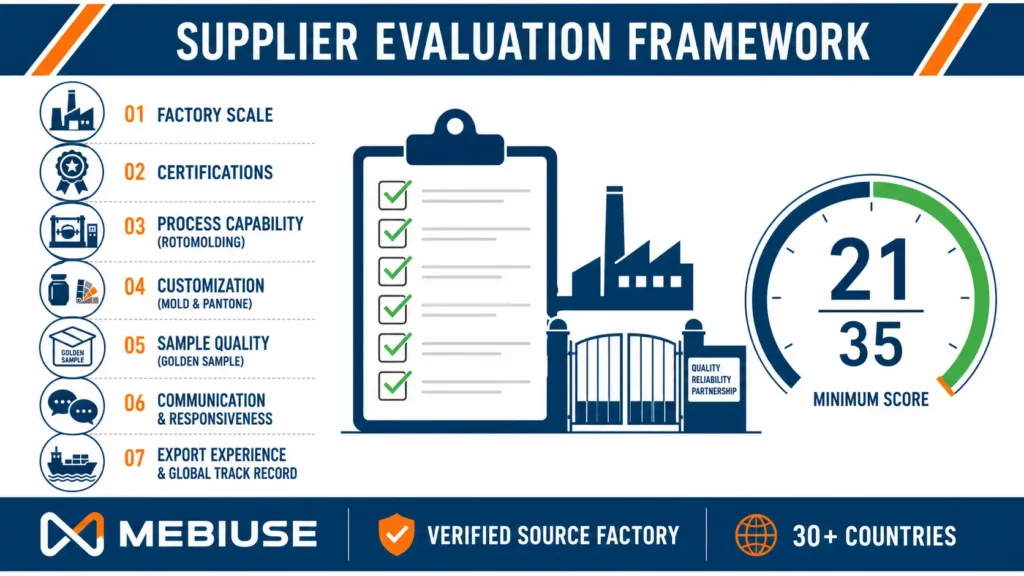
A complete evaluation covers seven criteria. Use a 0–5 score per criterion; suppliers with combined scores below 21/35 should not advance to sample testing.

Criterion 1: Factory Scale & Production Capacity
A real factory has a self-owned production floor, equipment list, worker headcount, and verifiable annual output. Trading companies renting office space in commercial buildings fail this criterion — they will outsource production to a different factory with no quality control over the actual production line (source: Asian Sourcing Group, Zignify).
Verify by asking for: production base address (must be in industrial zone, not commercial), equipment list with photos or video, worker headcount split by department, and a sample shipping record or BL (bill of lading) showing past export volumes.
Criterion 2: Quality Certifications
Certifications matter, but only when their scope matches your product. CE and ISO 9001 are the minimum bar for portable fuel tanks exported to most markets (source: MEBIUSE official site, ISO). The critical check is certificate scope: an ISO 9001 certificate covering “plastic toy parts” cannot be used to claim fuel-tank compliance, and a CE certificate for a different model number than the one you ordered is certificate laundering (source: Asian Sourcing Group).
Verify by asking for: ISO 9001 certificate with scope statement, CE declaration of conformity listing your exact SKU/model, and product-specific test reports (e.g., drop test, leak test, UV-aging test) issued by a recognized lab within the last 12 months.
Criterion 3: Manufacturing Process & Technology
Portable fuel tanks are predominantly made by rotomolding (rotational molding), which produces hollow, seamless tanks using biaxial rotation and heat — a process that gives design freedom, lower tooling cost than injection molding, and strong hollow parts without internal stresses (source: Xinghui Rotomold, Rotovia). The standard material is UV-stabilized HDPE, valued for chemical resistance, impact resistance, and UV resistance — exactly the properties a fuel tank needs for outdoor storage (source: Plastic Tank Companies).
China’s manufacturing hubs for portable fuel tanks are concentrated in Zhejiang (Wenzhou / Taizhou area) and Shandong (Binzhou area), where integrated rotomolding lines, mold workshops, and export logistics are mature (source: Industry synthesis, MEBIUSE official site).
Verify by asking for: rotomolding machine specs (arm length, oven capacity), HDPE material data sheet from the resin supplier, mold workshop photos, and a process control document covering wall-thickness tolerance and leak-test rate.
Criterion 4: Customization Capability
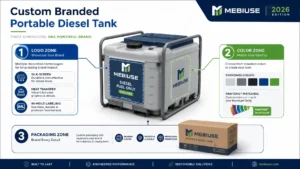
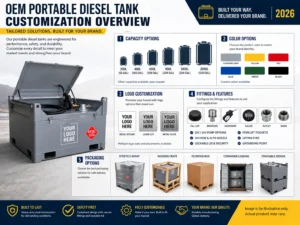
Customization capability covers four sub-criteria: existing mold library (does the factory have a mold close to your spec, or will you commission a new one?), in-house mold workshop (sub-contracted mold development adds 2–4 weeks and reduces revision control), Pantone color matching (does the factory run dedicated material batches for custom color?), and logo application methods (silk-screen printing, molded-in embossing, adhesive labels, hang tags — each with different durability and cost tiers) (source: Bancy Solutions, MEBIUSE official site).
Common MOQ for OEM portable fuel tank orders is typically around 100 units; this number varies by mold complexity, color matching requirement, and whether the factory uses a shared or dedicated mold (source: Xinghui Rotomold, Plastic Tank Companies).
Verify by asking for: mold library catalogue with photos and dimensions, sample color chips for past Pantone matches, logo application samples, and a written MOQ policy stating minimums by customization level.
Criterion 5: Sample Quality & Prototyping
Sample quality is the only criterion that requires physical inspection — documents can be forged, but a real sample cannot. The factory should produce a pre-production sample (1–5 units) for your approval before mass production. The sample you approve becomes the “Golden Sample” — the binding reference for all future mass production. Once signed off, subsequent production is measured against the Golden Sample, giving you contractual grounds to reject any batch that drifts in wall thickness, color ΔE tolerance, or logo position (source: Asian Sourcing Group).
Verify by asking for: a paid sample (refundable against first order) sent via courier with tracking, sample lead time stated in writing, and a signed Golden Sample protocol included in the framework agreement.
Criterion 6: Communication & Responsiveness
Communication quality is the leading indicator of post-purchase experience. A candidate factory that takes longer than 48 hours to respond to a technical question during the sales stage will be slower during mass production (source: Zignify). Look for: native or fluent English speakers, a dedicated account manager (not a rotating sales rep), time-zone overlap with your team, and a sample RFP turnaround of 5–7 business days.
Verify by: sending a written technical questionnaire with 8–10 questions, measuring response time and depth, and asking for the direct contact of the production manager — a real factory will connect you; a trading company will deflect.
Criterion 7: Export Experience & Logistics
Export experience covers four checkpoints: export license (Foreign Trade Operator Registration — without it, the factory must use a third-party agent that adds hidden commissions) (source: Asian Sourcing Group, Sinospect); incoterms fluency (FOB, CIF, EXW, DDP — experienced exporters walk you through cost implications of each); customs documentation (commercial invoice, packing list, certificate of origin, MSDS for fuel tanks); and export packaging (carton + pallet + container loading optimization, with photo records).
Verify by asking for: export license copy, three past shipping records (BL or AWB) to your destination market, and a packaging diagram showing how units are loaded into a 20ft or 40ft container.
How to Verify a China Fuel Tank Factory: A Step-by-Step Checklist

Once a candidate supplier passes the 7-criterion scoring, run a 4-step verification workflow before signing a framework agreement.
Step 1: Document Review
Request and verify the following documents:
- Chinese business license with business scope (经营范围) explicitly including 生产 / 制造 / 加工 (Production / Manufacturing / Processing) — entities limited to 批发 / 零售 / 进出口 are trading companies (source: Asian Sourcing Group, Sinospect).
- Unified Social Credit Code (18-digit) cross-referenced on National Enterprise Credit Information Publicity System (GSXT) — confirms factory status as “In Operation” (在业/存续); “Dormant” or “Revoked” means cease negotiations (source: Asian Sourcing Group).
- Export license (Foreign Trade Operator Registration) — without it, third-party agent adds hidden commissions.
- ISO 9001 / CE certificates with scope statement covering your product category.
- Product-specific test reports matching your exact SKU/model number.
Step 2: Virtual Factory Tour
A live video factory walkthrough on a real-time call is preferred over pre-recorded marketing clips — pre-recorded footage can be borrowed from another factory or shot at a non-operating time (source: Sinospect, Zignify). Walk through: receiving area (raw material inspection), rotomolding shop floor (machines running), mold workshop, assembly line, QC station, finished goods warehouse, and export packaging area. Take notes on worker activity, equipment utilization, and housekeeping standards.
Step 3: Sample Testing
Order paid samples (refundable against first order) for physical and functional testing:
- Physical tests: wall thickness measurement, drop test, leak test under pressure, UV-aging accelerated test.
- Functional tests: pump cycle test, hose fitting torque test, meter accuracy check (if applicable).
- Aesthetic tests: Pantone color ΔE measurement, logo adhesion test, surface finish comparison vs. reference image.
Step 4: Third-party Inspection
For orders exceeding USD $10,000, engage a third-party inspection agency such as SGS, TÜV Rheinland, Intertek, or Bureau Veritas — cost is typically 2–3% of order value (source: Asian Sourcing Group). The two main inspection types:
- Pre-Shipment Inspection (PSI) — most common; conducted when 80%+ of order is finished and 100% packed.
- During Production Inspection (DUPRO) — catches defects when only 20% of order is complete, allowing corrective action mid-run.
Red Flags: 5 Warning Signs of an Unreliable Fuel Tank Supplier
Five recurring red flags disqualify a supplier regardless of price competitiveness:
| # | Red Flag | Why It Matters |
|---|---|---|
| 1 | Quote 20%+ below market average | Likely substandard material (recycled HDPE), unfinished production, or hidden costs added later |
| 2 | Refuses paid sample or refuses to send sample at all | Cannot guarantee mass-production quality matches claims |
| 3 | No export license or refuses to provide one | Third-party agent adds 8–15% hidden commissions, erodes your margin |
| 4 | Slow or evasive communication beyond 48 hours on technical questions | Indicates lack of engineering depth; will worsen during mass production |
| 5 | History of delayed shipments | Indicates capacity constraints or cashflow problems that will repeat on your order |
If a candidate supplier triggers two or more of these red flags, disqualify immediately and move to the next candidate — do not negotiate, do not request samples (source: Industry synthesis). For more on China-specific verification, see our diesel fuel tank manufacturer in China checklist.
Why Importers Choose MEBIUSE as Their Portable Fuel Tank Partner
MEBIUSE — operating under Binzhou Shizhou Intelligence Technology Co., Ltd. — is a source factory with 15+ years of portable fuel tank manufacturing experience, 2 self-owned production bases in Zhejiang and Shandong, exporting to 30+ countries and serving 500+ global clients (source: MEBIUSE official site).
How MEBIUSE scores against each of the 7 evaluation criteria:
| Criterion | MEBIUSE Position |
|---|---|
| Factory Scale & Capacity | 2 self-owned production bases in Zhejiang & Shandong |
| Quality Certifications | CE & ISO certified; all parts double tested before shipping |
| Manufacturing Process | Seamless rotomolding with UV-stabilized HDPE |
| Customization Capability | Flexible OEM/ODM; Pantone color matching; multiple logo methods (silk-screen, embossing, adhesive label, hang tag); in-house mold workshop |
| Sample Quality | Golden Sample protocol standard; paid samples available with refundable credit against first order |
| Communication | English-speaking sales team with dedicated account managers; typical response within 24 business hours |
| Export Experience | 30+ countries; FOB, CIF, EXW, DDP incoterms supported; established customs documentation workflow |
For importers comparing MEBIUSE against other candidates, the differentiator is the combination of self-owned production (no trading-company margin leak), proven export volume, and full OEM/ODM customization under one roof. See our portable fuel tank manufacturer selection framework for a broader view of how MEBIUSE fits in the OEM landscape.
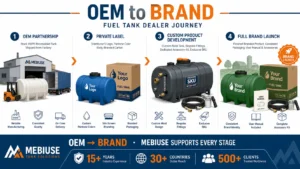
To learn how a private label program fits into this evaluation, see our guide on private label portable fuel tanks.
Request an OEM Portable Fuel Tank Quote
Frequently Asked Questions
How long does a portable fuel tank supplier evaluation take?
A structured 7-criterion evaluation typically takes 2–4 weeks from first contact to Golden Sample approval. Document review and virtual factory tour fit into week 1; sample ordering, shipping, and testing fill weeks 2–3; third-party inspection and framework agreement negotiation complete week 4. Rushing the process below two weeks typically means skipping sample testing — which is where most post-purchase disputes originate.
What is the most important criterion when evaluating a portable fuel tank supplier?
For most importers, verification of factory ownership is the single most important criterion — it determines whether you are dealing with a source factory or a trading company. Verify the Chinese business license scope includes 生产 / 制造 / 加工, cross-reference the Unified Social Credit Code on GSXT, and confirm export license status before evaluating any other criterion. A trading company that scores perfectly on every other criterion still costs you 8–15% in hidden commissions.
Should I evaluate a supplier based on price alone?
No. Price is the result of the other six criteria, not an independent variable. A quote 20%+ below market average signals substandard material, unfinished production, or hidden costs added later. Score the supplier on factory scale, certifications, manufacturing process, customization, sample quality, communication, and export experience first; price then becomes a comparison among verified candidates with comparable quality.
Can I trust a Chinese fuel tank supplier without visiting the factory in person?
Yes — a live video factory walkthrough on a real-time call is the established alternative to in-person visits, and is preferred by many importers for cost and time efficiency. Walk through the receiving area, rotomolding shop floor, mold workshop, assembly line, QC station, finished goods warehouse, and export packaging area. Pre-recorded marketing videos are not a substitute — they can be borrowed from another factory or shot at a non-operating time.
How do I know if a supplier’s certifications are real?
Three checks confirm a certificate is real and applicable to your order: (1) the certificate scope statement must cover your exact product category — “plastic toy parts” cannot cover fuel tanks; (2) test reports must match your exact SKU/model number, not a similar-looking product; (3) the issuing body must be a recognized certification body, verifiable on the certifier’s own website. ISO certificates can be cross-checked on the certifier’s database; CE declarations require a technical file and EU-type examination for higher-risk categories.
What does Golden Sample mean in supplier evaluation?
The Golden Sample is the pre-production sample (typically 1–5 units) you approve before mass production begins. Once you sign off, the Golden Sample becomes the binding reference for all future production — wall thickness, color ΔE tolerance, logo position, surface finish are all measured against it. Subsequent shipments that drift outside the Golden Sample tolerance can be rejected contractually. This protocol is the buyer’s strongest protection against “quality fade” between shipment 1 and shipment 5.
Is MOQ negotiable when evaluating a portable fuel tank supplier?
Industry-standard MOQ for OEM portable fuel tank orders is typically around 100 units; this number varies by mold complexity, color matching requirement, and whether the factory uses a shared or dedicated mold. MOQ is negotiable through five levers: long-term partnership commitment with annual volume guarantee, dedicated mold investment that amortizes across future orders, mixed-product orders combining multiple SKUs, off-season scheduling when capacity is available, and a proven track record of on-time payment. Use these levers only after the supplier has passed the 7-criterion evaluation — never negotiate MOQ up front with an unverified supplier.
Official Sources
- MEBIUSE official site
- MEBIUSE OEM/ODM pillar — portable fuel tank customization guide
- MEBIUSE portable fuel tank manufacturer — selection framework
- MEBIUSE diesel fuel tank manufacturer in China — buyer checklist
- MEBIUSE private label portable fuel tanks — distributor program
- MEBIUSE contact — request an OEM quote
- ISO — International Organization for Standardization
- SGS — Inspection, Verification, Testing and Certification
- Bureau Veritas — Testing, Inspection and Certification
- Asian Sourcing Group — 5-Step Chinese Factory Verification
Publisher and editorial information
Published by MEBIUSE Editorial Team. MEBIUSE is a portable fuel tank manufacturer with self-owned production bases in Zhejiang and Shandong, supporting importers worldwide with OEM, ODM, and private label portable fuel tank programs using UV-stabilized HDPE rotomolding and seamless manufacturing processes.
For editorial inquiries, contact https://www.mebiuse.com/contact/.
Last reviewed: 2026-08-08 | Published: 2026-08-08 | Publisher: MEBIUSE